
Monster typhoon in the Pacific Ocean is bearing down on group of remote US islands
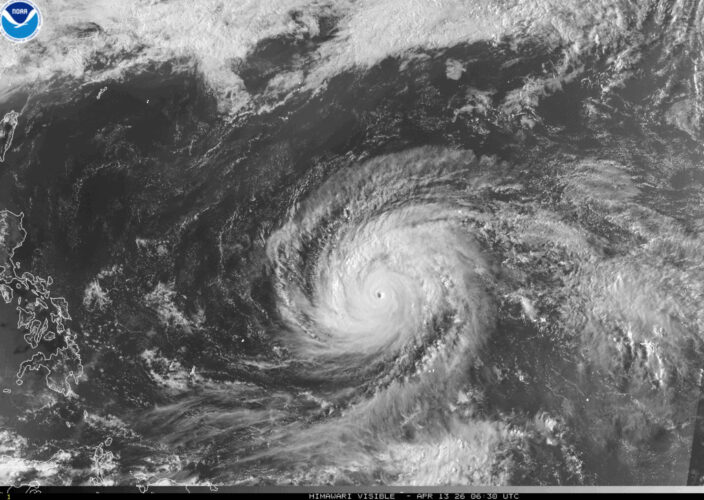
This satellite image provided by the National Oceanographic and Atmospheric Administration (NOAA) shows super typhoon Sinlakua in the Pacific Ocean, Monday, April 13, 2026. (NOAA via AP)
A super typhoon is taking aim at several remote U.S. islands in the Pacific Ocean, lashing Guam with heavy rain and tropical storm-force wind gusts hours before its arrival.
Super Typhoon Sinlaku is on track to barrel over the Northern Mariana Islands late Tuesday local time with widespread rain and flooding along with destructive winds that could cause lengthy power outages, the National Weather Service said.
Guam, a U.S. territory with several American military installations and about 170,000 residents, isn’t expected to take a direct hit but still could see damaging winds.
The tropical typhoon — the strongest on Earth so far this year — was producing sustained winds of 173 mph (278 kph) on Monday as it neared the islands of Rota, Tinian and Saipan, according to the Joint Typhoon Warning Center.
While it’s expected to weaken slightly over the next few days, Sinlaku should cross by the islands as a Category 4 or 5 typhoon.
The typhoon has stayed mostly on a track that puts it going over or just skirting along Tinian and Saipan, said Joshua Schank, a lead meteorologist in Guam for the weather service.
About 50,000 people live on the three islands, with most on Saipan, known for its laid-back resorts, snorkeling and golf as well as the capital of the Northern Mariana Islands.
Saipan was the site of one of World War II’s bloodiest battles in the Pacific, in which more than 50,000 Japanese and American soldiers and local civilians died.
In Guam, where Typhoon Mawar knocked out power for days in 2023, U.S. military officials warned personnel to prepare for the storm and shelter in place. The military controls about one-third of the land on the island, a critical hub for U.S. forces in the Pacific.
The island already was being hit by heavy rains and wind gusts up to 60 mph (96 kph) very early Tuesday, Schank said. Most businesses were closed and residents were told to stay home, he said.
President Donald Trump on Saturday approved emergency disaster declarations for Guam and the Northern Mariana Islands, allowing for additional help with emergency services.
The Federal Emergency Management Agency said it is coordinating support across multiple agencies, dispatching almost 100 FEMA staff as well as personnel from the Environmental Protection Agency, Department of Transportation and U.S. Army Corps of Engineers.
“We are ready to respond to this event,” Robert Fenton, a FEMA regional administrator, said from Guam on Sunday. The agency began preparing supplies and staff late last week, he said.
FEMA’s response comes amid the record-long Department of Homeland Security Shutdown, but the agency’s emergency response functions continue during a funding impasse. Over 10,000 disaster personnel are still paid and FEMA’s disaster relief fund — which the agency said had about $3.6 billion around the end of March — can be spent until it runs out.
A super typhoon is a name given to the strongest tropical cyclones that brew in the northwestern Pacific Ocean, where Earth’s most intense storms usually form.
Monitored by the Joint Typhoon Warning Center in Guam, super typhoons are the equivalent of Category 4 or 5 hurricanes in the Atlantic, with winds of at least 150 mph (240 kph). There have been more than 300 super typhoons identified since the warning center started using that name nearly 80 years ago.