
Wall Street slumps after Trump threatens 8 NATO members with punishing tariffs over Greenland
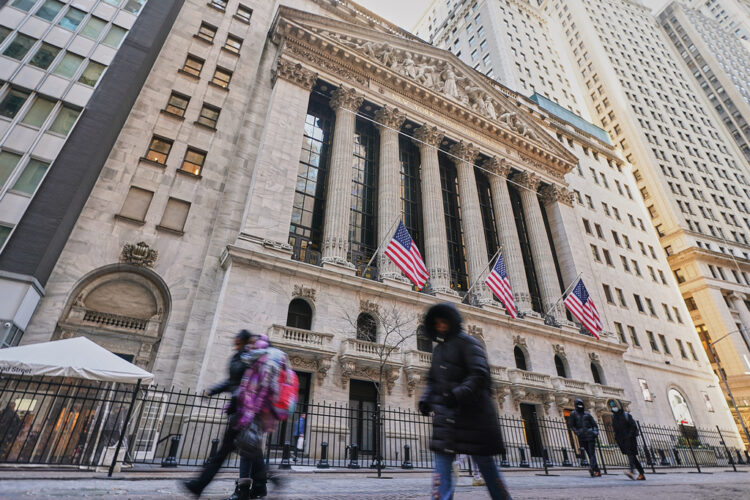
Morning commuters pass the New York Stock Exchange, Tuesday, Jan. 20, 2026. (AP Photo/Richard Drew)
U.S. futures tumbled alongside global markets early Tuesday after President Donald Trump threatened to hit eight NATO members with new tariffs as tensions escalate over his attempts to assert American control over Greenland.
Futures for the S&P 500 sank 1.8% while futures for the Dow Jones Industrial Average dropped 1.6%, almost 600 points. The tech heavy Nasdaq slumped 1.8%.
Markets in Paris, Frankfurt and London all fell more than 1% and were on track for a second straight day of losses.
Silver and gold both rose to records again as investors sought safety amid heightened geopolitical tensions. Gold was up 3% at $4,733 an ounce while Silver jumped more than 7% to $95.30.
Trump said Saturday that he would charge a 10% import tax starting in February on goods from Denmark, Norway, Sweden, France, Germany, the United Kingdom, the Netherlands and Finland because of their opposition to Trump’s desire to make Greenland part of the United States.
The annual combined imports from European Union nations are greater than those from the top two biggest individual importers into the U.S., Mexico and China.
Trump linked his aggressive stance on Greenland to last year’s decision not to award him the Nobel Peace Prize, telling Norway’s prime minister that he no longer felt “an obligation to think purely of Peace,” in a text message released Monday.
Trump’s message to Jonas Gahr Støre appeared to ratchet up a standoff between Washington and its closest allies over his threats to take over Greenland, a self-governing territory of NATO member Denmark.
Trump’s threats have sparked outrage and a flurry of diplomatic activity across Europe, as leaders consider possible countermeasures, including retaliatory tariffs and the first-ever use of the European Union’s anti-coercion instrument.
In Europe at midday, France’s CAC 40 slipped 1.2%, while Germany’s DAX lost 1.5% and Britain’s FTSE 100 shed 1.3%.
U.S. Treasury Secretary Scott Bessent, speaking on the sidelines of the World Economic Forum annual meeting in Davos, Switzerland, asserted that America’s relations with Europe remain strong. He urged trading partners to “take a deep breath” and let tensions driven by the tariff threats over Greenland “play out.”
“Geopolitical events will remain in focus today, particularly any talks that may take place in Davos,” said Michael Brown, a senior research strategist at Pepperstone, referring to the World Economic Forum.
Wedbush Securities analyst Dan Ives said the new tariff threat “is clearly an overhang on the conference,” but that it would likely simmer over time.
“Our view is just like over the last year the bark will be worse than the bite on this issue and tariff threats as negotiations take place and tensions ultimately calm down between Trump and EU leaders,” Ives wrote in a note to clients.
This week will bring more U.S. corporate earnings and the latest inflation measurement that’s preferred by the Federal Reserve for making policy decisions.
The U.S. Federal Reserve’s next policy meeting is in two weeks. It’s expected to keep its benchmark interest rate unchanged, as it strives to balance a slowing jobs market with inflation, which remains above the Fed’s 2% goal. The Bank of Japan has a monetary policy board meeting ending later this week.
In Asian trading, Tokyo’s benchmark Nikkei 225 lost 1.1% to 52,991.10 after Prime Minister Sanae Takaichi called a snap election for Feb. 8.
Yields on long-term Japanese government bonds surged after Takaichi indicated Monday she planned to dissolve parliament and hold an election, aiming to capitalize on her strong public opinion ratings. She also has proposed temporarily suspending the food tax.
Chinese markets also declined. Hong Kong’s Hang Seng gave up 0.3% to 26,487.51, while the Shanghai Composite ended nearly unchanged at 4,113.65.
In South Korea, the Kospi dropped 0.4% to 4,885.75, while Australia’s S&P/ASX 200 lost 0.7% to 8,815.90.
Taiwan’s Taiex gained 0.4% and the Sensex in India declined 0.8%.
U.S. benchmark crude oil gained 52 cents to $59.86 per barrel. Brent crude, the international standard, picked up 51 cents to $64.45 a barrel.