
Tiny bee hotels open a hidden world of city pollinators in South Africa
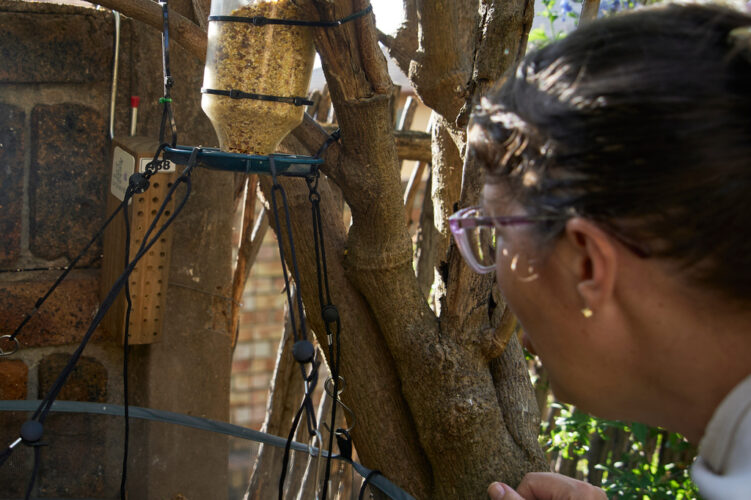
Johannesburg citizen scientist Guinivere Pedro looks at a bee hotel at her house in Johannesburg, South Africa, Oct. 28, 2026. (AP Photo/Alfonso Nqunjana)
JOHANNESBURG (AP) — Just before checkout on a warm spring morning in South Africa, a solitary bee peeks outside one of the world’s smallest hotels and then retreats to her room: a small hole drilled into untreated pine.
Monitoring this tiny, black guest is Celia Haupt of Johannesburg, a banking analyst-cum-bee hotelier who owns one of the 510 bee hotels distributed to volunteers across her city and Cape Town.
As they report on the bees, these citizen scientists are themselves being monitored as part of UrbanBEE, a project exploring how cities shape solitary bee diversity and how engaging with overlooked pollinators can reconnect city dwellers with nature.
Haupt, for one, has spent months watching her bee hotel. She thinks of its guests as “little homebodies” who love their cozy holes but are happy to meet the neighbors now and then.
“They pop their heads out, and I feel like they’re chatting to me,” Haupt told The Associated Press. “For a solitary bee, they’re not so anti-social. Maybe these are the extroverted introverts.”
Honeybees get the glory, solitary bees deserve more love
The hive-dwelling managed western honeybee is among the world’s best-studied insects, but most of the more than 20,000 bee species known worldwide are solitary, making them harder to locate and monitor.
South Africa alone has roughly 1,300 bee species, most of them solitary, and they also help pollinate wild plants and crops as they stock their nests with pollen and nectar for their young, burrowing underground or filling cavities in wood or hollow stems.
UrbanBEE grew out of a pandemic-era project involving 347 Johannesburg residents, led by University of the Witwatersrand researcher Chevonne Reynolds. The expanded project, funded by the European Union-backed Biodiversa+ partnership, includes parallel studies in Budapest, Hungary; Turin, Italy; and Vienna, Austria. The volunteers began submitting weekly photographs in October 2025.
Comparing hotels across African and European cities could show how climate, vegetation, development and socioeconomic conditions affect bee diversity and how collecting data changes how people value urban nature. Researchers also hope a standardized approach can be adapted for other cities as the world gets warmer.
These bees do the cutest things
For many participants, learning about biodiversity started with recognizing creatures they hadn’t realized were bees.
“Now I know that not every flying insect is a fly,” Johannesburg citizen scientist Guinivere Pedro said.
Sage Naidoo pointed out a tiny guest using its rear end to guard her room in a hotel hanging from a tree on the Wits campus.
“If you look at this, you might think that it’s an ant with wings, but it’s actually a solitary bee,” said Naidoo, a PhD candidate helping to coordinate the South African campaign. He identified her as an Allodapula, a species that can remain with their young in small social nests. “In my opinion, they’re the cutest type of bee that we have.”
Other species close their nests with mud, plant fibers, leaves, colorful flower petals or a thin, cellophane-like membrane. Behind the seals, young bees develop on stores of pollen and nectar left by their mothers.
“If a leaf cutter enters your hotel, you’ll typically see this bright pop of green,” Naidoo said.
Waiting for Bee-Yoncé
Haupt’s hotel had plenty of rooms but no guests for about two months as a friendly competition intensified. Weekly occupancy maps became informal scoreboards as participants compared arrivals and noted whose hotel was filling fastest.
“Everyone wants to be doing better than their neighbor,” Naidoo said. “It was like, ‘My bee hotel has 20 bees, whereas yours has five.'”
The effort brought Haupt and her daughter closer and rekindled a connection with a former schoolmate she had known only from a distance 40 years earlier as they commiserated over their vacancies and, eventually, celebrated arrivals.
“Here we were bonding over a lack of occupancy in the bee hotel, then joy over the bee hotel, and a little bit of rivalry,” Haupt said.
Haupt finally welcomed her first guest after moving her hotel to catch the morning sun. She named the bee “Yoncé,” naturally.
Owning a hotel of her own
When Pedro joined UrbanBEE, she announced on LinkedIn that she had finally become a property owner: “Finally, I have a hotel of my own,” she said. “It’s just a very small one.”
After a few weeks without guests, Pedro moved her hotel to a sheltered spot, where bees appeared seemingly overnight.
Preliminary results show people changing their gardening practices to attract more pollinators as they’ve been drawn into the hotels’ miniature dramas. Naidoo said researchers also found hotels being occupied earlier in Johannesburg than in cooler and windier Cape Town.
A year later, Pedro’s hotel is nearly full. She has planted more flowers, left parts of her garden undisturbed and even taken birding courses.
“The bees revealed to me how much life there is in the garden,” she said. “Once you notice the first small thing, the next small thing presents itself.”