
The sell-off for tech stocks worsens and drowns out strength elsewhere on Wall Street
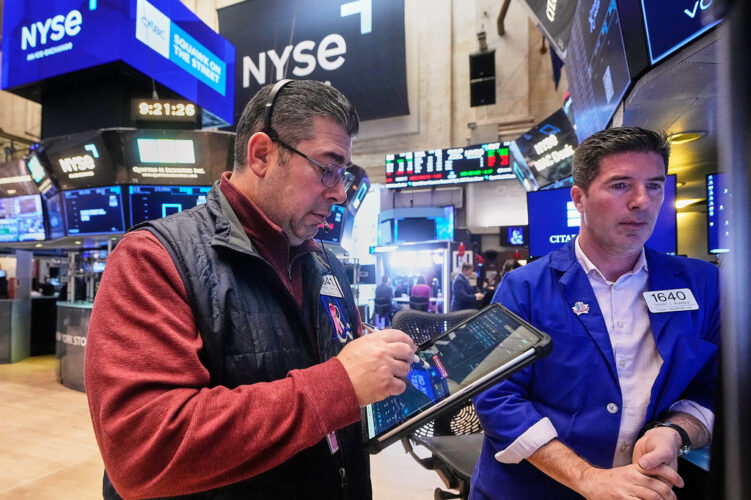
FILE - Trader Michael Capolino, left, and Specialist Thomas McArdle work on the floor of the New York Stock Exchange, Monday, Jan. 26, 2026. (AP Photo/Richard Drew, file)
NEW YORK (AP) — A sell-off for tech stocks is barreling into Friday and forcing the U.S. market down again, with Amazon and Intel leading the way this time.
The S&P 500 fell 1.3% and was on track to erase its gain for October, even though it set its all-time high during the month. The weakness for technology stocks dragged the Nasdaq composite down 2.5%, as of 9:35 a.m. Eastern time, though the rest of the market was holding up better for a second straight day. The Dow Jones Industrial Average fell a more modest 0.3%, or 173 points.
Amazon was one of the heaviest weights on the market and dropped 4.4% after reporting a weaker profit for the summer than analysts expected. Potentially more concerning for investors was Amazon’s reporting that it burned through $42.4 billion of cash over the prior 12 months, according to a measure called free cash flow. It spent $94.8 billion on property and equipment, primarily through investments in artificial-intelligence technology.
A day earlier, Alphabet’s stock dropped more than 12% to its worst day on record after telling investors that it burned through more cash during the summer than the spring because of similar, mammoth investments in AI.
Worries are rising about whether all those hundreds of billions of dollars will produce enough profit and productivity to make the investment worth it. At the same time, stocks of computer chip companies and other winners from the frenzy to build AI data centers have come under pressure on concerns that high interest rates may slow the further build out of data centers.
Intel tumbled 28.8% and is flirting with its worst day since 1974, even though the chipmaker reported a stronger profit for the latest quarter than analysts expected. It gave a forecast for profit in the final three months of this year that fell far short of analysts’ expectations. CEO Lip-Bu Tan said the personal-computer industry continues to feel pressure, which hurts demand for Intel’s CPUs.
In the cryptocurrency industry, meanwhile, stocks tumbled following a hack on the world’s biggest crypto exchange. The price of bitcoin fell toward $77,000 from more than $86,000 earlier this month, and a U.S.-based blockchain intelligence firm said a North Korean unit was likely behind the attack that impacted more than $6 billion worth of crypto at Binance.
Coinbase Global fell 12.7% even though it reported stronger results for the latest quarter than analysts expected. Strategy, which says it owns about 4% of the total supply of bitcoin, fell 11.6%. It also reported a stronger profit for the latest quarter than analysts expected, while saying its chief financial officer will resign next week for personal reasons.
Such losses overshadowed strength for the rest of Wall Street, where many stocks rallied after reporting stronger profits for the summer than analysts expected. The market is heading toward a second straight day where the majority of stocks in the S&P 500 rises but get overwhelmed by losses for larger, more influential Big Tech stocks.
Mondelez International climbed 4.6% after the company behind Oreo cookies and Ritz crackers reported stronger-than-expected growth.
Colgate-Palmolive rose 4.7% after higher prices for its products around much of the world helped it deliver better revenue and profit than analysts expected.
Exxon Mobil rose 2.3%, and Chevron added 1.6% after the oil giants both reported stronger profit for the summer than analysts expected.
Starbucks had a more muted move following its own better-than-expected profit report and slipped 0.2%. Its revenue for the quarter fell short of analysts’ expectations.
Expectations are high broadly for U.S. companies’ ability to make bigger profits, even though people around the world are feeling discouraged about high inflation and high fuel prices. Such expectations are what drove the S&P 500 to its record earlier this month.
In the bond market, Treasury yields eased in a signal that investors were buying U.S. government bonds in search of something safer to own. The yield on the 10-year Treasury fell to 4.93% from 4.98% late Thursday and from more than 5.30% earlier this month.
Treasury yields fell even though oil prices bounced higher, something that pushes upward on inflation and usually drives yields higher. The price for a barrel of Brent crude oil rose 2% to $113.04. It’s near the high end of its range since the war with Iran sent oil prices and inflation higher.
In stock markets abroad, indexes were mixed in Europe following sharper action in Asia.
South Korea’s Kospi dropped 3.5% as worries about AI hit its tech-heavy market, while the Hang Seng in Hong Kong climbed 1.5%.
Japan’s Nikkei 225 fell 2.1% after the Bank of Japan decided to keep interest rates steady, echoing moves made earlier in the week by the Federal Reserve and the European Central Bank.