
UVU partners with Provo-based company to combat “AI deepfakes” in Utah elections
Carlene Coombs
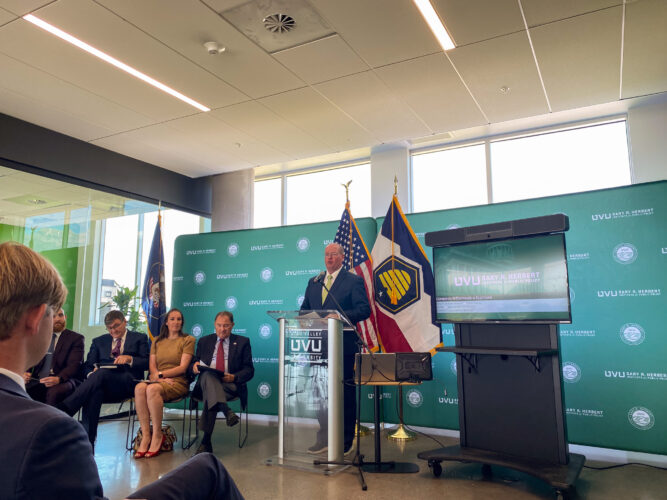
Justin Jones speaks at a press conference at the Utah Valley University on July 9, 2024.
Carlene Coombs
Justin Jones speaks at a press conference at the Utah Valley University on July 9, 2024.
Daily Herald file photo
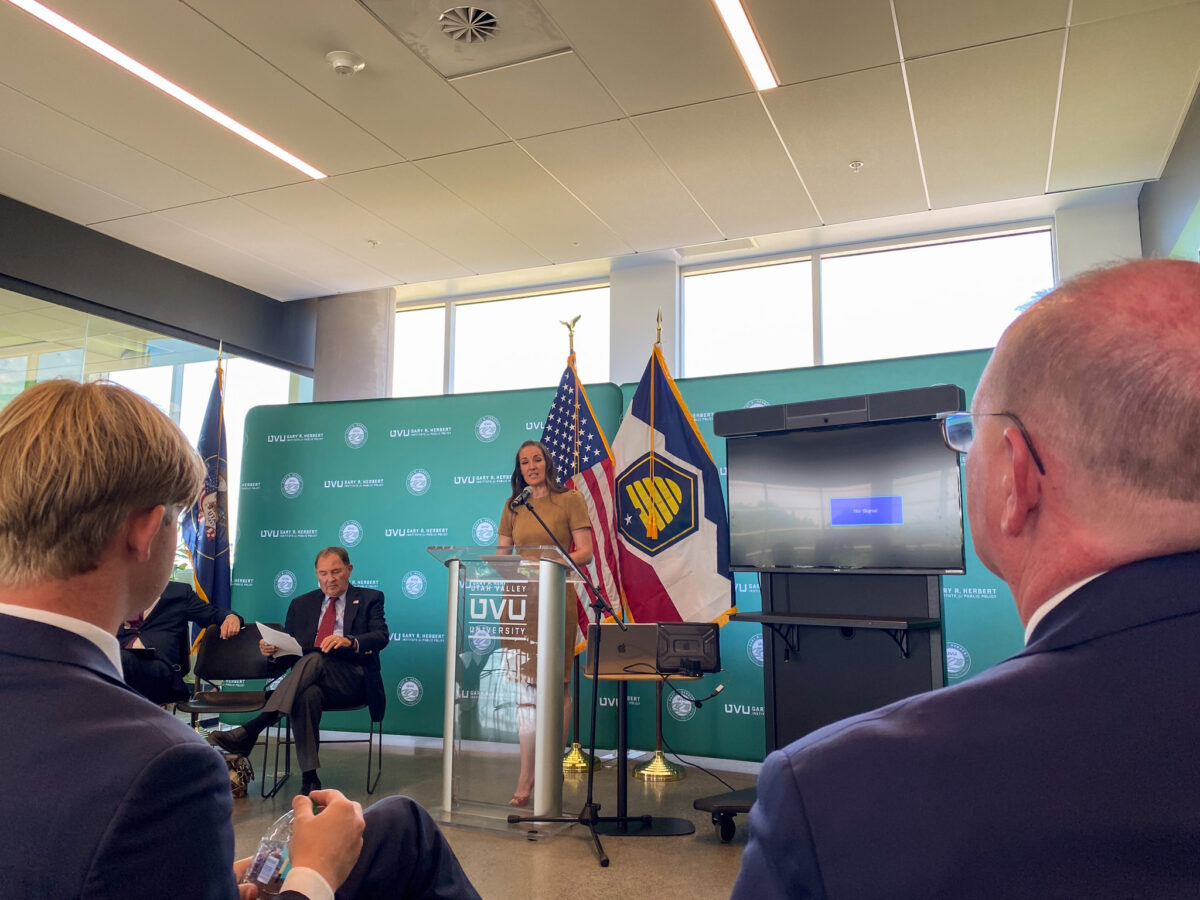
Utah County Commissioner Amelia Powers Gardner speaks at a press conference at the Utah Valley University on July 9, 2024.
As election season heats up, Utah Valley University is teaming up with a private company that has started a pilot program to combat AI-generated “deepfake” content related to Utah elections.
The Provo-based company, SureMark Digital, is offering its services to candidates in Utah’s congressional and U.S. Senate races as well as to journalists and influencers who are covering or talking about those elections.
The purpose is to verify videos made by “high-profile” individuals and provide a way for viewers to be assured that the content is real.
SureMark Digital Chairman Scott Stornetta said the company verifies individuals wanting to use the technology by having someone who personally knows the individual do a video interview to verify their identity.
After the person is verified with SureMark, the company issues them a credential to be attached to their content.
“The idea is that once they’ve authorized their content, no matter where that content shows up on the internet, it will carry its credentials with it,” Scornetta said.
Viewers then have to download a browser extension that allows them to click a button to run an algorithm and see if a piece of content has been verified by SureMark as real.
Stornetta said “AI deepfakes” thrive in environments where viewers don’t know the source, but he believes that increasing access to verification technology can combat disinformation and misinformation.
“As we elevate the standard and make it widely known that people can always check the source, then they will come to view things that aren’t sourced, that are anonymous, as having less and less credibility,” he said.
The pilot program begins this month and will focus on Utah’s congressional and U.S. Senate races.
UVU won’t be involved in creating or administering the pilot program, said Brandon Amacher, director of the Emerging Tech Policy Center, but will be monitoring its success and studying how to continue tackling election disinformation created through AI.
“The university’s role is we are essentially going to be, one, a convening body … but two, we’re also going to be a third party evaluator taking a look at this pilot program with an unbiased set of eyes in order to see, okay, where’s this making an impact? Where is it effective? Where, maybe, is it not effective?” he said.
The partnership combines public policy and politics and national security studies by involving UVU’s Herbert Institute for Public Policy and Center for National Security Studies.
During a press conference on Tuesday announcing the program, former Utah Gov. Gary Herbert said as new technologies emerge, so do ways to create and spread disinformation during election cycles.
“I think all of us know that one of the basic fundamental aspects of our democratic republic is the ability for us as citizens to go out and vote for the person, individuals that we choose to be our leaders,” he said. “We don’t want somebody in there giving us false misinformation, disinformation, that could sway us in a different direction.”
Utah County Commissioner Amelia Powers Gardner spoke at the press conference supporting the program, saying that election administration officials can “do all the work in the world” to ensure that election administration is secure, but disinformation can still impact voters’ trust in elections.
“If citizens can’t have confidence in the campaign information that they’re receiving, then it’s hard to have confidence in the election,” she said.
During the press conference, speakers referenced fake robocalls in New Hampshire that used audio that sounded like President Joe Biden to attempt to discourage voters from showing up to the polls in the state’s primary election in January.
Herbert also showed a fake video of Utah Gov. Spencer Cox giving a speech that was shared on social media during Utah’s primary gubernatorial race.
Along with working to tackle election disinformation, Justin Jones, director of the Herbert Institute for Public Policy, and Amacher are both excited about the opportunity the partnership provides for UVU students.
Jones said they’ll be utilizing the innovation of political science and cybersecurity students while providing them with the opportunity to co-author research papers, collect data and work alongside professors in studying the issue.
Amacher said having students involved in the project will prepare them better for graduation and life after university.
“I think the opportunity to work on a high-impact project like this, alongside faculty and staff, is a very powerful thing and will prepare the students to take on high-impact problems in their career,” he said.
On its website, SureMark has a directory of individuals it has verified, with only a handful so far, but it includes U.S. Rep. John Curtis, who is running for U.S. Senate this year, and Utah County Commissioner Amelia Powers Gardner.