
Automated Ball-Strike System sees 60.7% success rate in first games
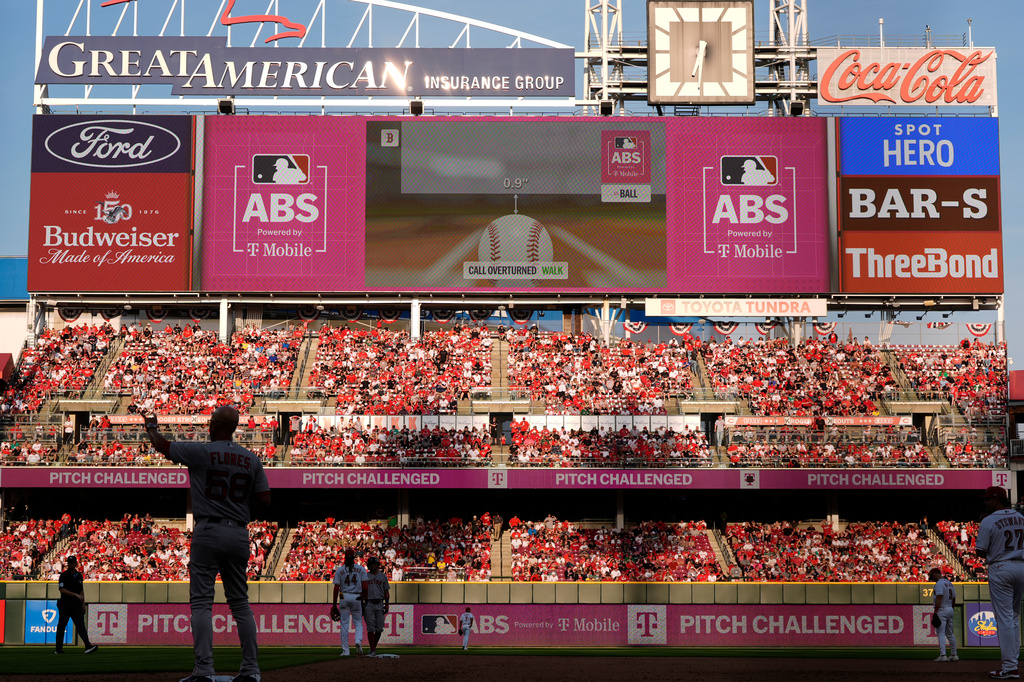
A call is overturned by Automated Ball-Strike System during the ninth inning of an opening-day baseball game between the Cincinnati Reds and the Boston Red Sox in Cincinnati, Thursday, March 26, 2026. (AP Photo/Carolyn Kaster)
CINCINNATI (AP) — Terry Francona had every reason not be a fan of the Automated Ball-Strike System, after the Cincinnati Reds’ 3-0 loss to the Boston Red Sox on Thursday.
However, the longtime manager was taking the long view after game one of 162.
Francona saw a walk by Eugenio Suárez on a full count overturned to a strikeout in the fourth inning while Connor Phillips’ ninth-inning strikeout of Boston’s Roman Anthony — also on a full count — overturned to a walk.
“I think our pitchers are going to have to get used to thinking the inning might be over, and it’s not,” Francona said. “It’s almost like when a guy comes out and you say, ‘Hey, way to go. Can you get one more?’ So you’re gonna have to stay dialed in.”
Going into Thursday night’s games, teams had a 60.7% success rate on challenges, going 17 of 28 through the first 10 games of the regular season.
Using Hawk-Eye technology, 12 cameras measure whether a pitch crosses the strike zone with accuracy of about one-sixth of an inch.
Red Sox manager Alex Cora was pleased after they were 2 of 3 on challenges. Even though there was one challenge he wished one of his hitters would have made.
Trevor Story was up with two outs and runners on first and second in the fifth inning. Story was caught looking on a fastball by Andrew Abbott that looked to be a ball.
“You just have to make sure. There was one early where Trevor is in that situation again, he’d probably challenge,” Cora said. “We thought the pitch was up. We don’t mind him challenging there because it changes the whole thing, right? We were talking about it. It’s a different ballgame now.”
The Red Sox did have a successful challenge in the bottom of the inning when Garrett Crochet’s cutter just got the lower half of the strike zone against Suárez. Instead of Suárez drawing a walk, catcher Carlos Narváez’s challenge resulted in the third out of the inning.
“He made a really good pitch right there. I thought it stayed down and it was a ball, but with the new ABS, good for him,” Suárez said.
Anthony’s challenge paid off. Instead of the third out of the inning and a strikeout, it was overturned to a walk and put runners at first and second. Story and Jarren Duran followed with RBI singles to give the Red Sox a 3-0 lead.
“I knew it was a ball. I was pretty confident,” Anthony said. “It turned the game around in a sense. It was good to turn that around, get on base and score there. I trust my instincts and discipline at the plate. I’ve had many in the past, up, down, in and out. That was a good example. Probably not even close. Just kind of knew it there.”
Pittsburgh’s Oneil Cruz became the first batter to have a ball four overturned to strike three during the third inning against the Mets. New York catcher Francisco Alvarez challenged and it showed the pitch caught the inside corner. The Mets were 2 for 3 on their challenges.
Minnesota and the Chicago White Sox both went 3 for 4 on their challenges, while Tampa Bay was 2 for 2.
Phillies reliever Zach Pop failed his team’s first challenge in the eighth inning against Texas’ Brandon Nimmo. Pop challenged James Hoye’s ball four call but it was confirmed on replay and Nimmo walked.
Manager Rob Thomson didn’t mind the challenge.
“I was good with it. It was a 10th of an inch off. That pitch decided an at-bat late in the game, we’ve got the lead. On the defensive side you want to use that challenge,” he said.
___
Sports writer Dan Gelston in Philadelphia contributed to this story.
___
AP MLB: https://apnews.com/hub/mlb