Movie review: ‘Race,’ fine performances propel well-intentioned Owens biopic
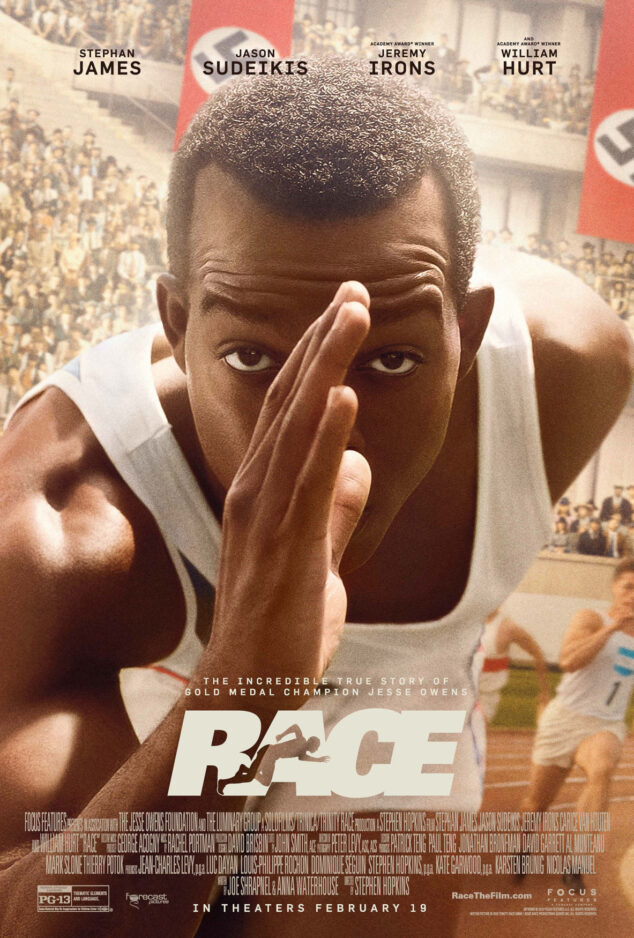
"Race" (Focus Features)

Stephan James plays Jesse Owens in "Race." (Thibault Grabherr/Focus Features)

Parents need to know that "Race" is partly a biographical drama about legendary gold medalist Jesse Owens and partly a historical drama about the American Olympic Committee's controversial decision to attend the Nazi-run 1936 Olympics. (Common Sense Media/TNS)
Parents need to know that “Race” is partly a biographical drama about legendary gold medalist Jesse Owens (Stephan James) and partly a historical drama about the American Olympic Committee’s controversial decision to attend the Nazi-run 1936 Olympics. Reflecting the subject matter and the 1930s setting, the language includes several uses of racial slurs (the “N” word, “negro,” “jigaboo,” “coon,” and “boy,” as well as the more jokingly used “cracker”); characters also use the words “s–t,” “bulls–t,” “a–,” “son of a bitch,” and more. There’s the implication of violence in Berlin when Olympic official Avery Brundage visits; he sees Jewish civilians forcibly carted onto transport vehicles, Jewish businesses defaced, and signs saying “No Jews or dogs allowed.” There’s also a tense scene when Nazi soldiers demand, at gunpoint, that Owens’ coach show his papers. Characters also drink (it’s suggested that Coach might have a drinking problem), kiss passionately, and make some racy comments/jokes. As part of a portrayal that presents him as both inspiring and realistically flawed, Owens is shown being unfaithful to the mother of his child. The movie, while imperfect, has good intentions and can be a conversation starter between parents and their tweens/teens.
WHAT’S THE STORY
“Race” tells the story of the indisputable hero of the Nazi-run 1936 Olympics in Berlin: not an Aryan athlete of the Fuhrer’s motherland, but African-American track-and-field athlete Jesse Owens (Stephan James). Instead of going to a more progressive college on either coast, Owens accepts a scholarship to run and jump for Ohio State University’s track coach, Larry Snyder (Jason Sudeikis). The two form a quick bond, and when Owens reveals he has a toddler to support back home, Snyder even gets Owens a no-show job with a lucrative paycheck. Owens proceeds to astonish the track and field community by setting three world records and tying another at a Big Ten track meet in 1935. As he becomes the most prominent track-and-field athlete in the nation, the American Olympic Committee (AOC) fights an internal battle about whether to boycott the 1936 games being held in Nazi-run Germany. The story then switches to the behind-the-scenes dealings between American businessman Avery Brundage (Jeremy Irons) and the Germans, under the leadership of Reich Propaganda Minister Joseph Goebbels (Barnaby Metschurat), who uses filmmaker Leni Riefenstahl (Carice van Houten) to help ensure that the Americans will compete in Berlin.
IS IT ANY GOOD?
This well-meaning historical drama features a wonderful performance by James, but it oddly shifts the focus from Owens’ legend and life to the inner workings of the most controversial Olympics. James, who also memorably played a young John Lewis in Selma, inhabits Owens as a natural talent who’s pleasant, kind, and hardworking. He’s so sweet and disciplined that even when he’s unfaithful to his fiancée, Ruth (Shanice Banton), with a vain groupie, he almost immediately does the right thing and begs forgiveness for the indiscretion. But, like most everyone else here, Owens is depicted in an overly sanitized way — uncomplicated and unthreatening. The relationship between Owens and Snyder is only contentious in one scene, giving the impression that the white coach was an enlightened man who was just somehow above the casual racism of his athletic department colleagues.
Director Stephen Hopkins takes a similar approach in depicting two highly controversial figures: Brundage, whose legacy as a sportsman and Olympic official is tarnished by rumors that he was both a Nazi sympathizer and openly racist, and Riefenstahl, who managed to survive accusation after accusation that she was a true believer in the Nazi cause, rather than just a filmmaker who benefited from Hitler’s patronage. Irons plays Brundage as a perfectly oily master of the universe who knows what’s going on but tells the Germans to tone down the uglier aspects of their regime for the sake of the Olympics, and van Houten portrays Riefenstahl as a director who’s just coincidentally a Nazi. The director continuously interrupts the relatively tame plot of Owens’ superstar college track career with behind-the-scenes drama at the AOC, where at least one Olympic official, Jeremiah Mahoney (William Hurt), led the charge to boycott the games in solidarity with the oppressed victims of Hitler’s regime. But, the film posits, sports is supposed to rise above politics — so much so that when an NAACP official asks Owens to personally boycott the Olympics, the issue doesn’t seem seriously considered. Ultimately the performances are fine, although it’s hard to consider Sudeikis in a dramatic role, and the story educational, but “Race” isn’t quite the extraordinary narrative Owens deserves.
RATING AND CONTENT
Recommended for ages 12 and older
Quality: 3 out of 5
Positive messages: 3 out of 5
Positive role models: 3 out of 5
Violence: 2 out of 5
Sex: 3 out of 5
Language: 3 out of 5
Drinking, drugs, and smoking: 3 out of 5
Consumerism: 0 out of 5 (Are products/advertisements embedded? Is the title part of a broader marketing initiative/empire? Is the intent to sell things to kids?)
MOVIE DETAILS
Theatrical release date: February 19, 2016
Cast: Jason Sudeikis, Stephan James, Carice van Houten
Director: Stephen Hopkins
Studio: Focus Features
Genre: Drama
Run time: 134 minutes
MPAA rating: PG-13
MPAA explanation: Thematic elements and language