Get Out There: How I avoid crowds in the world’s most popular destinations
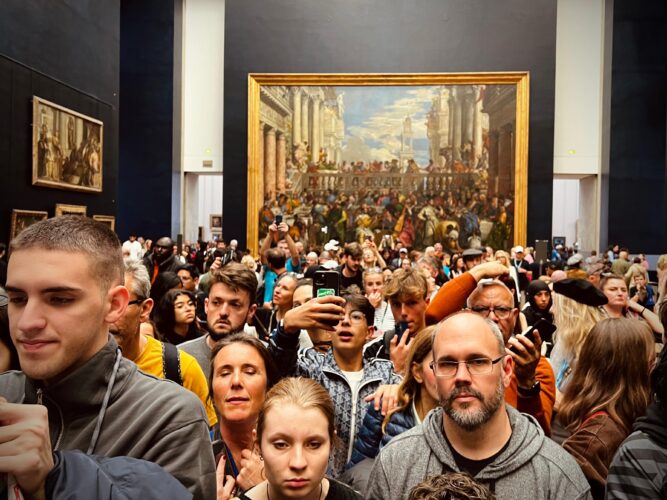
Courtesy Blake Snow
The Mona Lisa Gallery in Paris.I like famous places. That might sound strange coming from someone who goes out of his way to avoid crowds. But both things can be true.
The world’s most iconic destinations — think Paris, Rome, Tokyo, London — are famous for a reason. They’re rich in history, culture, food, and atmosphere. The problem isn’t the places. It’s when everyone tries to experience them the same way, at the same time, in the same spots.
After years of trial, error, and more than a few elbow-rubbing museum experiences, I’ve settled into a simple approach that consistently makes even the busiest destinations feel surprisingly livable. It comes down to a few intentional habits.
First, I almost never do the obvious thing at the obvious time. Most travelers follow predictable rhythms. They visit major attractions mid-morning or early afternoon and eat lunch at noon when everyone else is hungry. Following that pattern is a sure-fire way of ending up in a crowd.
Instead, I flip the script. I go early or late. Very early or very late. The difference between arriving at a major site at 9:30 a.m. versus 7:30 a.m. can feel like visiting two different cities.
I’ve stood alone in otherwise packed plazas simply because I showed up before the tour buses arrived. I’ve walked through museums in near silence during the final hour of the day while others were already thinking about dinner. In that way, timing changes everything.
Second, I avoid staying in the most obvious neighborhoods. In cities like Paris, Rome, and London, there’s a powerful gravitational pull toward the historic center. It makes sense. That’s where many of the sights are. But it’s also where most of the crowds concentrate.
So I usually stay one or two districts away. Close enough to access everything easily, but far enough to experience daily life instead of nonstop tourism. Restaurants are less packed. Streets feel more residential. Prices drop. And suddenly, you start feeling like a visitor in a city, not a participant in a queue.
Third, I design my trips around movement, not checklists. The traditional approach to travel is accumulation. See as many landmarks as possible in as little time as possible. I used to do this too, and it almost always led me straight into crowds.
Now I think in terms of flow. Instead of jumping from landmark to landmark, I cluster experiences by neighborhood or theme. One morning might be dedicated to wandering a single district. One afternoon might be nothing more than a long walk with no fixed destination. This reduces backtracking — and backtracking is where crowds often are.
Fourth, I look for “adjacent experiences.” Every famous attraction has a shadow version nearby that delivers a similar reward with a fraction of the people. Near the most visited museums, there are usually smaller collections that are just as rewarding. Near iconic viewpoints, there are quieter hills, bridges, or rooftops with equally good perspectives. Even within the same city, there are parallel experiences waiting for anyone willing to take a few extra steps.
In Barcelona, for example, I’ve had far better experiences exploring local neighborhoods outside the Gothic Quarter than I ever did standing shoulder-to-shoulder in it with thousands of other visitors.
Fifth, I embrace bad weather and off-season travel. This one is simple but underrated. The same destination can feel completely different depending on the season you visit. A rainy weekday in shoulder season often delivers more memories than a sunny weekend in peak summer.
And finally, I’ve learned to accept that I won’t see everything — and that’s okay. When I stopped trying to win travel, I started enjoying it more. For sure, I still visit famous places. I still see the landmarks. I still take photos. But I no longer let the most popular version of a destination dictate my entire experience.
Because the truth is, avoiding crowds isn’t about avoiding people. It’s about avoiding patterns. And once you break the pattern, even the world’s busiest destinations start to feel surprisingly open again.
Blake Snow contributes to fancy publications and Fortune 500 companies as a bodacious writer-for-hire and seasoned travel journalist to all seven continents. He lives in Provo, Utah with his wife, five children, and one ferocious chihuahua.