Parking meter plague: Historic American Fork tombstone gets new life
AMERICAN FORK — Plagues have concerned humanity for most of its history — perhaps the most famous being the Bubonic Plague, which is thought to have killed 25 million in Europe in the 14th century. One plague not found in medical textbooks is the Parking Meter Plague, which was said to be the death of American Fork 60 years ago.
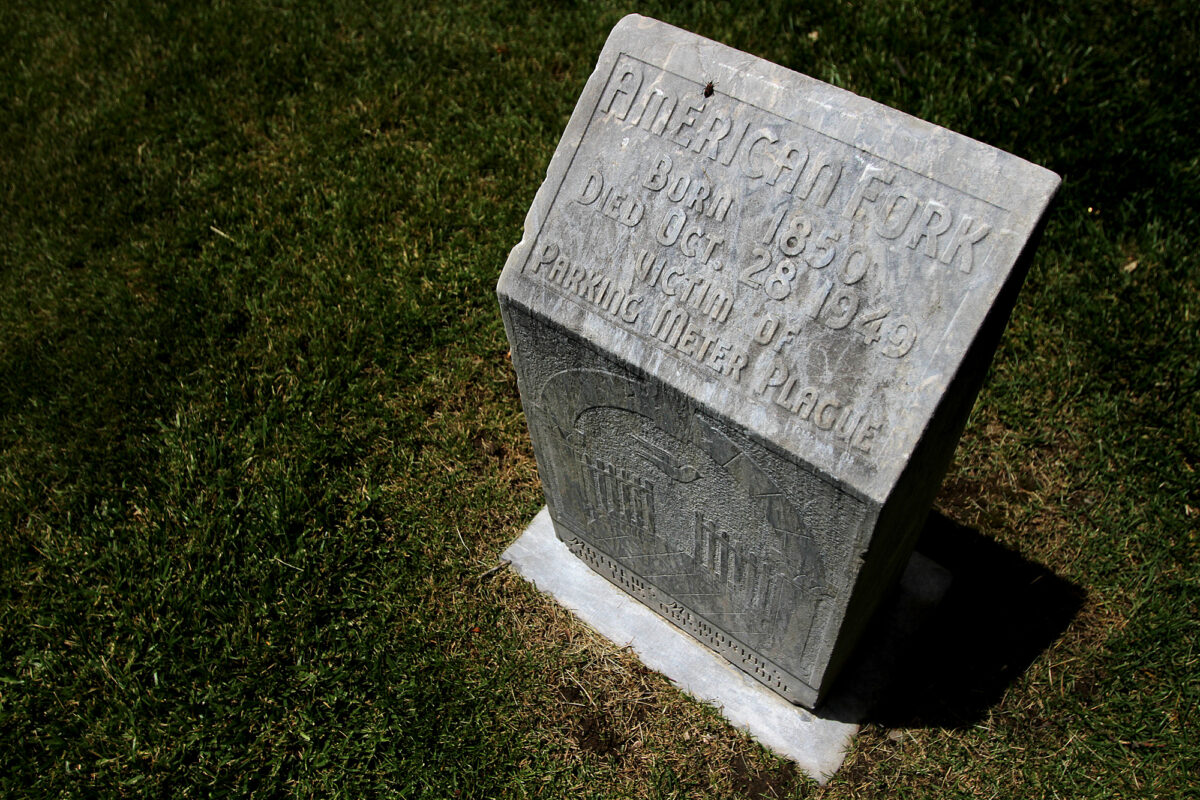
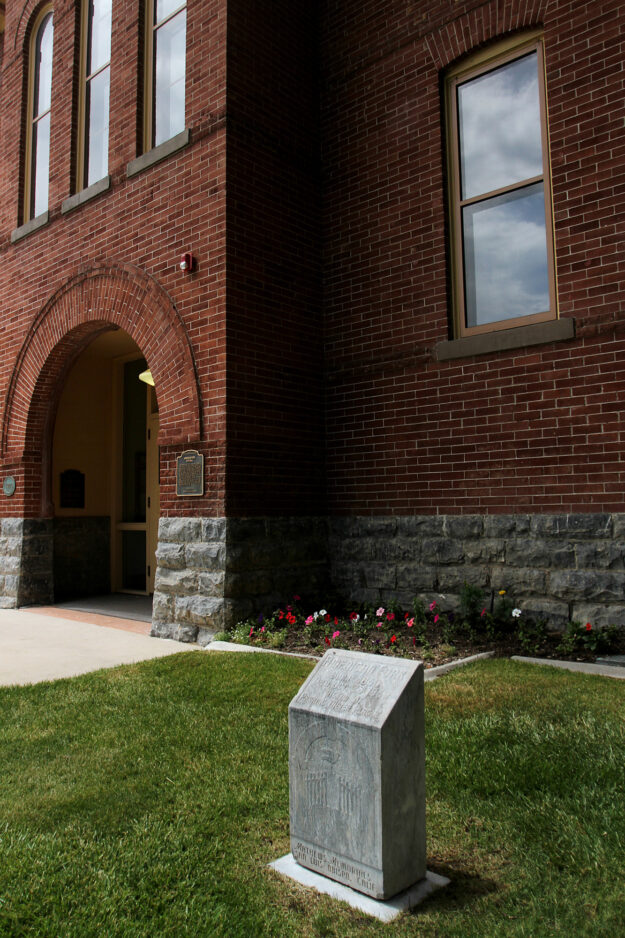
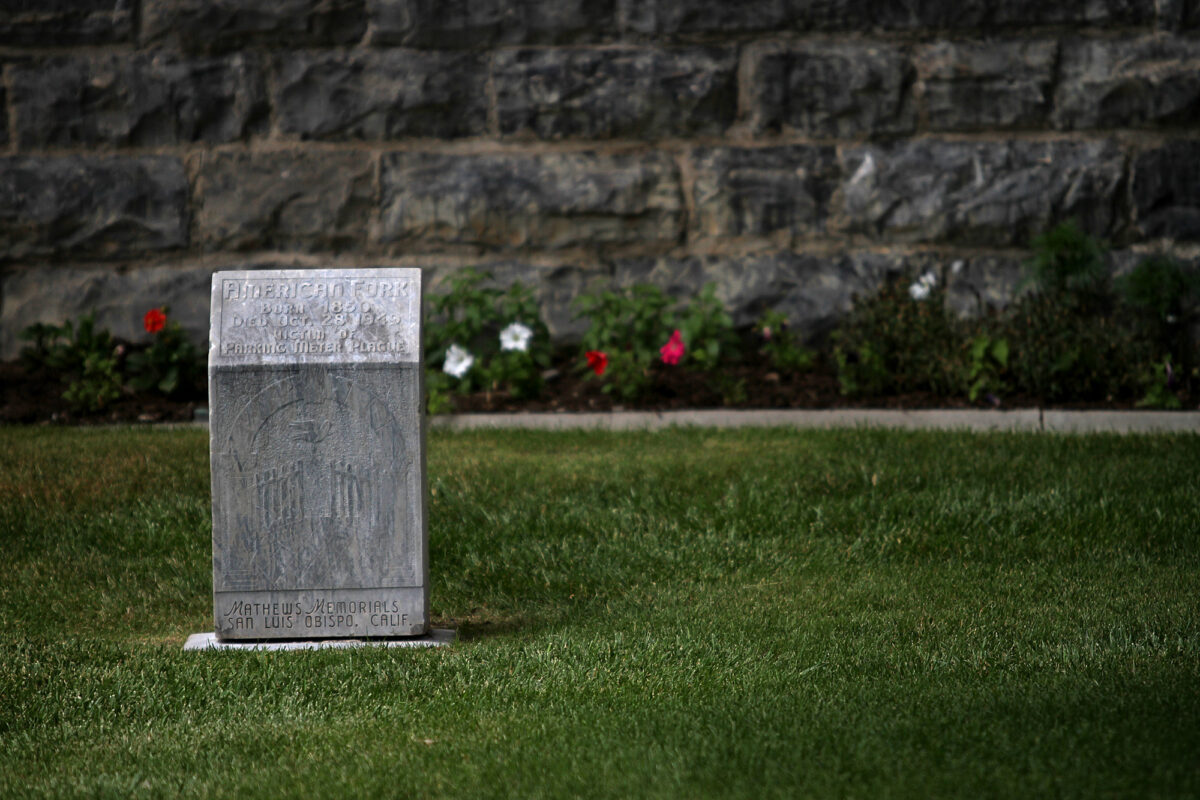
In 1950, a 400-pound tombstone protesting a recently enacted parking meter ordinance was found on a downtown street corner. The historic tombstone has found a new home, on display in front of City Hall, 31 N. Church St. Residents may view the artifact and see a piece of city history.
Mayor J.H. Hadfield and others recently discovered where the historic piece was and urged the owner to donate it to the city. Clyde Baxter had inherited it from his father, William [Billy] Baxter, who purchased it for $2, according to “American Fork City — The Growing Years,” by Betty Spencer.
Bob Hall, a friend of Clyde Baxter, is the one who suggested he donate it.
“One day I got to thinking about it, so I checked on it,” he said. “We talked about it. He talked like he’d like to find a place for it. He donated it, and we just took it down to city hall. He didn’t want any fanfare.
“He was pleased to donate it,” Hall said.
The story begins in 1949 when, after years of debate, American Fork’s council members decided to do a six-month trial of installing parking meters in a section of downtown. Spencer’s book says that the novelty of using the meters contributed to collecting $58.10 the first day of the operation of 142 meters. The cost was a penny for 12 minutes and a nickel for an hour, with a two-hour limit.
The newness soon wore off and the meter officer began writing tickets to offenders. The penalty was $1 per violation. Not many paid, however, Spencer says. The meter officer resigned in February and there were 1,000 unpaid tickets at the time.
There were those who complained about the meters and some apparently went to lengths to express their displeasure.
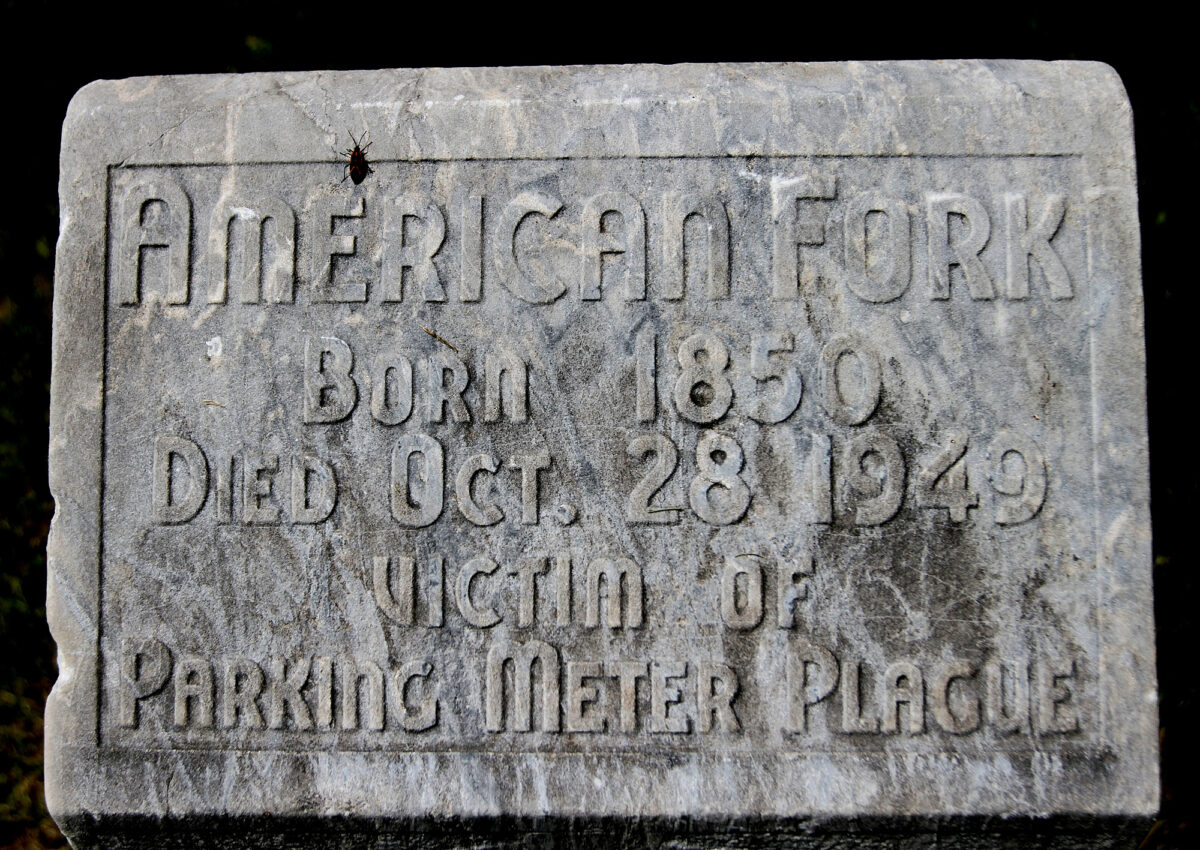
One April morning in 1950, pedestrians found the tombstone on the sidewalk at the northwest corner of Main and Center Streets. It said “American Fork. Born 1850. Died Oct. 25, 1949. Victim of the Parking Meter Plague.”
The tombstone was placed at city hall until the parking meters were removed. It was then moved to a storage space at the fire station until Baxter purchased it.
Many claimed credit for the deed, but Spencer investigated and found out the real story.
“After several months of losing customers due to the meters, a group of young businessmen met one evening at Humphries Photo Supply,” her book says. “In attendance were Howard Humphries, Keith J. Richan (Richan’s Office Supply), Le Roy Griffin (Griffin Bakery) and Arthur Gordon (Gordon’s Studio). All thought ‘something’ should be done to mark the ‘death’ of this fair city.
“One suggestion led to another and they decided Humphries would call a friend in California to see if he would make a tombstone. Not only would Matthews Memorial make the stone, but they would charge nothing, except shipping! It was ordered.”
Extensive news coverage told of the tombstone, with the story going across the country and being front page news in all Utah dailies.
Later, the merchants held a “Tombstone Revival Days” celebration with a three-day sale. The American Fork High School band marched down Main Street on that Saturday.
The meter company quietly removed the offending meters.
Mayor Hadfield said it was good to have the marker on display.
“It is a matter of history,” he said. “It is a period of time when American Fork was trying to do what they thought was right. It had an impact. When the public and merchants were against it, it was promptly removed. It teaches us not to jump to conclusions until we study the consequences. We are happy to have it back.”