What will Utah’s congressional map be in 2026? Judge expected to rule ‘on or before’ Nov. 10
Attorneys give final arguments in state’s redistricting legal battle
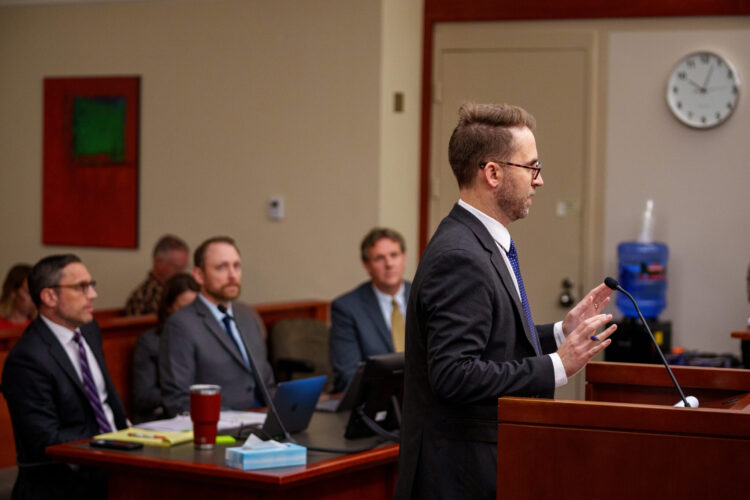
Pool photo by Trent Nelson/The Salt Lake Tribune
Mark Gaber, the lawyer representing the plaintiffs, speaks as Judge Dianna Gibson holds a hearing on Utah’s congressional maps process in Salt Lake City on Friday, Aug. 29, 2025.Attorneys for the Utah Legislature and the plaintiffs in the state’s redistricting legal battle cast their final arguments on Tuesday in front of 3rd District Judge Dianna Gibson, who must now sort through more than 1,000 pages of evidence and 15 hours of testimony before deciding the future of Utah’s congressional boundaries.
At the end of the hearing, Gibson said she would issue a decision “on or before” Nov. 10. That’s the deadline state election officials have said is the latest possible date a new congressional map can be chosen in order to give county clerks time to prepare for the 2026 elections.
Until then, the question remains: Will the judge allow the Republican-controlled Legislature’s preferred map to stand? Or will she agree with the plaintiffs and pick one of their two alternatives instead?
Meanwhile, another issue consumed most of Tuesday’s hearing, which focused on debate over whether Gibson should block SB1011, a law that the Utah Legislature approved last month along with their preferred map (known as map C), requiring that three specific statistical tests be used to evaluate congressional maps: the partisan bias test, the mean-median difference test, and an ensemble analysis.
The plaintiffs suing the state — which include the League of Women Voters of Utah, Mormon Women for Ethical Government, the Campaign Legal Center and a handful of Salt Lake County voters — have alleged that the law “cherry picks” statistical tests that are flawed to guard against partisan favoritism in a state like Utah, where the majority party (Republicans) consistently win by wide margins in statewide elections.
They claim SB1011 gives lawmakers “cover” to pass a map that doesn’t comply with Proposition 4 – a law passed by voters in 2018 requiring an independent redistricting process that adheres to a prioritized list of neutral map-drawing criteria, starting with minimizing city and county splits.
By requiring the use of three statistical tools that their redistricting experts testified are problematic in a state like Utah, the plaintiffs assert that the Legislature again passed a law that “impaired” Proposition 4 and therefore violates their right to alter and reform their government through a ballot initiative.
“The court has a ton of evidence before it to conclude these changes in SB1011 impair Prop 4,” one of the plaintiffs’ attorneys, Aseem Mulji, said in front of Gibson on Tuesday.
The partisan bias test, especially, creates a “filter” preventing a map that allows a congressional district that leans Democratic.
“If it has a Democratic district, it’s going to be culled, it’s going to be rejected,” Mulji said.
But the Legislature’s attorney, Tyler Green, argued the Legislature passed SB1011 in response to their interpretation of a line in Gibson’s previous Aug. 25 ruling when she voided the state’s 2021 congressional map.
In that ruling, Gibson wrote that “given the general, non-specific nature” of Proposition 4’s language, the Legislature “retains discretion in determining what judicial standards are applicable and they retain discretion to determine the ‘best available data and scientific and statistical methods’ to use in evaluating” maps.
Green argued that because Proposition 4 specifically calls out “measures of partisan symmetry” to be included in the “best available” methods, lawmakers codified the partisan bias test as a required tool.
“The Legislature had to find a test to measure partisan symmetry. There was no getting around it,” Green said, pointing to testimony from the Legislature’s retained redistricting expert — Sean Trende, senior elections analyst for Real Clear Politics — who said the partisan bias test is the best and only method.
He also argued that expert testimony from both sides showed that “none of these tests are perfect,” but the Legislature was put in an “unprecedented” position to figure out how to comply with Proposition 4’s requirements, so it used its discretion to set some guardrails on how to test for partisan favoritism.
During Green’s arguments, Gibson asked multiple questions, including whether lawmakers believed that they “had to codify a specific test” in order to comply with Proposition 4.
Green said lawmakers’ concern was “if we do nothing … then it’s impossible for us to know what target we’re shooting at.”
“It’s impossible for us to say for the public, ‘Look, these were the objective measures we were using,'” Green said, adding that it was also meant to ensure “the court knows this is the Legislature’s view on what was the best available” methods and why legislators chose their preferred map.
But Gibson pointed to the plaintiffs’ experts testimony that “seem to suggest that by applying these metrics, the ones that have been codified under SB1011, that you significantly limit all of the available options for a proposed (map), and those limits all favor the majority party.”
“So maybe help explain how limiting and restricting the qualitative and quantitative metrics helps to facilitate Prop 4 and the ultimate goal of anti gerrymandering?” Gibson asked.
Green said arguments that the partisan bias test is “no good” assumes that the only maps “that are fair are the ones that guarantee a seat for Democrats in the first place.”
Green said one of the plaintiffs’ experts, Jowei Chen, used an algorithm that almost always created a district concentrated in northern Salt Lake County, and he argued the court has “plenty of evidence to suggest that Dr. Chen’s simulations were anything but neutral.”
But Gibson said that “one of the things that was most interesting to me” was that one of the Legislature’s experts, Michael Barber, political science professor at Brigham Young University, used simulations that treated Salt Lake County differently than other counties, allowing that county to be “cut up more than once.”
“So maybe explain the validity and credibility of running those simulations in that way,” she asked Green.
Green responded that there’s “no dispute” that Salt Lake County’s population is big enough that it must be split at least once in order to draw a congressional map in Utah with equal populations in all four districts.
“The whole of Salt Lake County cannot be kept intact. It must be split,” Green said, adding that while Proposition 4 requires minimizing county splits, it doesn’t specify how many splits are acceptable.
When questioning the plaintiffs’ attorney, Mulji, Gibson asked about the Legislature’s stance that they were required to codify the use of the partisan bias test because their experts said it was the best way to measure for partisan symmetry.
“The fact that it’s called out (in Proposition 4), does it give more importance?” the judge asked.
Mulji argued there was no one “exclusive way” to measure partisan symmetry and assess for partisan favoritism, “but the statute makes clear partisan symmetry is just one of multiple methods.”