When smoke, smog and dust roll in, a few precautions can help you breathe cleaner
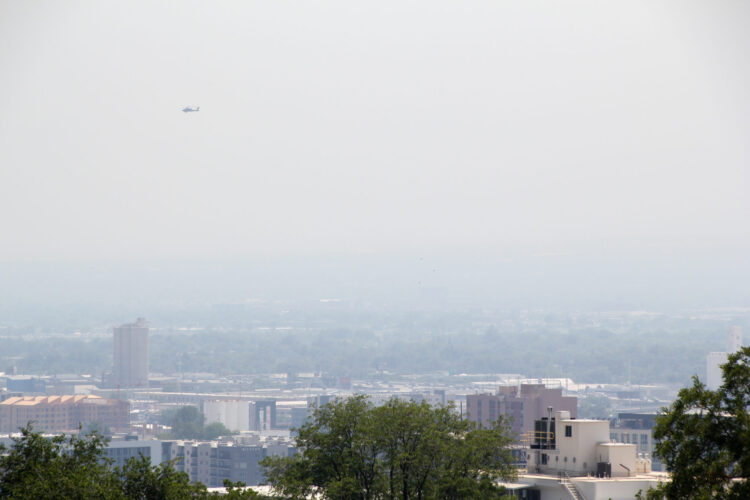
McKenzie Romero/Utah News Dispatch
Wildfire smoke obscures the view of Salt Lake City from the Utah Capitol on June 23, 2026.Smoky skies have teamed up with ozone pollution and dust storms over the Great Salt Lake for a many-sided assault on air quality this summer.
Wildfire smoke has cleared away for now, but it may be just a matter of time before it returns to northern Utah during this historic fire season. And it’s not the only source of bad air to keep in mind.
Here are some tips to breathe as clean as possible in the weeks ahead:
Earlier is better
Planning to hit the park or the playground? Consider going right after breakfast.
“The big key there is to exercise in the morning when the ozone is low,” said Dr. Nathan Dean, a pulmonologist at Intermountain Medical Center in Murray and a professor of internal medicine at the University of Utah.
Ozone pollution — or smog — tends to build up later in the mornings and in the afternoons. Cars, factories and refineries all play a role in creating the haze, and breathing it in can cause inflammation in the lungs that the American Lung Association compares to a sunburn. For the details on current conditions or to see what the forecast holds, visit the Utah Department of Environmental Quality’s online tracker.
Children face the biggest risks from exposure to ozone pollution, according to the U.S. Environmental Protection Agency. That’s because their lungs are still developing and they tend to be active outside when ozone levels are higher. Long-term exposure can aggravate asthma and is linked to chronic respiratory issues.
Take workouts inside
When wildfire smoke rolls in, resist the urge to hit the trail. Get to the gym or an indoor pool instead.
“People in Utah get really used to having the inversions in the wintertime, where you can go up to the mountains and get out of it,” Dean said. Not so for smoke. It hangs over higher elevations, too.
Consider taking a page out of his book. When the gauge for particulate matter pollution tops a reading of 20, Dean stays indoors to exercise, instead of cycling or running outside. Those who despise treadmills have other options, he noted, like spin classes or other group fitness classes.
If you must head out into smoky or dusty air, mask up
An N95 mask will help keep out fine particulate matter from wildfire smoke or dust storms. But a surgical mask or a cloth version like the ones that became common in the COVID-19 pandemic aren’t heavy duty enough.
The N95 mask must fit tightly over the nose and chin — an option that may work for commuters waiting for a bus or train but might be too uncomfortable for those working for several hours outside in the heat. And unfortunately, the mask won’t offer protection against ozone pollution.
Gunky air poses an immediate risk to people who already have conditions like asthma or chronic obstructive pulmonary disease. But it can also have significant, long-term effects for others.
The vast majority of lung cancer cases come from smoking cigarettes, and radon exposure and genetics can be factors, too, Dean said. But so is air pollution.
“There’s a pretty clear association between lung cancer and particulate matter and fire smoke,” Dean said.
But there are good sources of information to help Utahns make decisions about how to protect themselves, Dean said. DEQ’s color-coded warning system ranks the air quality in counties across the state from green to yellow and red, helping them decide whether it’s safe to go outside or better to stay in, keep windows closed and fire up an air purifier.
Local News
‘5 minutes before the miracle’: How Provo fighter Court McGee turned addiction into two-decade MMA career
A bond that runs deep: Brigham Young High School Class of 1961 gets together for another reunion in Provo