‘We can embrace this opportunity:’ Elder Gong counsels professors on AI use at BYU
Jaren Wilkey, BYU Photo
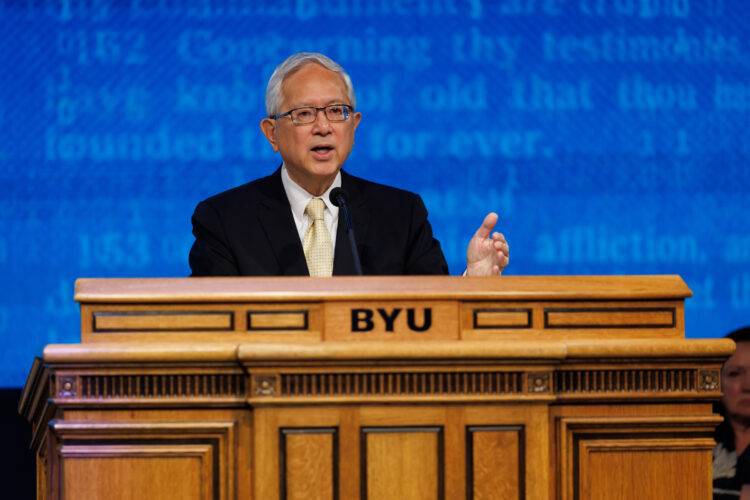
Elder Gerrit W. Gong speaks at BYU's University Conference Monday, Aug. 24, 2026, in Provo.The rise of artificial intelligence is among the “greatest opportunities” at Brigham Young University and the Church Education System, but it should be used ethically and productively, Elder Garret W. Gong of the Quorum of the Twelve Apostles said in a BYU campus address Monday.
Speaking to professors and faculty at the annual University Conference, Gong encouraged educators to allow students to utilize AI technology in the classroom to “deepen their experience with the real world” and “hone their reasoning skills.”
However, he warned that AI should not be used in place of students’ own work, and should not promote laziness, dependence or dishonesty.
“To me, it is hard to completely ban AI from our classrooms and expect our students to learn how to use this impactful technology,” Gong said. “Likewise, however exuberant we may be about AI, to me again, it seems premature to declare AI will soon bring easy abundance and leisure, where we only sip lemonade and sit in lounge chairs, as in the movie ‘WALL-E.'”
Gong’s remarks were The Church of Jesus Christ of Latter-day Saints leader’s latest about the rapidly growing technology that is reshaping the world economy.
At BYU’s Education Week last year, he said artificial intelligence can be a tool for good but cannot replace wisdom or truth from God. In a church video released in June, he shared how church members can hear the voice of God clearly in an age of artificial intelligence.
Monday’s message was more directed toward the student experience and how AI should be used in an educational realm at BYU as it begins its fall semester on Wednesday, Sept. 2.
Gong told professors their responsibility to their students is to nurture faith, foster growth and character and teach hard work, and he said human relationships are at the core of the student experience. He added that AI can influence the core relationships staff and students hold with themselves and others.
“I believe AI will influence every course, every discipline, every degree, every future family, community and workplace environment for our students, employees and community,” Gong said.
“We can embrace this opportunity. It gives us an opportunity to reexamine, reimagine and reaffirm our educational principles, purposes, processes, our means and ends.”
Gong offered four framing questions about AI in a BYU education:
- How should AI influence our students and us as faculty, staff and administrators?
- How should AI influence courses, disciplines and degrees?
- How should AI influence guiding principles, values and curriculum?
- How can BYU contribute to society’s conversation about human identity, dignity and flourishing?
Gong counseled professors to take a tempered approach in their instruction to students about AI, reminding them that AI is mathematical algorithms and not alive, and that AI is not the solution to every problem.
He also said educators should prepare students to live and thrive in an AI world and told them not to fear AI but become acquainted with the basic technology themselves.
“You don’t need to be an expert, but be able to speak from some firsthand experience,” Gong said. “Have an AI policy in your class. It may be as direct as ‘Do your own work.’ If AI can help your students learn and grow, invite them to use it. But help your students become knowledgeable, responsible and accountable for how they use AI.”
The apostle said that as BYU develops its AI guiding principles, they may reflect the church’s AI policies but should be tailored in a way that meets the school’s educational circumstances.
While AI is transforming many careers and professions, Gong said technology will open “wonderful opportunities for humans,” and that every BYU student who exhibits hard work, works smart and exemplifies Christlike character will be in high demand.
“At its core, a BYU education in the age of AI can help our students protect and promote human moral agency to become and do good,” he said. “We can use AI to, A, enhance individual effort and work, B, champion human dignity, value, and worth as intrinsic, innate, and divine, C, balance AI efficiencies and individual opportunity, and D, define and pursue the gift of possibility to promote human flourishing.”