BYU professors highlight the significance of BYU 250
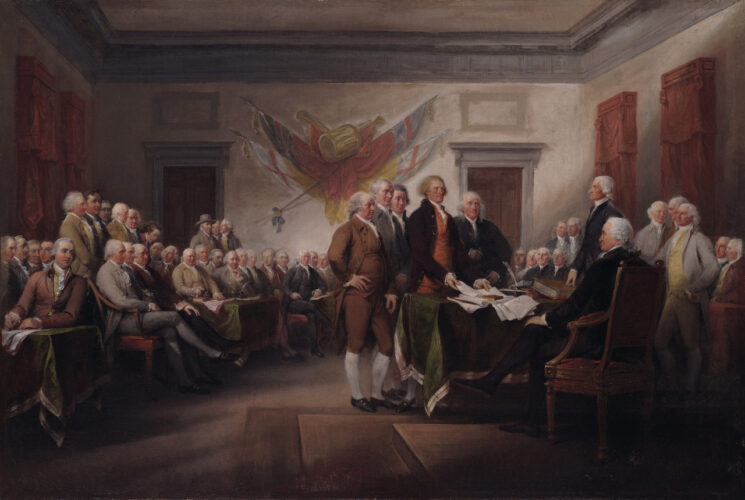
Courtesy Yale University Art Gallery
Painting depicting the signing of the Declaration of Independence.Brigham Young University Professor Tyson Reeder believes the founding fathers hoped to create a great nation when they signed the Declaration of Independence in 1776 but never could have envisioned the scale of what it would could become.
There was no precedent, he said, for establishing a republic across such a vast territory where people of different beliefs and backgrounds could unite to form a functional nation led by the people.
“It was just unheard of,” Reeder said. “The conventional wisdom of the time was that a representative republic, or a democracy, needs to be confined to pretty small borders, because it needs to be people who kind of think alike and aren’t going to be torn and driven by factions.
“I think it speaks to the uniqueness of the U.S. Constitution that it was able to provide a framework for governing a republic over such a vast amount of territory, and bringing together so many diverse ideas and opinions, and such a diversity of people, and being able to create a functioning government out of that.”
For the United States’ 250th anniversary, The Daily Herald spoke with Reeder and fellow BYU American history professor Jay Buckley on their perspectives of a nation that defied the odds, the constitution that made it possible and the potential of the country to keep improving.
“To Americans, this 250th anniversary of the signing of the Declaration of Independence is a time for reflection, an opportunity to honor the nation’s progress,” Buckley said. “A moment to examine the continuous efforts to achieve the founding ideals of life, liberty and the pursuit of happiness.”
Buckley and Reeder argue an independent America wasn’t the result of a single act realized by the stroke of a pen but an ever-evolving process to form — as the preamble of the U.S. Constitution says, “A more perfect union.”
“We shouldn’t assume that the founders just created a perpetual motion machine that is now working and will never stop, but that we have responsibilities to try to improve how the nation functions and how our democracy and our republic function, so that we can continue on for the next 250 years,” Reeder said.
It took 11 years after the Declaration of Independence for delegates to sign the U.S. Constitution 1787, and George Washington did not become president until 1789. Though they identified as a nation after the Constitution was ratified, Reeder said it wasn’t until after the Civil War citizens thought of themselves as American citizens first and members of their state second.
The Constitution itself has 27 amendments, 17 of which came after the Bill of Rights was ratified in 1791. Buckley pointed to the 13th amendment that abolished slavery in 1865, and the 19th amendment that allowed women the right to vote in 1920, as examples of how each generation has moved the founding principles forward.
“Our liberty can never be safe but in the hands of the people themselves, and that puts both an opportunity and the responsibility on those people who are benefiting from what others before us have brought this nation to be, as we try to improve our present and reflect upon how we can make the future even better for the next generation,” Buckley said.
American citizens are enabled by a carefully-crafted constitution that charts the nation’s course, according to Reeder. It ensures no singular governmental entity should overtake the power of the people because the document was framed to diffuse power among “a number of sovereigns,” including the legislative, executive and judicial branches and the state governments, he said.
“The presidency, judiciary, legislature — those are going to exist simultaneously, but in tension with each other, and it’s going to be that tension that ironically makes the whole thing work,” Reeder said. “It’s like you take three separate sticks and you stick them on the ground, and you kind of make a teepee out of them, right? As long as their tension is pushing against each other, they actually stabilize one another.”
With no clear leader, the system requires compromise — a virtue the Founding Fathers themselves had to exhibit to create the constitution, according to Buckley.
As the semiquincentennial arrives Saturday, both historians recognize space for improvement. Buckley said Americans must act by the same principles as the founding fathers, committing to the rule of law, exercising decency and reason.
“They need to serve in public office and set aside their private interests for the public good,” he said. “They need to be willing to make moderate compromises that can advance the cause, and most importantly, they need to practice individual and public virtue.”
Buckley fears that the three-branch government is being replaced by a two-party system, where the legislature defines itself either for or against the president, based upon the president’s party.
“The legislature isn’t looking out for its own power as a legislative body,” he said.
However, he remains optimistic about America’s democracy because the power still remains in the people.
“Ultimately Americans still have the ability to make their government what they want it to be, and so I think that’s really important to keep in perspective,” Reeder said. “And the framers recognized that they weren’t creating a perfect constitution, and because they recognized that they weren’t creating a perfect constitution, they built into the constitution ways to amend it.”
Americans face the burden of their nation being compared to what could or should be, according to Buckley. He said that with it comes a great responsibility.
“We need to do our best to continue to uphold those same principles to pledge to each other our lives and our fortunes and our sacred honor to move our nation forward,” Buckley said.