Power policies: Utah County Commission makes 345-kilovolt-plus transmission projects a permitted use
Jacob Nielson, Daily Herald
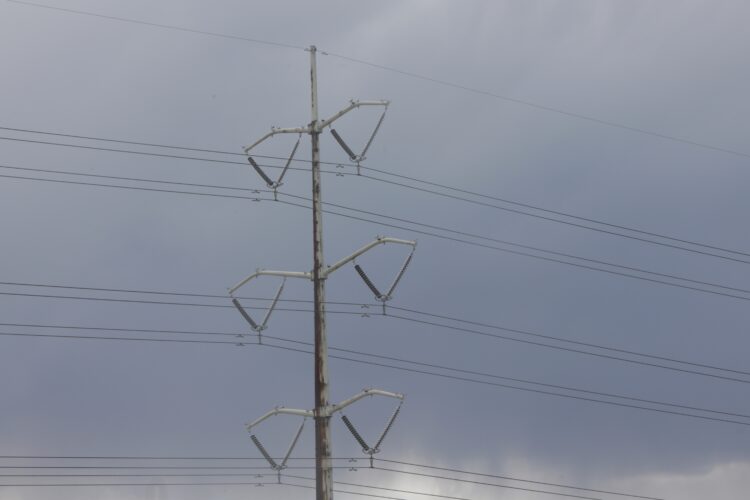
A powerline is shown Thursday, July 9, 2026, in Provo.The Utah County Commission approved an ordinance amendment Wednesday removing the requirement that 345-kilovolt and larger transmission line projects on unincorporated county land receive conditional use approval, instead allowing them as a permitted use.
County officials said the amendment, requested by Rocky Mountain Power, will simplify the approval process for these large power lines — such as the proposed 45-mile Spanish Fork to Mercer Transmission Line project — while still adhering to state and federal regulations, existing county zoning requirements, and requiring owner consent.
The county added stipulations to the permitted use that address noise concerns, visual impact mitigation, establish a 135-foot setback zone from existing dwellings when feasible and require location priority when feasible.
Utah County Attorney Dale Eyre said other utilities listed in the county public facilities code do not require conditional use permits, and that the change was necessary because conditional-use permits are parcel specific, meaning a multiparcel power line would require conditional-use applications for hundreds of individual parcels.
He said each conditional use approval can have its own conditions, which can cause conflicts between owners or be appealed to the Public Service Commission.
“Every step adds years and costs to approving the power line,” Eyre said. “It’s simply not possible. It’s one of the first things I noticed when I got to the land use department is, why do you have that? Have you never done this before? You’ve never obviously had this fight because it’s not one you want to have.”
The move came despite pushback from property owners alongside the proposed Spanish Fork to Mercer route.
Joseph Ibarra, who lives in the Salem Park neighborhood, cited the planning commission’s recommendation to deny the amendment and said instead of removing the conditional-use permit, the county should create an exception allowing a utility to file a single conditional use permit for the entire line.
“Don’t remove every meaningful local check on a 345,000 volt transmission line. Fix the one thing that’s actually broken,” Ibarra said.
He argued that removing the conditional-use permit process would remove local checks regarding EMF, wildlife, property values and safety. Many, including Ibarra, said Rocky Mountain Power failed to communicate truthfully with residents and stakeholders.
“Utah County should not respond to an applicant’s noncompliance by removing the very local review process that exposed it,” he said. “We should not lower the already incredibly low bar because Rocky Mountain Power failed to clear it.”
Rocky Mountain Power representatives at the meeting argued the ordinance change would not impact an individual’s right to dispute the Spanish Fork to Mercer project.
Matt Moskin, speaking on behalf of RMP, said the individual negotiations will still happen when the route is solidified, and property owners will still have the ability to negotiate with RMP or “have their day in court.”
He also said the change is in the public’s better interest because, under the conditional-use format, an applicant has to acquire occupancy or title before going before the county.
“Which means realistically, they have to go condemn first, and then ask questions of: Is this where you would put the line?” Moskin said.
He said the change allows the company to work with the property owner before condemning property while still complying with existing standards.
Throughout the two-hour-plus discussion, commissioners worked to determine whether the amendment would have adverse effects.
Commissioner Skyler Beltran asked whether the county would have more authority on location priority, whether the property owner has more leverage, and whether there would be additional APA protections under the condition-use permit compared with the permitted use. Eyre said no.
Commissioner Brandon Gordon asked what would happen if he voted against the amendment.
“I haven’t spent much time on that because I think it would be very very bad,” Eyre said. “If you leave in conditional use permits, they will start condemning property. The Fourth District Court will need to hire new personnel to do 200 condemnations.
“I think you’ll actually end up in court sooner than that because of the deadlines that they’re under, according to the federal government, that this be a close loop, that eventually they’re either going to go to the Public Service Commission or to the state courts or to the governor’s office and say Utah County is stopping this, and you need to stop them.”
Local News

‘5 minutes before the miracle’: How Provo fighter Court McGee turned addiction into two-decade MMA career

A bond that runs deep: Brigham Young High School Class of 1961 gets together for another reunion in Provo