Can a progressive beat Ben McAdams? That’s the big question in Utah Democrats’ 1st District primary
Pool photo by Scott G Winterton, Deseret News
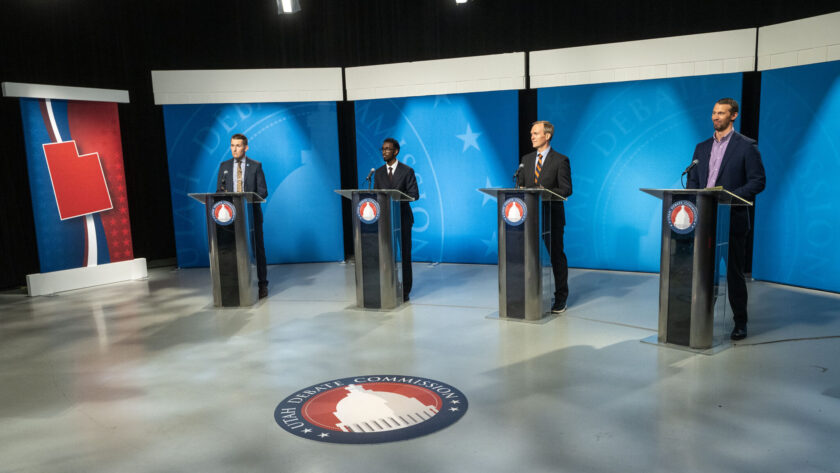
Candidates Nate Blouin, Liban Mohamed, Ben McAdams and Mike Farrell face off in the First Congressional District Democratic primary democratic debate at the Eccles Broadcast Center in Salt Lake City on Wednesday, May 27, 2026. (Pool photo by Scott G Winterton, Deseret News)A surprise blue-leaning congressional district in Utah has brought a race for the Democratic nomination that continues to be crowded even after the party’s convention and Hail Mary efforts to consolidate the list of progressive candidates.
Now that ballots are starting to hit mailboxes, voters in the small district encompassing heavily populated Salt Lake County, regardless of their affiliation, will address the looming question — can Ben McAdams, the last Utah Democrat to serve in Congress, be beat?
State Sen. Nate Blouin, tax attorney Michael Farrell and former tech public policy analyst Liban Mohamed — who won at the party’s nominating convention — are aiming to make their way to the November ballot going against the current and splitting progressive voters in three.
Even as the race is perceived to be between him and the rest of the field, McAdams said he’s not focused on other candidates, but on his platform. However, he repeated a line he has said in the past when speaking about some Democrats labeling him as a moderate.
“Progressive has to mean making progress,” McAdams said, arguing that he has accomplished policy change during his time in different elected offices. “The biggest battles that Utah Democrats have fought over the last years, I’ve led the charge, and I’ve fought, and I’ve won. So, you know, all of the candidates talk about being a fighter, but none of them can point to any victories that they’ve secured.”
The three self-proclaimed progressive candidates had mixed comments about their strategies to prevent the vote from splintering.
“This is a two-way race between Ben McAdams and us. It always has been,” said Blouin, who made a public call to consolidate the progressive vote behind a single candidate selected through a poll of the Democratic primary electorate in late May.
Blouin, who commissioned the poll, ended up prevailing in that survey ahead of Mohamed, who was the party’s choice, and Farell, but also behind McAdams. However, his call was not taken well by the other progressive candidates, who described the effort as “white privilege” and “desperation” after a contentious debate last month.
Now, in the last stretch of their campaigns, there are still a lot of issues on which all candidates agree, including platforms advocating for affordable health care and immigration reforms. But, the race for the Democratic nomination has been rocky and filled with controversy, with candidates pointing fingers at each other as they scrutinized each other’s donor lists, track records, past jobs and resurfaced old online comments.
Voters are split, but Blouin still has confidence in his odds.
“I think the poll we just had out there shows that we absolutely can win. I mean, even in a four-way race, even with two other progressives on the ballot, there is a pathway,” he said. “It’s not a great one, but it is a path.”
Farrell rejected the premise of this being a race between McAdams and the progressive pack, arguing that it is a contest to pick the overall best candidate. Also, he added, he doesn’t consider the track records of his opponents to be “particularly progressive” — since Blouin hasn’t been successful in passing bills during his time as a legislator, and Mohamed has advocated for tech companies in the past, he said.
“The idea that me, Nate, and Liban are exclusively fighting over the same small pool of progressive voters, I just think it’s wrong,” Farrell said. “And I think that the people who are arguing that are mostly, frankly, doing it in bad faith, in the sense that they’re most likely someone who supports Nate Blouin.”
Mohamed, who won the nominating convention by a tight margin, said he’s confident in his campaign’s ability to beat McAdams again.
“I do believe that our campaign has a good shot to win. I do believe that progressive consolidation would help, obviously, the odds to ever so increase,” Mohamed said. “Unfortunately, after winning convention, and the ballots were printed shortly after, certain progressives decided that they didn’t want to get behind us, and that’s OK.”
An open primary’s effect
Utah Democrats are allowing all registered voters in the district, regardless of their affiliation, to participate in their primaries, a tradition the party has held as part of its “big tent” strategy.
That’s a blueprint that party leadership and most candidates in the 1st Congressional District have supported, especially in deep-red Utah, where some voters are registered Republicans not because of their political beliefs, but to get the opportunity to vote in GOP primaries.
Considering the state’s political makeup, and with the deep blue District 1 surrounded on all sides with even redder districts, the winners of the primary races are expected to prevail in November. The Democrat who comes out on top in the 1st District will face Republican Riley Owen and Libertarian Jesse West in the general election.
Taylor Morgan, a political consultant with the Utah-based lobbying and public affairs firm Morgan & May, foresees the progressive vote being split between Blouin, Farrell and Mohamed, ensuring McAdams’ victory, even if the primary were to be closed.
“Then you throw on the ability (of) 100,000 Republican voters or conservative unaffiliated voters to request a ballot to vote for Ben McAdams, and it essentially states that progressives have absolutely no chance in that district,” Morgan said. “Ben McAdams is going to win that one by 20% or more.”
The results of this election could matter beyond the next U.S. House term, he said, since the court-ordered congressional maps resulting from yearslong court challenges from the anti-gerrymandering group Better Boundaries, could change if Republicans are successful in renewed litigation. And McAdams, Morgan said, “is highly competitive and viable as a Democratic candidate in at least two” of the potential future maps.
For the first time in years, Utah Democrats have a strong possibility to have a voice in Congress, McAdams said.
Winning the seat is not a foregone conclusion, McAdams said. But the challenge goes beyond this election.
“The Utah GOP has already spent millions to try and overturn fair maps, and they’re not done. They’ve got more tricks up their sleeve that they have told us that they are going to be working on to try and overturn Proposition 4 and fair boundaries, and I think we need our strongest candidate on the field to protect fair maps,” McAdams said.
Meeting the moment
The new CD1 map has energized Democrats ahead of the June election, attracting voters’ attention to the hotly contested primary. Mohamed, however, said he felt “like a lot of us can meet the moment in a better way.”
“I think each and every one of our campaigns have a moral obligation to live up to this moment, to run for the people instead of against each other,” Mohamed said, “and to make this the beautiful thing that everybody wanted to see, and hopefully they will see the last weeks of this campaign.”
While describing this chance in the state Democratic Party as “probably the best it’s been in a while,” Farrell said he has seen enthusiasm about the race while knocking doors in the district. But he has also found a lot of people aren’t aware there’s a primary coming.
“A lot of people are just like ‘OK, well, this is exciting, but we’ll see if anything changes.’ And that level of (being) checked out is terrible,” he said. “We need people to be actively engaged and civically engaged for our democracy to work.”