Renderings show vision for massive data center proposed in Utah, but permits could take years
There’s still a long road ahead before a design is approved by state entities
Courtesy of O’Leary Digital
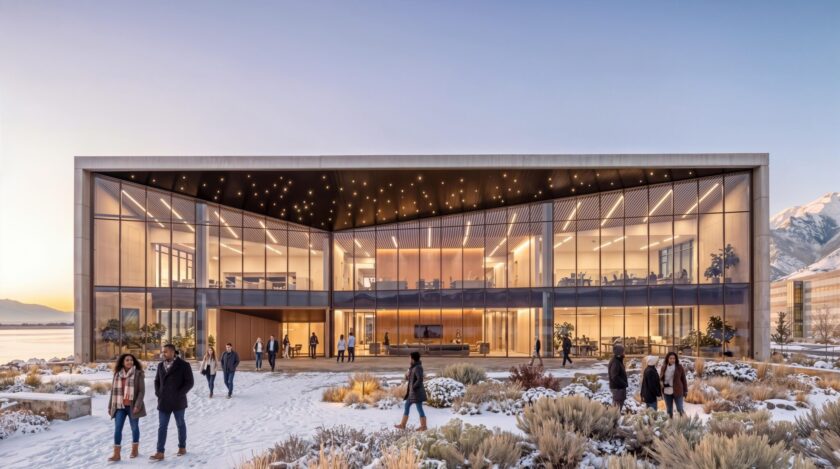
A rendering shows an initial vision of a building in the Stratos Project, a proposed data center campus project proposed in Utah. (Courtesy of O’Leary Digital)Backers of a proposed massive data center are revealing their view of what it could look like, but the project generating intense public outcry in Utah has a long road ahead.
The plan for the campus proposed in Box Elder County isn’t final yet. However, O’Leary Digital, the developer of the project, already has a vision of full glass and wooden facades and buildings forming perfect rectangles in front of Utah’s iconic mountains.
O’Leary Digital — chaired by principal backer and celebrity “Shark Tank” investor Kevin O’Leary, aka “Mr. Wonderful” — published initial renderings on what the data center project could look like, including a campus with “a cluster of ten 100MW data center buildings,” in addition to another 100 megawatt data center with “thoughtfully-designed buildings.”
The map also features a site to generate 1 gigawatt of natural gas power paired with battery storage systems, a 3,000-acre solar array that’s aimed to produce 500 megawatts of electricity.
There’s also a small “Downtown Wonder Valley” space, which developers describe as “a mixed-use innovation district that supports the Valley’s workforce, strengthens regional opportunity and offers shared amenities for the Valley and surrounding community.”
However, all of these images and plans are still premature and need to receive many nods before a building permit is issued.
The full project area takes up about 40,000 acres of land in unincorporated Box Elder County split into three different sites. According to a Box Elder County news release, one is intended to host a data center and an energy plant capable of generating 7.5 to 9 gigawatts of power — about double what the entire state consumes.
The two other sites are planned for uses that “may include manufacturing, retail, restaurants, hotels, and public works infrastructure.” Those development areas are included in an independent state authority’s expectations to create 2,000 jobs within the project area.
What’s next?
After the Box Elder County Commission approved an interlocal agreement with the Military Installation Development Authority, or MIDA, in early May, local elected officials are still expected to participate in the next steps of the multi-year process.
The deal requires that MIDA establishes a development review committee, Paul Morris, executive director of MIDA, said in a news conference after the County Commission’s approval. Six out of seven of the members will be selected by Box Elder County. Official appointments of those members are expected to be made either in the June or July MIDA meeting, he added.
“Then, under the standards, the developer has to come in with a master plan that has to be reviewed by that committee and then also reviewed by the MIDA board,” Morris said. “And after that, anything they specifically do has to meet subdivision requirements, site plan requirements before they can even get a building permit.”
That’s in addition to federal and state environmental permits the project needs.
Permits and public comment
It could take two years for the Stratos development to show it can meet state standards and receive the necessary approvals from Utah’s Department of Environmental Quality, said Tim Davis, the agency’s commissioner. But it’s hard to nail down a timeline with so much up in the air.
“It could be sooner than that, it could be longer than that,” Davis told Utah News Dispatch on Tuesday. “Depends on what they bring us. It’s impossible for us to get any closer to that until we finally see what they’re proposing.”
The department hasn’t received any applications from the developers yet for permits dealing with water and air quality, Davis said. And its backers have work to do before that point. For example, they’ll need to monitor the air for a full year before they can apply for an air permit, then demonstrate they won’t violate federal standards for multiple types of emissions, Davis said.
The department tends to spend roughly six months reviewing such applications, he added.
“This one, being as complex as it is, may take longer than that,” Davis said.
He noted members of the public will have chances to weigh in during a 30-day public comment period and a public hearing.
“There’s plenty of time and process for people who are concerned about this to engage,” Davis said. “We haven’t even started, and we take our job seriously.”
While backers of the data center pulled back one application to use 1,900 acre-feet of spring water for the project earlier this month after thousands of Utahns filed objections, another remains pending. It seeks to divert a tiny fraction of the other, at roughly 11 acre-feet of water per year, “primarily for power generation,” states the application filed by Murray Hollow, LC.
An acre foot of water is enough to cover an acre one foot deep. It can supply roughly two households for a year.
The pending application pertains to water currently approved for stock watering and household use. The application adds that a portion would also go into a “closed-loop” system that would involve flushing out water “to the natural hydrologic system and ultimately to the Great Salt Lake.”
Opponents of the data center plan have raised concerns about the potential for groundwater pollution and argued that water in the area should be directed to the dwindling Great Salt Lake, not to help cool servers.
As of Tuesday afternoon, more than 40 people had written to the Division of Water Rights to protest the request. A hearing on the contested application has not yet been scheduled.