Continuum of Care: What I wish you knew about homelessness
Craig Mitchelldyer, Associated Press
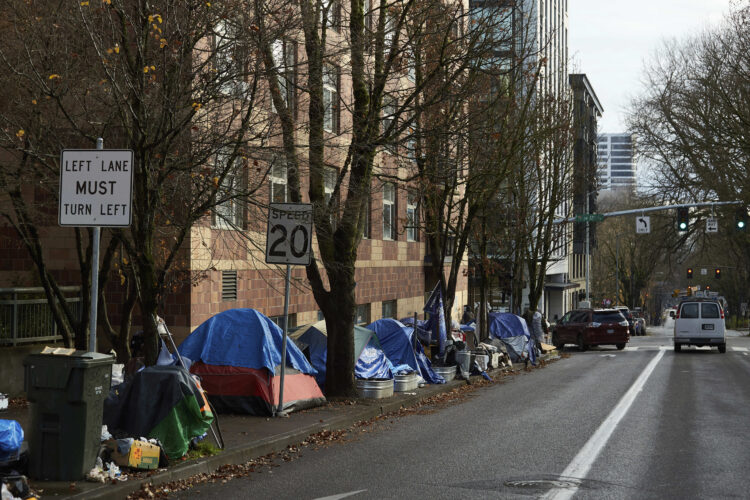
Homeless tents line the sidewalk on SW Clay St in Portland, Ore., on Dec. 9, 2020.“The ache for home lives in all of us, the safe place where we can go as we are and not be questioned.” — Maya Angelou
For the last 15 years, I have worked in Provo in homeless services. I’m often asked questions about my work, but so many of the questions that I am asked are about common assumptions or misconceptions about the homeless. I wish I could tell you all the things that I have learned and what it’s like working every day with people who are experiencing the worst day of their lives.
I’ve asked a group of front-line homeless service providers to tell you what they wish you knew about the homeless individuals in our community, what it’s like to work with homelessness, and about homelessness in general. These women and men work in Provo with people in our community who are the most vulnerable and often the most unseen.
They know their names, their struggles, their successes, and their failures. They sit with people in grief, in illness, in loss, and in triumph. These women and men come from agencies in our city: Community Action Services and Food Bank, the Food and Care Coalition, Wasatch Behavioral Health, Provo City Housing Authority, Center for Women and Children in Crisis and others.
What I wish you knew about homeless people in our community:
- “Homeless people are just like the rest of us. They have the same wants and needs of everyone else. They want love and acceptance and strive for better lives. They are smart and intelligent and are very ingenious. I always say if you need a problem solved – ask a homeless person.” — K., 22 years of service.
- “I wish people remembered that this is someone’s brother or sister, and at one point, they were held as a child with the same value, hopes, and aspirations that you and I have for our children.” — R., 16 years of service.
- “There are many reasons people are homeless and sometimes because of life circumstances, health, joblessness, and being vulnerable people end up homeless. It is not always because of addiction, mental illness, criminal activities, etc.” — Anonymous, 30+ years of service.
- “For women, being the victim of domestic violence is a leading cause of homelessness. These women experience the trauma of domestic violence combined with the stress and uncertainty of being homeless. Often women are the primary caregivers of their children as well. Finding a safe, secure place to stay is especially important for a woman with children. Emergency shelters for individuals and families are often full or not easily accessible. Trying to secure shelter can be exhausting and time consuming. Feeling that society looks down on you and makes assumptions about your situation can lead to depression and other mental health issues.” — Center for Women and Children in Crisis staff.
- “There is always hope.” — D., 22 years of service.
- “Most of the people that are panhandling are not the homeless clients that we work with. If people want to help, they need to donate to an agency that is trying to help.” — P., 22 years of service.
What I wish you knew about working with the homeless:
- “As service providers, we are so grateful for all of the outpouring of support that we receive from our community year round. If I had one tip on how to best help non-profit organizations in the area it would be this: ask them what they need most before donating. We do have needs that are obvious and easy to think of, like canned food and socks. We also have needs that are less obvious, but just as vital.” — M., 3 years of service.
- “The homeless population includes children, veterans, elders, disabled and domestic violence victims. Homelessness can happen to anyone.” — C., 16 years of service.
- “When my clients die, it’s like losing a family member. When I have had homeless people I have cared about freeze to death on the streets of Provo, I get angry and I cry and I feel devastated at how unfair it is. I am never the same afterwards. And I wonder why more people don’t care when we lose these precious, precious lives.” — A., 12 years of service.
- “You can find some of the most kind, grateful and appreciative people among the homeless population.” — E., 6 years of service.
- “It is a roller coaster of emotions. On one hand, we see individuals at their rock bottom, struggling to survive. It can be difficult to see individuals make negative choices. On the other hand, we also see individuals overcoming various barriers and challenges and succeeding at changing their lives.” — J., 5 years of service.
- “Helping the homeless is not as easy as getting someone a job. People don’t become homeless just because they lost their job. Homelessness is usually the result of a lifetime of abuse, lack of education, poor social support systems, and mental and physical problems. Individuals come to me that have a disability, a criminal record, a mental health diagnosis, a large amount of debt, and a poor credit score all combined. There are no quick solutions when it comes to homelessness. And laziness has never been a part of the problem.” — G., 3 years of service.
- “We spend so much time debating about which program to fund or which strategy to implement…but the bottom line is all these people need is love. If we start seeing PEOPLE instead of a PROBLEM, I feel we’ll find the best path to help naturally. All it takes is a moment to “see” someone and “love” someone.” — C., 4 years of service.
What I wish you knew about homelessness:
- “It is very rare for me to find anyone that would choose to be homeless as it is an exhausting daily survival experience. I wish people would know that many experience homelessness as a result of enormous trauma histories, abuses, and severe mental health conditions. I wish most of all that people knew that this is something that we can resolve and prevent with enough support and kindness one to another.” — R., 16 years of service.
- “I wish people knew the solution to homelessness is pretty simple. Homelessness is caused by lack of access to appropriate housing. The solution, then, is to find and provide more housing options for our homeless. When those experiencing homelessness are housed and offered supports, they’re able to successfully remain housed. No matter how a person became homeless or what struggles they are dealing with every day, we all need to work together to make sure they have a stable home that they can call their own. After that, any mental health, addiction, or other personal issues become much more manageable.” — Anonymous, 32 years of service.
- “Homelessness continues to be a serious and devastating social issue plaguing the United States. People from all walks of life can experience homelessness. It can be embarrassing for them to ask for help. Homeless people need to feel that they can trust agencies who offer services to them. Safe, secure housing is a basic right for all.” — Center for Women and Children in Crisis staff.
- “Affordable housing is the biggest barrier to combating homelessness. We need more landlords who are willing to work with service providers to help this vulnerable population.” — E., 4 years of service.
- “For our homeless clients, it’s not always about pulling themselves up by their bootstraps to get back on their feet. We have clients who do everything right and still struggle to regain their financial independence because of the flaws in our current societal system. What we are doing now is not enough. We can do more. We can do better.” — M., 3 years of service.
To support the homeless in our community, consider donating to the Mountainland Continuum of Care Housing First Fund at http://mountainlandcoc.org/housing-first-fund.html.
Heather Hogue is the Mountainland Continuum of Care Project Coordinator.
Community

‘This is your building:’ Lehi Civic Center opens for administrative, community use

Veteran’s Stories: Lehi’s Jim Slade helped when he could and saw tragedy in Vietnam