EveryDay Learners: Ensuring safe sleeping circumstances for babies
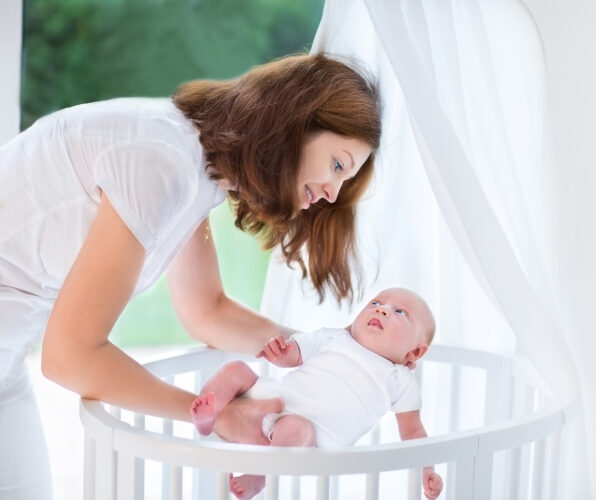
Adobe Stock
Parents may want to sleep close to their baby for various reasons.If you’re a new parent, you may have heard conflicting information about whether your infant should sleep in the same bed as you or in their own crib. In this article, we’ll unpack the research behind co-sleeping to help you decide if it’s a good choice for you and your baby.
The American Association of Pediatrics recommends that infants sleep in the same room as their parents, but not the same bed, for the first six months. The AAP does not recommend bed-sharing under any circumstances as evidence indicates that this increases the risk of sudden unexpected infant death (SUID).
Instead, the baby should sleep in a crib or bassinet that meets the safety standards of the Consumer Product Safety Commission (the package will indicate this). The infant should sleep on a firm mattress that fits the crib and a fitted sheet that fits the mattress. Nothing else should be in the crib except the baby — pillows and loose bedding are dangerous.
Importantly, infants should always be laid to sleep on their back until they are at least 1 year old. They should only sleep on a surface firm enough that it won’t indent or conform to the shape of the infant’s head. Memory foam and other soft surfaces can cause suffocation.
The AAP does recommend placing the infant’s crib or bassinet in the parents’ bedroom for the first year. This way, you and your baby can hear and respond to each other throughout the night and your baby stays safe. There are also bedside sleepers that attach to your bed so your baby can be right next to you.
Parents may want to sleep close to their baby for various reasons. In many cultures in the world, cosleeping (including bed-sharing) is the norm. Parents may also find it easier to breastfeed when baby sleeps close by. Research has shown that mothers subconsciously keep an eye on their baby, even while asleep, and that babies’ breathing and heart rate tend to get in sync with their parents’ breathing if they sleep close by.
Parents sometimes take babies into their own bed to sleep, and this can happen when parents are so tired that they feel it is easier to take the baby into bed with them. However, it is essential to keep your baby safe and avoid the following situations.
If your baby is under 4 months old, if there is loose bedding like pillows or blankets, or if one of the people in the bed is not the infant’s parent, the risk of an SUID increases significantly. And bed-sharing on a soft surface like a couch or armchair, bed-sharing with someone who has taken any alcohol or drugs (medications or otherwise), or bed-sharing with a current smoker increases the risk of an SUID by more than 10 times compared to the baseline risk of bed-sharing.
If you have any questions about co-sleeping, talk to your physician. You can also enroll in United Way’s programs Help Me Grow Utah and Welcome Baby for more parenting questions and support.
Parents who enroll in Help Me Grow Utah are connected to a parent support specialist who can answer their questions, connect them to resources and assist in taking developmental screenings. To sign up, go to helpmegrowutah.org/parents/.
Welcome Baby provides home visits to empower and support new parents in the transition to parenthood. If you would like a home visit from a Welcome Baby volunteer, sign up at unitedwayuc.org/welcome-baby.
Avery Stonely is the EveryDay Learners operations coordinator and Ilse DeKoeyer is the EveryDay Learners early childhood expert at United Way of Utah County.