BYU students, faculty transforming mountain rescue efforts in India and beyond
BYU students, faculty transforming mountain rescue efforts in India and beyond
Courtesy BYU Video
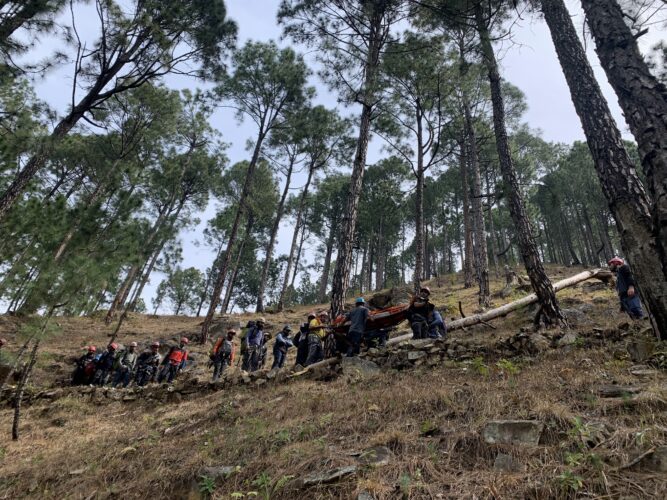
Since 2021, BYU nursing professors and students have been helping transform mountain rescue methods so Hindu pilgrims journeying through the Himalayas to ancient temple sites can worship with increased safety. (Courtesy BYU Video)Each year, up to 5 million Hindu pilgrims undertake the Char Dham Yatra, a sacred journey through the Indian Himalayas to four ancient temple sites known as the “four abodes of God.” It is the journey of a lifetime, with most pilgrims arriving in Rishikesh, India, or the “Gateway to the Himalayas,” carrying little more than a backpack and a walking stick.
Shiva devotees then bathe in the holy Ganges River to begin their physical and spiritual journey for enlightenment and salvation.
The Char Dham Yatra is strenuous, taking weeks or even months to complete the 1,000 kilometers on foot. And it is dangerous, with thousands of pilgrims dying on the route every year.
“Most people are at least 50 years old by the time they can go on the pilgrimage,” said Scott Summers, a Brigham Young University nursing professor and Utah County Search and Rescue member. “It is very physically demanding and can involve complicated medical issues such as trauma, hypothermia and high-elevation sickness.”
Since 2021, BYU nursing professors and students have been helping transform mountain rescue so Hindu pilgrims can worship with increased safety. Part of the broader Mountain People Project founded by nursing professor Craig Nuttall and co-operated with Summers, BYU established the first medically trained helicopter airlift program in the region to evacuate people to the main trauma center — All India Institute of Medical Sciences in Rishikesh.
In addition, they have trained about 2,000 mountaineers, state police officers, doctors and nurses in wilderness first responder skills, especially those essential to high-altitude rescues.
Nuttall explained that BYU’s education initiatives are empowering an unprecedented number of Indian-led rescues. In the last year, the newly trained helicopter team saved more than 100 patients, and the state disaster response force responded to more than 100 monsoon mudslides.
While the mountain guide rescues can’t be quantified, the BYU team has been informed of successful rescues only made possible by the mountain rescue training.
“We really want to educate people so they have the skills to help themselves and help others around them,” Nuttall said. “That’s how we are having the biggest impact.”
The BYU-India partnership is now moving from first-responder training to a geospatial stage. BYU professors and students will be quantifying where emergency medical services are most needed along the pilgrimage route as they map population surges, environmental and weather risks, and current mobile medical facilities. With this information, they can propose locations for improved medical care to governmental and local healthcare officials.
In addition to initiatives in the Indian Himalayas, Mountain People Project is facilitating service in the country of Georgia and the Wasatch Mountains of Utah, with upcoming initiatives in South America and Europe.
As BYU students educate and empower mountain communities, they have opportunities to become better nurses and disciples of Jesus Christ. Applying classroom knowledge in real-world settings pushes students to think and act innovatively. Cooperating with cultures different from their own invites students to follow the example of the Master Healer — to respect, love and serve others.
“One of BYU Nursing’s main goals is to not only gain skills medically as a nurse but also to develop relationships of understanding so they can see viewpoints other than their own,” Nuttall said. “This is so they can be better providers, so they can care for people like Jesus Christ cared for people.”
Amanda Ball, a graduate student in the Family Nurse Practitioner Program, values how global outreach can help nurses respect other cultures while understanding how to best share their gifts and skills. As an example, Ball initially felt inadequate to present the training she had developed to dozens of nurses and paramedics who were highly skilled in the Indian health care system.
“As I shared the flight simulation training that I had created, I learned to recognize how my gifts and talents can really bless others,” Ball said. “There are so many people who have needs, and God will use us as we are to bless those around us.”