BYU: Nursing professors piloting program to reduce early-career burnout
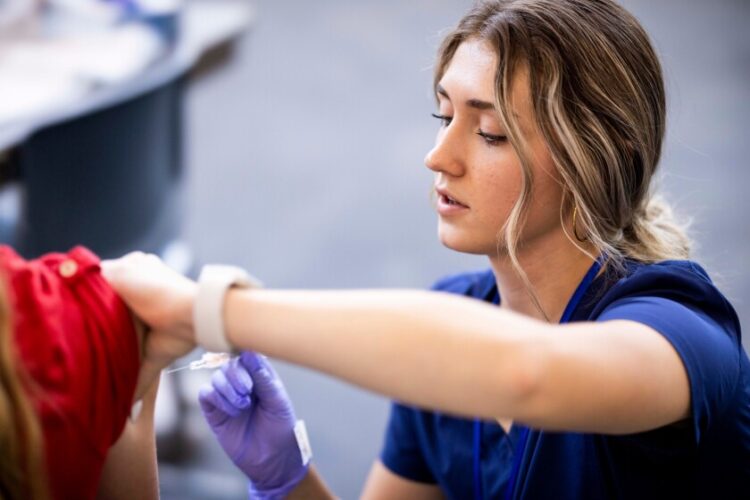
Courtesy BYU
A Brigham Young University study has shed light on how to address the problem of early burnout in the nursing profession.Nursing jobs are dominating hiring trends, and young people are paying attention. In the 2024-25 application cycle, applications to nursing programs jumped a staggering 24% and The Wall Street Journal recently reinforced nursing’s reputation as being AI-proof.
With the federal officials expecting an 8% shortage in full-time RNs in the U.S. by 2028 and the World Health Organization expecting a shortage of 4.5 million nurses by 2030, this surge in applications is promising news. But there is a major complicating factor: young nurses are experiencing widespread early-career burnout.
Brigham Young University Nursing is working to address the problem of early burnout head-on.
Along with two students, visiting professor Hiromi Tobe and BYU nursing professor Adrianna Watson recently published a study in the Journal of Advanced Nursing demonstrating a pilot educational workshop that increases emotional resilience in nursing students who are still developing the cognitive and emotional skills to process stressful events.
“Students are often well prepared in technical and clinical competencies, but they may feel less explicitly supported in developing the emotional and relational capacities needed to sustain compassionate care in the face of intense human suffering,” Watson said.
Tobe, a pediatric nursing professor at Ishikawa Prefectural Nursing University in Japan, was the primary curriculum developer for the study. Before her appointment at BYU, she had been refining a family resilience-enhancement workshop in a Japanese medical setting. In collaboration with Watson, she then adapted the resilience concepts for an international, mixed- gender student population.
“Understanding how we alleviate human suffering within ourselves is foundational to how we care for others,” Tobe said. “If we do not learn how to meet suffering with compassion, steadiness and humility in our own lives, we cannot do so sustainably in service to those we are called to serve.”
For the study, undergraduate nursing students participated in a three-week program as an optional activity within two upper-division nursing courses. (The study subjects were mostly white, female and highly motivated, but the authors expect future research will expand the findings to diverse populations and settings.) Following the classroom sessions, participants engaged in four semi-structured focus groups moderated by a trained qualitative researcher with the following results.
- Participants successfully re-framed stressful experiences through journaling and gratitude practices; they redefined resilience as self-awareness, self-compassion and renewal.
- Subjects reported that social connection through peer encouragement and facilitator-led check-ins was critical to sustaining mindfulness practices and building a healthier clinical culture of support.
- Participants valued facilitators who had experienced professional distress in the field and activities that could be transferred across settings. They reported a need to spread out the pacing of the program.
The findings inform resilience-building efforts across international global health settings, with direct responses to educational reform calls from WHO, the international Sustainable Development Goals and the International Council of Nurses.
“What I found especially compelling in this study was that resilience was not experienced by participants simply as an individual skill to be mastered,” Watson said. “Rather, the students described flourishing through community: through peer encouragement, shared reflection and supportive, structured accountability that helped them remain engaged in resilience practices during a demanding season of professional formation.”
The research is already impacting educational settings. Watson explained that an improved curriculum has been integrated into BYU nursing courses that were already focusing on stress management and wellness. On a broader note, Tobe and Watson have incorporated their findings into a wellness chapter of an international book for nursing students called “Compassionate Nursing Practice: A Guide for Students” that is to be published soon by Routledge.
“Resilience is not simply an individual skill or coping strategy; rather, it is a relational, moral and spiritual capacity — one that deepens through guided practice, supportive community and openness to divine love,” Tobe said. “Individuals who can cultivate peace within themselves can gently extend that peace to others.”