EveryDay Strong: Halloween isn’t about candy – it’s about helping kids thrive
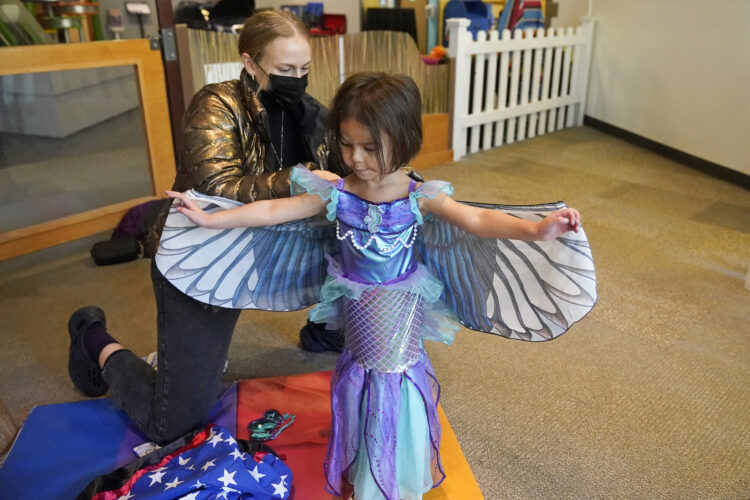
AP Photo/Rick Bowmer
Angela Montierth helps her daughter Justina, 4, with her costume during a visit to Discovery Gateway Children's Museum on Oct. 28, 2021, in Salt Lake City.As adults, the only concept we seem to associate with Halloween is candy. Yet for kids and teens — and you, if you’re willing — the holiday can mean so much more.
Because when you’re willing to look twice, you might see that Halloween actually serves as an annual opportunity for children (and all community members) to meaningfully build safety, connection and confidence.
Once a year on Halloween night, kids and teens who go trick-or-treating feel safe to explore and separate — both in a literal and figurative way.
I remember that as a kid on Halloween, the neighborhoods (and neighbors) that weren’t familiar to me became suddenly easy for me to explore and approach. Feeling safe to separate from my parents came naturally as I went up to knock on strangers’ doors or — as I got older — went up and down wandering different streets with my friends or siblings.
I felt emotionally safe and reassured, too, to see all these otherwise-unapproachable Grown-Ups dressed up in costumes. A huge man three times your age was hardly intimidating when he was wearing a toga and wig.
In addition to this sense of emotional safety, Halloween night provides our kids an invaluable sense of connection — a night to spend time with friends and to feel part of a larger community.
Halloween is the ONE annual holiday dedicated to helping all kids in a community feel confident to approach their neighbors.
Consider safe ways you can participate this Halloween night — because the communal “working togetherness” of Halloween fosters a sense of connection, a sense of feeling safe to explore and separate, in our community’s kids and teens. And your participation is incredibly vital.
After all, this is the one night a year, the one annual holiday, dedicated to helping all kids in a community feel confident and empowered to approach their neighbors.
So, how might you break down barriers for kids in your community to feel safe to approach and connect with you this Halloween? How might you set aside your own “dignity” to help the kids in your neighborhood feel safe, connected and confident?
Maybe you stop telling yourself you’re “too old” for Halloween and put on a costume. After all, what is the result when a child (or one of our peers) sees a normally boring, stuffy adult willing to dress up and set aside All Seriousness for a day? They give themselves permission to do the same.
Costumes build a sense of connection when a joke or reference is understood. And they also act as a form of play that can cross all age barriers, giving the wearers permission to be a little bit stronger, a little bit cleverer, a little bit braver than they might feel they “actually” are.
When we put on a Halloween costume, we help our kids and our peers reduce their stress and anxiety — and perhaps, ironically, feel safer to be themselves.
“Lose your dignity to find your child” is advice that our handbooks encourage, and Halloween is a holiday where it’s perfectly acceptable to do just that.
There’s a lot of hardship out there right now. Our kids see us worrying, and they worry a lot, too. They often try to grow up too quickly because they want the confidence and competence to do something about the wrongness of the world.
But part of feeling “too old” for Halloween is the sense of feeling “too busy” or “too serious” to play.
This year, I invite you to take the time to dress up and participate in Halloween. If we focus on the safety, connection and confidence this holiday naturally brings to the table, this year’s Halloween may be the best we’ve ever had.
Community
EveryDay Strong: Halloween isn’t about candy – it’s about helping kids thrive

RMU: Making a difference: Friendships, connections renewed in a small world of service