With demographic dip in sight, Utah universities prepare for budget impacts
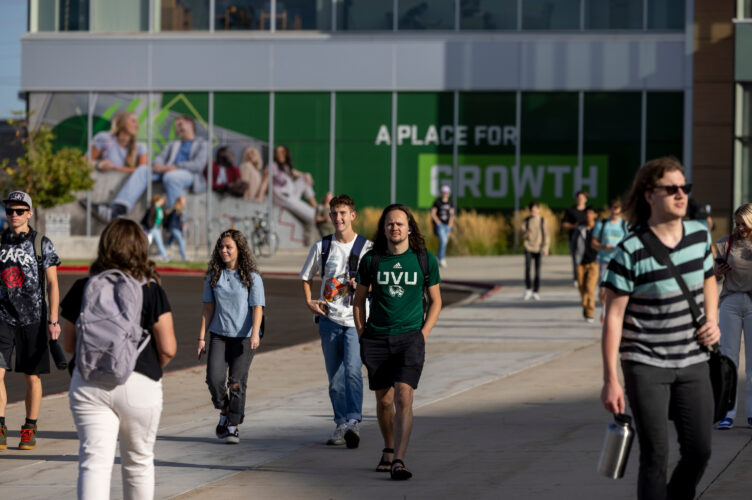
Courtesy Jay Drowns, UVU Marketing
Utah Valley University students traverse campus on the first day of the semester on Aug. 23, 2023.Universities across the country are preparing for a major threat: a demographic dip in traditional college-aged people and a drop in the public’s confidence in higher education. Utah, according to a new report, is faring better than the national average. Still, that existential hazard persists in the state, and fiscal analysts are bracing for a future budget impact.
In Utah it’s not only about the decline of fertility rates. The share of students enrolling in a public Utah colleges within three years of high school graduation has also been in decline for the last few years, going from 56.7% in 2019 to 51.7% in 2025, Kem C. Gardner Institute researchers said in a presentation to the Utah Board of Higher Education on Wednesday.
That shrinking enrollment is expected to have a substantial impact on Utah schools’ budgets. But, if that’s happening years into the future, why are analysts looking at adverse economic scenarios now?
“We’re not talking about 50% declines. We’re not talking about these cliffs that happen instantaneously. That they’re more slow moving, and there is time to navigate it. But it does require being conscious about how you’re going about that,” said Phil Dean, chief economist with the Kem C. Gardner Policy Institute at the University of Utah.
One of the solutions the institute recommends includes keeping an eye on retention and completion rates.
According to data from the Utah System of Higher Education, Utah universities and colleges lost about 7,000 students out of the 2023 cohort.
“If you were able to retain those students, then that would basically make up what you would lose that year in the demographic dip,” Andrea Brandley, a senior education analyst at the Gardner Institute said. “And then if you retained them for three years, you could multiply these numbers by three as they went on to finish a bachelor’s degree, so there’s a lot of opportunity here to be able to both improve student outcomes and also increase student enrollment.”
Another way to curb the impact of shifting demographics is to find ways to attract students over 25 years old. More than a third of working age adults have no credential at all, Brandley said, citing a study by Lumina Foundation. A larger portion of them have some sort of certificate, but may benefit from continuing education.
“The opportunity, of course, is to find ways to adapt and to lead where higher education may have the same mission, the mission remains constant, but the students it serves may change. How it delivers education may change, and the challenges it helps to solve will likely continue to evolve,” she said. “So, thinking through all of that and trying to approach things in a proactive way will likely reduce the challenges.”
The Utah System of Higher Education can also build on existing efforts, like recently planned systemwide coordination efforts, which could lead to a unified system of courses across institutions, analysts from the institute said.
With colleges and universities throughout the country facing the same struggles, Utah Commissioner of Higher Education Geoffrey Landward said “rethinking about how we’re operating this system became an imperative.”
Especially when competition with other states will be fierce, he said.
“This data is exactly why this approach is critical now, and that’s why I think you see other states scrambling to try and rethink how their state systems are operating, because they see the same numbers and they see the same data and they see the same problem,” Landward said. “That Utah’s ahead puts us at a strategic advantage for now, if we can capitalize on what we’ve started.”
Utah News Dispatch is part of States Newsroom, the nation’s largest state-focused nonprofit news organization.