3-year-old hospitalized as part of E. coli outbreak in Lehi



-

- A GoFundMe has been started for 3-year-old Avery Allen of Orem, who is in Primary Children’s Hospital after contracting E. coli. She is one of eight people living in or connected to Lehi to get E. coli, and one of the five who were hospitalized.
-
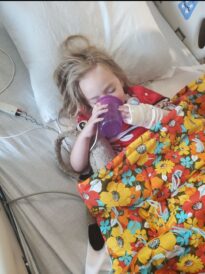
- Avery Allen, 3, contracted E. coli and was diagnosed with hemolytic uremic syndrome on Wednesday, Aug. 2, 2023. She is being treated at Primary Children’s Hospital in Salt Lake City.
-

- A family portrait of Jacob Allen, Brianna Allen and their daughter Avery Allen. Avery is currently in the hospital fighting kidney failure due to E. coli.
Eight Lehi residents or people with close ties to Lehi all reportedly contracted E. coli within two weeks, with five hospitalized due to the severity of their conditions, one of which is a 3-year-old girl from Orem. Last week, the Utah County Health Department released advisories to all residents of Utah County to avoid drinking or playing in pressurized irrigation water to avoid exposure to E. coli.
Two of the cases were confirmed to be E. coli 0157:H7, which John Hopkins Medicine states on its website “causes a severe intestinal infection in humans. It is the most common strain to cause illness in people. It can be differentiated from other E. coli by the production of a potent toxin that damages the lining of the intestinal wall causing bloody diarrhea.”
The investigation to identify the source of the E. coli is ongoing, but Jeanteil Livingston, Lehi City communications manager, said officials are “leaning towards pressurized irrigation water” being the source. They suspect that the E. coli cases were caused by someone drinking or playing in the irrigation water. However, Livingston said nothing is confirmed until all of the tests to identify the source of the E. coli are complete, which are being conducted by epidemiologists for the Utah County Health Department.
3-year-old gets E. coli
One of these eight cases is a 3-year-old girl, Avery Allen, who lives in Orem but goes to day care in Lehi. Her father, Jacob Allen, said he and his wife, Brianna, noticed Avery was sick when she began acting lethargic and had blood in her stool July 30. Jacob Allen said she watched all of the “Toy Story” movies without getting distracted. “That’s not her. … She’s usually a pretty hyper, rambunctious little girl,” he said.
They took her to the doctor on July 31 but were advised to wait a few days to see if it persisted. Two days later, on Aug. 2, they took her back to the doctor and she was admitted to Utah Valley Hospital. There, they discovered she had E. coli and diagnosed her with hemolytic uremic syndrome, a serious disease which can cause damage to the lining of blood vessel walls, destroy red blood cells and lead to kidney failure. She was transferred to Primary Children’s in Salt Lake City that evening.
It has yet to be determined how or where Avery contracted E. coli. She is on dialysis every Monday, Wednesday and Friday as both of her kidneys are failing.
“We’re just trying to get her kidneys to wake back up and start functioning again,” Jacob Allen said. Avery has had two blood transfusions, is currently on a feeding tube, and had to get platelets but will likely need them again, he said. “There’s certain anxieties that I don’t think you’ll ever fully know until you have a kid.”
Avery is expected to be in the hospital for a few more weeks, and during that time Allen and his wife have a room at the Ronald McDonald House. “We have been able to kind of switch off who gets to have a good night’s sleep, and like I said, just taking it one day at a time,” he said. “It’s rough.”
Allen said they have been told it is an “unlikely scenario” that Avery will need a kidney transplant, adding that, “Things have stopped getting worse.”
“She (Avery) has had her own ups and downs,” he said. “She hasn’t really been her normal, happy self in about a week.”
According to Allen, the only time she usually talks is to ask for something she needs. However, he said, “Today we did catch her singing along to ‘Frozen’ and it made me optimistic; she’s starting to show signs of being playful again.”
“We’ve had tons of support from family, friends (and) church groups,” he said, explaining that much of the support has been in the form of meals being made for them. In addition, Avery’s uncle, Justin Hatch, created a GoFundMe to help her parents with the cost of getting her the help she needs. Their goal is to raise $20,000, of which about $2,000 had been pledged by Monday evening.
Allen said all donations will be used to pay for Avery’s medical bills, and any money that is left over will be donated to Primary Children’s Hospital.
Practices to stay safe from E. coli
The Utah County Health Department issued an advisory for pressurized irrigation water to remind Utah County residents that irrigation water poses health risks such as E. coli. Individuals should not drink irrigation water or play in it, which includes filling kiddie pools with it, running through the sprinklers, using it for slip-n-slides or using it for other water activities.
In the press release from the Utah County Health Department, Lehi Mayor Mark Johnson is quoted as saying, “This is a critical situation, and I am concerned for the public. I want residents to be aware that pressurized irrigation water should not be used for anyone to play in. No one should drink irrigation water that comes to their home.'”
In addition to avoiding ingesting the pressurized irrigation water and playing in it, the health department said, “E. coli can be transmitted from person to person. Good handwashing and hygiene are necessary to prevent the spread.”
Symptoms of E. coli include: bloody diarrhea, persistent diarrhea, fever, nausea and vomiting. The Utah County Health Department said to contact a health care provider if these symptoms arise.
Produce that is grown in a home garden and is watered with pressurized irrigation water can still be eaten, but steps should be taken to remove residue and bacteria before eating.
Barbara Rowe, a writer for Utah State University Extension, outlined how to reduce the bacteria on produce. She said to rinse all produce under cold, drinkable, running water and to use a brush to scrub potatoes and melons or other produce with grooves because hands cannot completely remove the dirt inside them.
She added, “(U.S. Food and Drug Administration) experts recommend removing the outer layer of leafy vegetables such as lettuce and cabbage before thoroughly rinsing the leaves in water. They recommend rinsing until you can’t see any visible dirt, then spinning them in a vegetable dryer. If you are saving your lettuce and cabbage for later consumption, dry the leaves before refrigerating to prevent bacteria growth.”