600 second chances: Syracuse woman, Intermountain Health celebrate transplant milestone
Courtesy photo
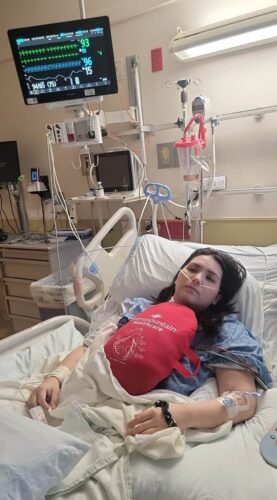
Jessica Leon of Syracuse received a heart transplant in April after waiting nearly three months for a donor. She is one of several recipients who helped celebrate the 600th transplant by Intermountain Health's team.Jessica Leon said even though she’s never met her hero, he will live with her for the rest of her life.
The 35-year-old Syracuse resident received a new heart on April 28 after waiting 81 days for a match. Leon had a condition called hypertrophic cardiomyopathy, which affects the left ventricle, the main pumping chamber of the heart.
“I was diagnosed with hypertrophic cardiomyopathy when I was 13,” she said. “I struggled with shortness of breath, but I did normal teenager stuff and I was able to be strong enough to get married and have my first child.”
Eight years later, Leon said she had her second child, but she suffered some complications.
“I had heart failure and my lungs filled up with fluid,” she said. “Last August, I was diagnosed with end stage hypertrophic cardiomyopathy. I didn’t realize I was getting worse because I was just adjusting my lifestyle around my symptoms.”
After waiting nearly three months on the transplant list, Leon was informed about a donor match.
“It was a hard situation,” she said. “I prayed for my donor and I prayed for their family. I can’t imagine the pain of losing a loved one and having to make that decision of donating their organs. By them doing that merciful decision, they prevented my daughters from going through that same loss. May God bless him and his family as well.”
On Tuesday, Leon was one of several transplant patients, donor families and caregivers who came together to celebrate a medical milestone by Intermountain Health — its 600th adult heart transplant.
“Six hundred transplants are an important medical milestone to the community and an opportunity for all of us to celebrate and thank the donor families who offered the generous gift of donation when they lost their loved one,” said Dr. Rami Alharethi, medical director of the heart transplant and artificial heart program at Intermountain Medical Center. “The milestone is also a terrific testament to the great team we have, including the patient who is at the center.”
The Intermountain Health adult heart transplant program began at LDS Hospital in 1985. The first recipient was a man in his 50s who had been suffering from heart failure.
“When we got the call that a donor heart was available, we were told it was a young patient who had suffered a terrible injury in Cache County,” Reid said.
The young man, it was discovered, was the recipient’s grandson.
“He had to make the decision of whether or not to go through with it,” Reid said. “He did and he lived 30 more years with his grandson’s heart.”
The transplant program moved to the Intermountain Medical Campus in Murray when it opened in 2007.
According to Reid, Intermountain performed 29 heart transplants last year, a record number for the program, and followed another 284 patients for heart transplants. This year already, more than 20 heart transplants have been performed.
“Heart failure is a terrible problem. Over 8 million people in the country have heart failure. It’s the No. 1 diagnosis in the Medicare population and surpasses all forms of cancer together. It’s a huge problem,” Reid said. “The donors are young patients — teenagers, people in their 20s and 30s — so we need to be mindful of those people as well.”
Brent Haupt, 72, of Herriman, was Intermountain’s first patient in 2015 on the total artificial heart freedom portal driver, a smaller, lighter controller for the total artificial heart that provides increased mobility for patients. After six months, Haupt’s waiting was over when a heart became available from a donor. He was back to work sooner than his doctors would have preferred.
“I may be 72 according to the calendar, but I feel 10 to 15 years younger,” he said. “I do everything I used to do and more.”
Haupt said that includes motorcycle riding, competitive target shooting, traveling, working in the yard and running a heart failure support group.
Tyler Larsen, 37, of Draper, received a new heart in June, becoming a member of Intermountain’s 600 heart transplant club. Other members of his family, including his mom, sister and uncle, have also needed the life-saving gift of a new heart.
The father of five said he was up and walking a mile around the hospital after his surgery. After 10 days, he was discharged.
“Being part of these amazing transplant journeys is rewarding,” said Alharethi. “What gives our team the most satisfaction is seeing our transplant patients, like Jessica, Tyler and Brent, go on and lead productive, long and happy lives.”
Over the past 38 years, the program has grown into a national model and is recognized as a center of excellence with high-quality outcomes and survival rates post-transplant that are among the highest in the nation.
Marley and Jady Tippetts spoke about their daughter, Jaydra, who died from an asthma attack and drug overdose this year.
“She battled with abuse for 10 years and we always knew it would be a possibility this would happen,” Jady Tippetts said. “There were issues with her heart because of the abuse and they could have fixed it, but her other organs would have been lost so we chose to go with four other donations.”
Daynene Snyder’s son Jayden died three years ago in a car accident.
“He was a donor the moment he got his license and became a donor hero to four individuals by donating his heart, liver, kidneys and eyesight,” she said.
For the third consecutive year in 2023, Fortune Magazine and PINC AI, a national health care quality firm, named Intermountain Medical Center one of the nation’s top 50 cardiovascular hospitals.
Intermountain Medical Center was also ranked as the 10th leading teaching heart hospital in the nation in Fortune’s Top 50 Cardiovascular Hospitals study, which identified hospitals throughout the United States that demonstrated the highest clinical and operational performance in heart and vascular care.
Intermountain has five board-certified advanced heart failure transplant cardiologists who provide specialized care for several thousand patients each year with advanced heart failure. The heart transplant program at Intermountain Medical Center is a national leader in extending lives, conducting research, and testing and researching new cardiovascular support devices.
“We discovered there’s such a small percentage of people on the donor list,” Jady Tippetts said. “More names need to be on it.”
Local News
Payson High assistant wrestling coach arrested on suspicion of sexually abusing multiple students
Launching toward the future: Provo man starts communications program to keep youth updated on air and space advancements