Deer mitigation in Elk Ridge to take place next month; city cites public safety
Isaac Hale, Daily Herald file photo
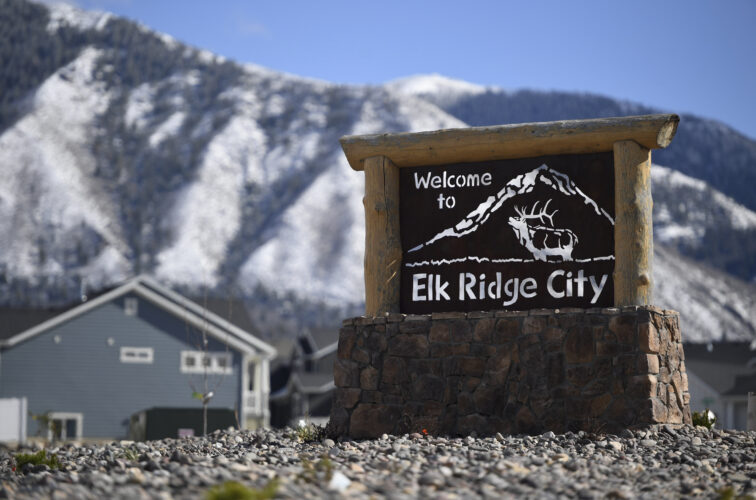
A welcome sign is pictured Friday, April 13, 2018, in Elk Ridge.Deer mitigation efforts in Elk Ridge will begin Aug. 1 and last the entire month.
The determination was made at the Elk Ridge City Council’s June 27 meeting. A significant increase in the deer population has been seen in previous years, and council member Jared Peterson said he has been working with the council and Utah Division of Wildlife Resources for around four years to discuss an effective deer mitigation solution to minimize the safety risks that come with the high population.
From summer 2021 to summer 2022, the animal population contained an average of 375 residential deer, which are born and live within city boundaries year-round, making them generational deer. The population needs to drop to 200 deer to reach a “reasonably safe level,” according to the plan proposed to and approved by the City Council.
The goal of the deer mitigation in Elk Ridge is to decrease the amount of residential deer while leaving the deer that reside in the mountains, called migratory deer, in peace. The time frame of only performing mitigation efforts in August helps to avoid deer that migrate through Elk Ridge closer to the fall and winter months.
The need for deer mitigation comes from several factors, Peterson explained. Public safety is one of the largest factors due to a high number of car accidents involving deer in Elk Ridge each month, several incidents of deer killing house pets and predators being spotted in town trying to hunt the deer.
The deer being a public nuisance are also a factor. Peterson said he receives continuous calls of complaints about deer eating plants, gardens and flower beds. The last factor is the health of the deer. The residential deer are 30% lighter than the migratory deer, Peterson said, meaning they are unhealthy due to the lack of food available to them in the city. “If they are eating what you have in your yard, it’s not good for them. … They are supposed to be foraging on native plants and that sort of thing,” he said.
This deer mitigation will hopefully encourage the deer to move back into the wild where they can receive the right nutrients and gain weight to stay healthier, Peterson said. In addition to being underweight, he said the residential deer’s mating cycles are off, which has caused does to give birth during the winter, and the fawns do not survive.
Peterson said he is sensitive to those who have formed a fondness of the deer and acknowledged they are fun to have in the city, but the safety concern must be addressed, he cautioned.
“Our goal is not to eliminate the deer,” Peterson said. “Our goal is to get them down to manageable levels. People will still be able to see deer, there will still be deer within the city. The deer will be healthier and not be as big a safety concern.”
Process of mitigation
The deer mitigation is authorized through the DWR. According to the agency’s website, “A city with a resident deer population that is significantly damaging private property or threatening public safety within its boundaries may request the Division for a certificate of registration (“COR”) to design, create, and administer an urban deer control plan.” Sydney Lamb, DWR wildlife manager, explained under urban deer control there are no restrictions on the gender or age of deer that can be caught. There are also several ways to mitigate the deer, which can include a residential deer hunting season or traps that are set up by the city.
Elk Ridge has decided to set up netting traps that lure the deer in with bait. Peterson explained that when a deer walks across the net for the food, the net captures the deer. Fawns and nursing mothers will be released, he said. They are hoping to capture mostly does to help curtail future population growth. Trapped deer are then euthanized and all meat is donated to local residents or meat donors who are interested in wild game meat.
Lamb said when a deer is trapped, the city is also “required to notify us (the DWR) as well as take some biological samples for testing for chronic wasting disease.”
With this being the first year of deer mitigation for Elk Ridge, they have two traps donated by the DWR. The city workers and volunteers will be taking charge of the deer mitigation including setting the traps and checking them regularly.
Peterson shared that the DWR told city staff, “Even though you have a couple of traps, you’ll be lucky to have one animal a day on average.” Elk Ridge’s urban deer control plan guides actions over the next three years, with the possibility of extending if the mitigation is effective. Within the first few years, Peterson said the numbers of deer needing to be removed will be high as the population needs to decrease by around 150. But once the population is at a manageable level, he said, the number needing to be removed to maintain the population will be significantly less.
Peterson said it is expected to take five to six years to reach the level of maintaining the population, and the mitigation program will evolve as they learn more and adjust to the results of their plan.
“If there’s a better approach here, or better tactic or a better method. We’re all for it. This is making do with the best of what we’re given,” he said.
“I think it’ll turn out to be really good for the city, even for those that are set against it,” he said, adding that in five to 10 years, “I want people saying, ‘Look, the animals that we have here are healthy, they’re not a safety concern and they’re still there.’ So, that’s when I know it’ll be successful.”
According to Lamb, the animals aren’t being relocated because of the risk that disease may spread across different deer populations.
Relocation outside of city limits also would be ineffective as officials say deer would simply travel back to the city, and relocating far enough away to be effective would put those deer populations across the state at risk. With enough funding, a sanctuary or something similar could be created, Peterson said. But with the resources available, trapping and euthanizing is the most effective way to control the population and keep the public safe, he added.
Public feedback
At the June 27 meeting, Peterson addressed concerns of the deer being in Elk Ridge first, thus it being their home. He said the deer population in Elk Ridge before it became heavily populated by humans was around 50 to 70 animals, so it has increased with human arrival. A big reason for the increase, he explained, is that humans are feeding the wild animals, and predators are less likely to attack within city limits, but he said the safety concern for children remains as predators have been spotted hunting the deer.
Peterson shared a story of residents who began feeding a deer on their property last winter. “Before they knew it,” he said, “these people had 100 deer coming to their place. It’s unbelievable, and then they had a ton of safety concerns. The person that was feeding them was now calling us saying, ‘Hey, I can’t even go out to my mailbox.'”
Internal city discussions were held on how to resolve issues like this, and officials decided to update their nuisance code pertaining to wildlife to include a no-feeding ordinance for the deer. “They are wild animals, they are not pets,” Peterson said. In the Elk Ridge City Urban Deer Control Plan, it also states that “The feeding of deer, elk, moose, and turkeys are prohibited within Elk Ridge City Boundaries.”
Peterson said while there are those in Elk Ridge who have said to leave the deer alone, the city council has mostly gotten positive community feedback. He said the feedback in other cities with deer mitigation plans is similar.
According to Peterson, the city council constantly receives complaints about the deer causing safety hazards and destroying yards. But beyond that, Peterson said he is the one who gets the phone call that there is a dead deer or an injured deer on the side of the road or in someone’s yard.
“There’s some people who, they just think they’re cute, you know, a few deer, and they like to see them around. But the reality is there’s another side to it,” he said.
Mitigation, Peterson said, will make it so less deer are killed or injured this way.
“I’m not heartless. I realize that the deer, they’re fun to look at, they’re pretty animals, but not when they’re being a danger or a hazard,” he said.
Local News

David Hinckley highlights analytic background, improving county government in campaign for Utah County Commission Seat B

J. Allen points to business experience, planning for the future in campaign for Utah County Commission Seat B