Finding affordable housing is difficult, panelists at Utah Valley summit say
-

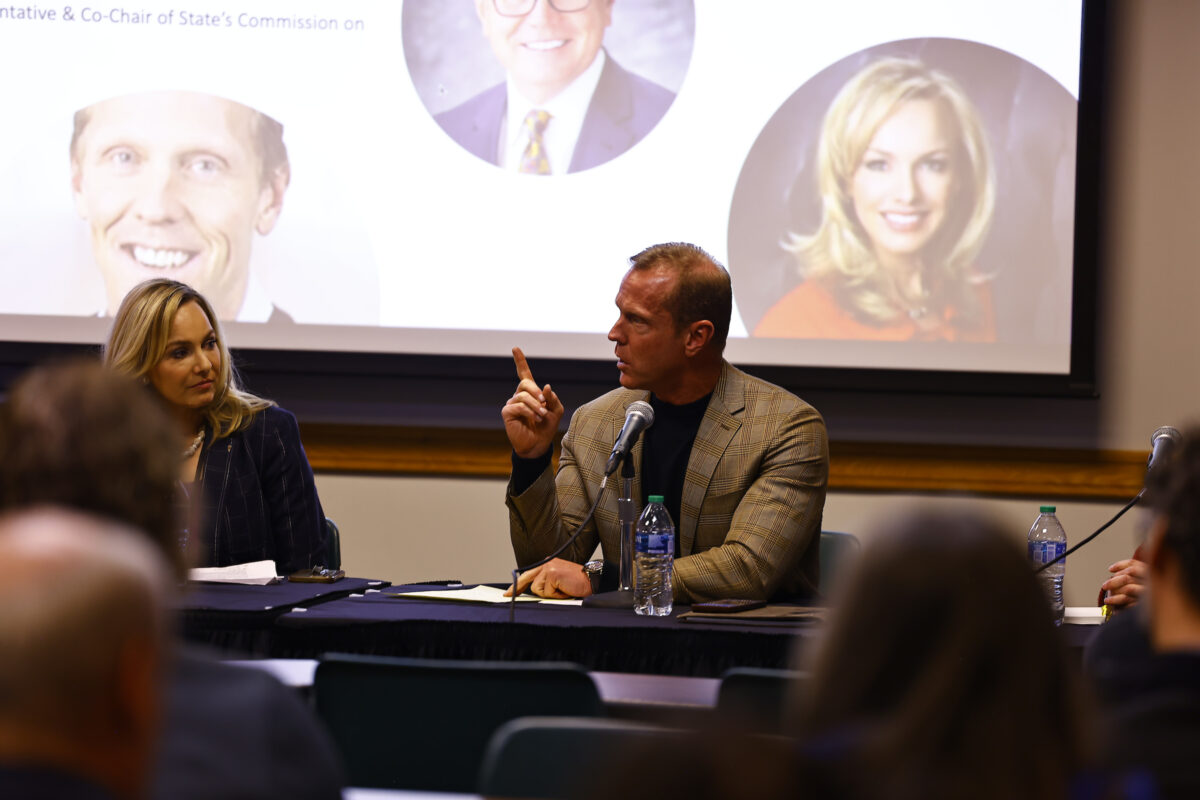
- Mike Ostermiller, a member of the Utah Realtors Association, discusses housing issues during the 3rd Annual Growth and Propserity Summit held at Utah Valley University in Orem on Friday, Nov. 3, 2023.
-

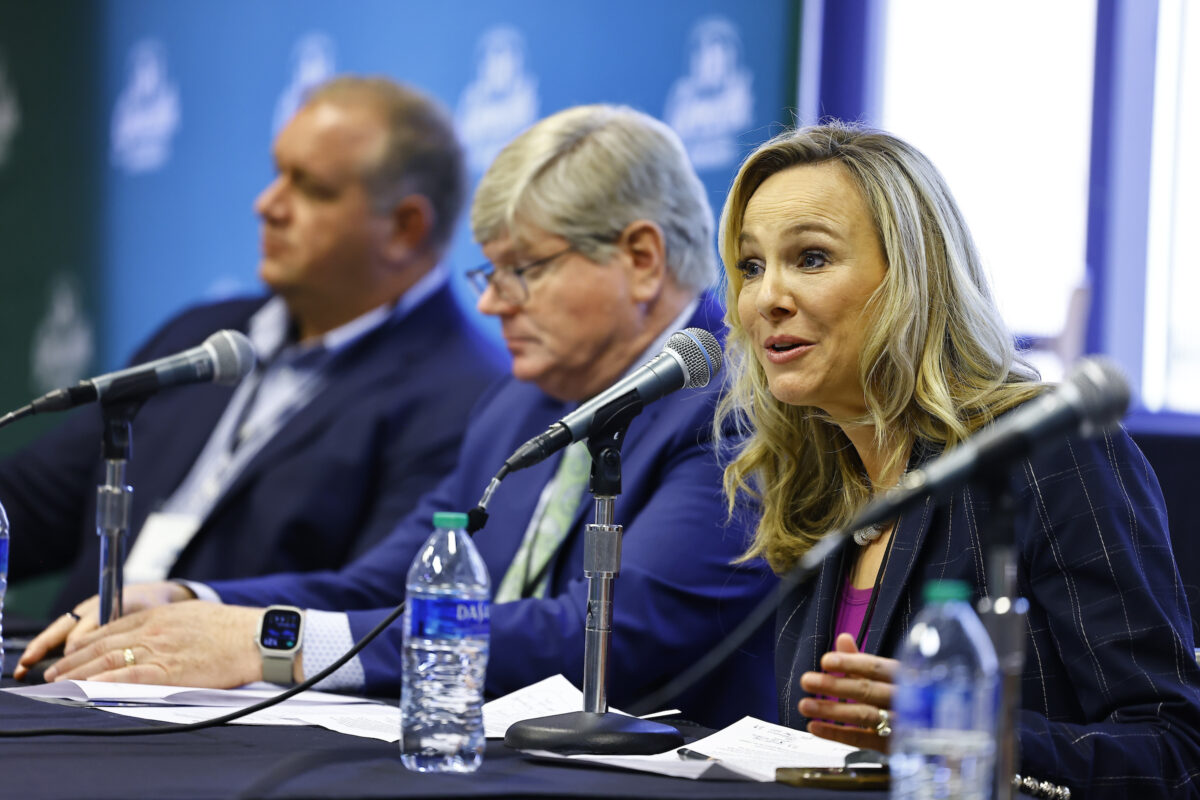
- Lindon Mayor Carolyn Lundberg speaks on a panel discussing housing during the annual Growth and Prosperity Summit at Utah Valley University, held Friday, Nov. 3, 2023.
Courtesy Jay Drowns Photography
Mike Ostermiller, a member of the Utah Realtors Association, discusses housing issues during the 3rd Annual Growth and Propserity Summit held at Utah Valley University in Orem on Friday, Nov. 3, 2023.
The National Association of Home Builders has reported that in the first quarter of 2023 it was cheaper to live in California than in Utah. Per the organization’s data, 77.2% of households in Utah are unable to afford a home compared to 76.3% in California.
In just two years, the average cost for a home here has risen $100,000, with the average home cost now coming in at $550,000.
That is why the Utah Valley Chamber of Commerce asked Rep. Stephen Whyte, R-Mapleton, a member of the Legislature’s housing committee, to host a panel discussion Friday at its 3rd Annual Growth and Prosperity Summit about what Utah and particularly Utah County need to do to address the issue.
Words used during the summit to describe the current housing situation included “daunting,” “confusing” and “overwhelming.” In short, experts said, there is much more demand than supply.
Utah needs 28,425 new houses to meet just the current demand, which is expected to increase in the next two years, according to the University of Utah’s Kem C. Gardner Policy Institute. Furthermore, Utah needs to build an additional 178,000 new units by 2030, just seven years from now. Of that, Utah County will need to build 51,689 new units, by far more than any other county in the state.
Courtesy Jay Drowns Photography
Lindon Mayor Carolyn Lundberg speaks on a panel discussing housing during the annual Growth and Prosperity Summit at Utah Valley University, held Friday, Nov. 3, 2023.
Whyte said the two biggest problems are demand exceeding supply and the not-in-my-backyard mentality.
Whyte asked what challenges are cities facing such as in lot sizes and zoning.
Participating in a panel discussion, Lindon Mayor Carolyn Lundberg said cities are cooperating when it comes to lot sizes, permitting and zoning issues to help accommodate a variety of housing.
“Cities are doing their part,” Lundberg said. She noted that thousands permits have been given throughout the county, but homes are waiting to be built.
That waiting to build problem is likely due to interest rates, according to Arthur Newell, executive vice president of Zions Bank, who said the federal government keeps adjusting the prime lending rate, which is now at 8.5%.
“New construction is strong but there has been a reduction this year in building,” he said.
Newell added that when government gets involved, costs get passed along to taxpayers.
“Builders are manufacturers of housing and we are unable to build what the public is asking for,” said Jason Harris, vice president of land acquisitions with Fieldstone Homes.
To show just how much costs have gone up, Whyte shared a slide showing a sampling of cost increases that have impacted labor and materials. In the U.S., costs have risen an average of 23% year over year, according to his presentation.
Below are some of the areas hit by rising prices (all percentages shown indicate increases):
- Lumber, 44.0%.
- Concrete/foundation, 13.4%.
- Plumbing/HVAC, 17.9%.
- Framing, 19.8%.
- Electrical/lighting, 15.8%.
- Steel/aluminum, 23.6%.
- Flooring, 16.6%.
- Windows/doors, 22.9%.
- Roofing/shingles, 15.8%.
- Insulation, 18.0%.
- Drywall, 14.6%.
Various other items such as siding, stucco, brick and cabinetry have all had double-digit increases, Whyte said.
Then there is the cost for the land to build on, permits, fees and landscaping.
Looking at all that and interest rates caused Mike Ostermiller of the Utah Association of Realtors and Property Rights Coalition to joke, “If you haven’t taken up drinking, maybe you should.”
Homes that would be marketed as affordable are part of what has been dubbed the “missing middle.” That includes units such as duplexes, fourplexes, courtyard homes, cottage courts, townhouses, multiplexes, triple-stacked homes, live/work spaces and more.
“Starter homes are extinct,” Ostermiller said. “For a $400,000 home you need 10% down and good credit. In 2020, only 685 starter homes sold.”
To show some of what is being done elsewhere, look at The Church of Jesus Christ of Latter-day Saints, which announced plans for a gated build-to-rent community in Queen Creek, Arizona.
It will have 320 units on 54 acres with a large park that will offer amenities such as pickleball courts, dog parks, pools, a lazy river and a clubhouse as well as play areas.
Construction will begin in the first quarter of 2024 by Hancock Builders. President Greg Hancock said his company is currently building nearly 3,000 build-to-rent units with about 7,000 in design.
“We are woefully short on housing, period. Now we’ve got an 8.5% 30-year fixed mortgage and entry-level price of $420,000. Affordability for housing is out. It’s gone. I don’t see it coming back, candidly. It might. But it’s a very difficult situation. The vast majority of the world rents. I believe rentals are absolutely where we’re headed,” Hancock told the Phoenix Business Journal.
When California changed it’s zoning rules for accessory dwelling units, or ADUs, permits in one year went from 1,000 to 23,000, according to Kam Valgardson of Irontown Homes
While many young families are still wanting that dream home, several others are looking at apartments, other rentals and alternative options.
Companies like MitModular in Provo are building shipping container homes, which can be built less expensively, are stronger in earthquakes and can be built in local opportunity zones in the county. However, most cities don’t have zones to put in modular or container-type homes.
Currently, Provo is revamping its zoning codes with the hope that new members of the City Council will approve. Some of those changes will most likely include zoning for smaller home lots.
Lundberg was happy to say that Lindon provides for smaller homes or ADUs and has done so for many years. “Strategically plan for homes and home ownership. Our kids still want the American dream,” Lundberg said.
“We need a mindset change,” Newell said. “This is the new normal for a while. People would adjust to smaller homes. Life will find a way.”
Harris noted this comment by Sir Winston Churchill, former prime minister of the United Kingdom: “Americans will do the right thing only after they’ve tried everything else.”
Whyte said he would like to get as much information as he can to take back to the Legislature and prove Churchill’s theory wrong.
“We need to create affordable homeownership options for our children and grandchildren now and for the future,” he said.