Why Sen. Evan Vickers, of southern Utah, wants to be the state’s next Senate president
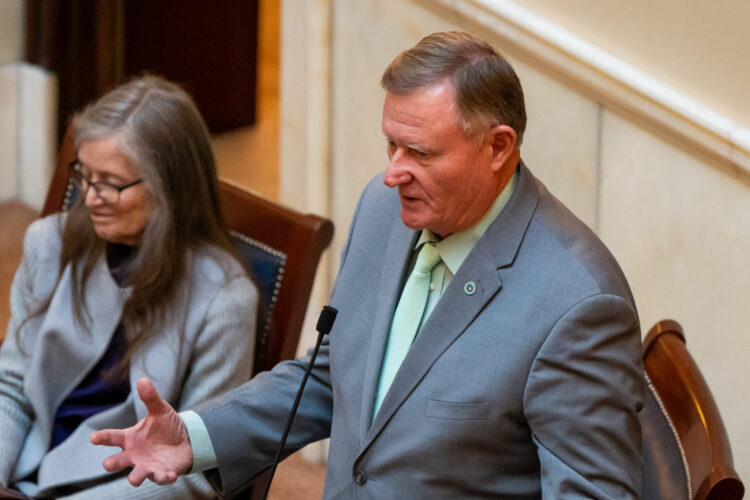
Senate Majority Leader Evan Vickers, R-Cedar City, is pictured on the first day of the legislative session at the Capitol in Salt Lake City on Tuesday, Jan. 16, 2024. (Photo by Spenser Heaps for Utah News Dispatch)
Senate President Stuart Adams’ unexpected primary loss sent shockwaves through the Legislature, leaving a leadership void that Senate Republicans will decide how to fill — but not until a closed-door caucus election after the November general election.
Even though those leadership elections are roughly five months away, one longtime senator is already making it known he’ll be vying to take Adams’ place: Sen. Evan Vickers, R-Cedar City, who served as Adams’ second, as majority leader, for years before he lost that position to Sen. Kirk Cullimore, R-Sandy, in 2025.
So far, both Vickers and Cullimore are considered likely contenders for the Senate presidency. However, Cullimore, through a Senate spokesperson, declined to comment for this story.
In an interview with Utah News Dispatch last week, Vickers pointed to his 18 years in the Legislature (four in the House and 14 in the Senate), as well as six years he spent as Senate majority leader before he lost the position to Cullimore.
“It was a close race,” he said. “You know, I have to admit, anytime you lose it’s a little painful and it’s taken me a while to get here, but I really do think that that was one of the best things that happened to me because I was able to sit back and kind of observe the caucus, the Senate in general and the Legislature and see what was working and what wasn’t.”
He said if he’s elected Senate president, he’d work to “get the public’s trust back.”
“It seems like we’ve lost that recently,” he said, adding that on some issues “the public has not been on our side” and that the Legislature has “never done a very good job of telling our story.”
From efforts to change an anti-gerrymandering initiative known as Proposition 4, to a controversial anti-collective bargaining bill for public unions that lawmakers repealed amid outcry, to bills expanding the Utah Supreme Court and giving the Senate and governor a say over who the high court’s next chief justice, Vickers said all those moves came with good policy arguments, “but the public didn’t understand that.”
“So I would like to do a better job (with the public), if we can, as we push forward,” Vickers said, whether that includes preparing for the Olympics in 2034, making sure public and higher education budgets are sound, and increasing resources for water infrastructure and transportation.
“Those are things that are going to take some effort and a lot of work within the Legislature,” he said. “But also, we need to do a really good job of helping the public understand what we’re doing and why we’re doing it.”
Vickers, from Cedar City in Southern Utah, also said senators who represent more rural areas off the Wasatch Front are hungry for more representation in Senate Republican leadership.
“So we were looking at ways that we might be able to leverage some opportunity to have more say,” he said.
After Adams lost his primary, that “changed the dynamics,” Vickers said, and he started making some phone calls and asking his fellow senators if they’d support his run.
“It certainly appears feasible. It doesn’t mean I’m going to win, but it certainly appears feasible,” he said.
Adams, Vickers said, has been an “amazing leader” who has “done some really wonderful things, and a lot of things that a lot of people will never even know what he’s done because they were behind the scenes … but he’s made the state a better place.”
But Vickers said he would differ from Adams in style, which he described as “a bit more controlling.”
“President Adams is very, very effective. His style — it really works for him, and he’s done well with it — is he is a little bit more controlling, I think, and he wants to be more engaged in a lot of the individual discussions,” Vickers said. “I’m a little different. I would like to have more people engaged in the process.”
Vickers pointed to Adams’ predecessor, former Senate President Wayne Niederhauser, as being a good delegator — and that’s what he said he would focus on rather than having “my finger on every pulse.”
Vickers also said he would continue making sure Senate Democrats are able to voice their opinions, and he said he would likely continue holding daily media availabilities during the session.
He also said he would only hold the position for up to four years, until his current term ends.
“Whether I end up being the Senate president or just being a senator in the body, I hope I can continue to build on what I’ve learned from (Adams) and others,” he said. “Yeah, I would like to see a few modest changes in how we function as a Senate and a Legislature, but on the same token I really want the Senate and the Legislature to continue doing really good policy for the state.”
Utah News Dispatch is part of States Newsroom, the nation’s largest state-focused nonprofit news organization.