
Public lands event to highlight San Rafael Swell’s history and heritage
Public lands event to highlight San Rafael Swell’s history and heritage
San Rafael Swell
Public lands event to highlight San Rafael Swell’s history and heritage
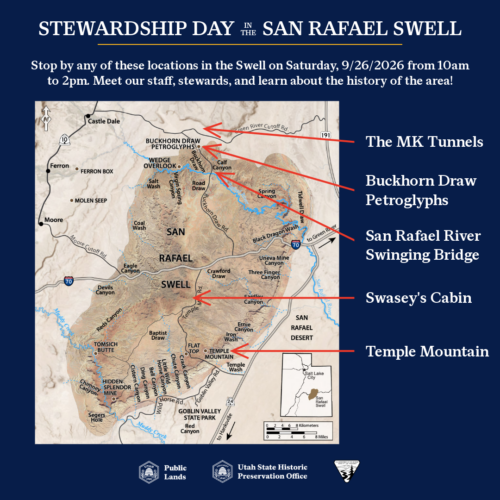
SAN RAFAEL SWELL — Visitors to the San Rafael Swell will have an opportunity to explore some of the region’s history and learn more about its cultural resources during a National Public Lands Day event Saturday, Sept. 26.
The Bureau of Land Management, Utah State Historic Preservation Office and Utah Public Lands Policy Coordinating Office are joining together for the event, which will take place from 10 a.m. to 2 p.m. at several historic locations throughout the San Rafael Swell Recreation Area.
The event is free and open to the public.
The celebration will highlight the long history of the San Rafael Swell, from ancient rock art and early ranching to Civilian Conservation Corps projects and the uranium and Cold War activities that left their marks on the landscape.
The event also comes as Utah and the BLM begin working under a new cooperative agreement signed in June 2026. The agreement establishes a framework for state, federal and local partners to share management responsibilities and expertise involving Utah’s public lands and their historic and cultural resources.
As part of Saturday’s event, visitors will be able to meet with archaeologists and learn about several historic locations throughout the Swell.
Buckhorn Wash Panels
At the Buckhorn Wash Panels, visitors can see ancient rock art preserved on the canyon walls alongside more recent inscriptions left by Civilian Conservation Corps workers.
The rock art provides a connection to the people who lived in the region thousands of years ago, while the CCC inscriptions offer a glimpse into a much more recent chapter of the Swell’s history.
The panels are one of several locations being featured during the National Public Lands Day event.
San Rafael Bridge
The San Rafael Bridge, also known as the Swinging Bridge, represents another important chapter in the area’s history.
The 167-foot suspension bridge was constructed by the Civilian Conservation Corps between 1935 and 1937. The bridge was built to provide access across the San Rafael River and helped open important grazing lands to local ranchers.
The bridge remains largely unaltered, providing visitors with a physical connection to the work carried out by the CCC nearly a century ago.
The Civilian Conservation Corps was established during the Great Depression and put young men to work on conservation and infrastructure projects throughout the country. In Utah, CCC crews worked on roads, bridges, trails and other projects that helped shape access to many of the state’s rural landscapes.
Swasey’s Cabin
The history of early ranching in the San Rafael Swell can be seen at Swasey’s Cabin.
Rancher Joe Swasey built the cabin in 1921 using Douglas fir logs brought from Eagle Canyon. The structure provided shelter for cowboys working in the area and serves as a reminder of the ranching operations that depended on the remote landscape.
The cabin is one of several historic structures that remain in the Swell and help tell the story of the people who lived and worked there before the area became a popular destination for recreation.
Temple Mountain
Temple Mountain offers visitors a look at a very different period in the Swell’s history.
During the uranium boom of the 1950s, the area became part of the nation’s effort to locate and develop uranium resources. The Atomic Energy Commission was involved in the development of the region, and a settlement known as Temple City grew around the mining activity.
Remnants of stone structures from the former settlement remain at Temple Mountain.
The uranium boom transformed portions of rural Utah during the post-World War II era as prospectors and mining companies searched for deposits of the mineral that had become strategically important to the United States.
MK Tunnels
The MK Tunnels provide another unusual connection between the San Rafael Swell and the nation’s Cold War history.
During the 1950s, contractor Morrison-Knudsen conducted tests in tunnels carved into Navajo Sandstone. The work examined how the sandstone would respond to forces associated with nuclear weapons and whether similar underground construction could withstand the effects of a nuclear blast.
The sites were part of the broader effort during the Cold War to understand how underground facilities could be designed and constructed for a changing military environment.
Today, the tunnels and other remnants of the project provide a glimpse into a period when national security concerns reached even remote areas of the Utah desert.
A landscape with many stories
Together, the sites featured during the event demonstrate the wide range of history found throughout the San Rafael Swell.
Ancient rock art, ranching cabins, CCC infrastructure, uranium mines and Cold War testing facilities represent vastly different periods, but each is connected to the landscape and the people who used it.
The National Public Lands Day event is intended to help visitors better understand those connections while highlighting the importance of preserving the cultural resources found on public lands.
National Public Lands Day is held each year to encourage Americans to visit, appreciate and help care for public lands.
Saturday’s event will also showcase the new cooperative relationship between Utah and the BLM following the agreement signed in June.
The agreement provides a framework for state, federal and local governments to work together and share expertise in managing public lands and the historic and cultural resources found on them.
The Sept. 26 event will run from 10 a.m. to 2 p.m. at various locations throughout the San Rafael Swell Recreation Area. Admission is free, and the public is invited to participate.
Because activities are spread among several locations, visitors can choose which sites they would like to explore and learn about.
For additional information, contact Nicole Nielson at 435-820-0687.
News
Public lands event to highlight San Rafael Swell’s history and heritage
Spring City Canyon Road to Temporarily Close for Forest Work
Public Hearing Set for Sanpete County Rural Healthcare Sales Tax Proposition
MANTI — Sanpete County residents will have an opportunity next month to learn more about and comment on a ...