Life balance: Former BYU football player Braden Brown back to help athletes improve mental health
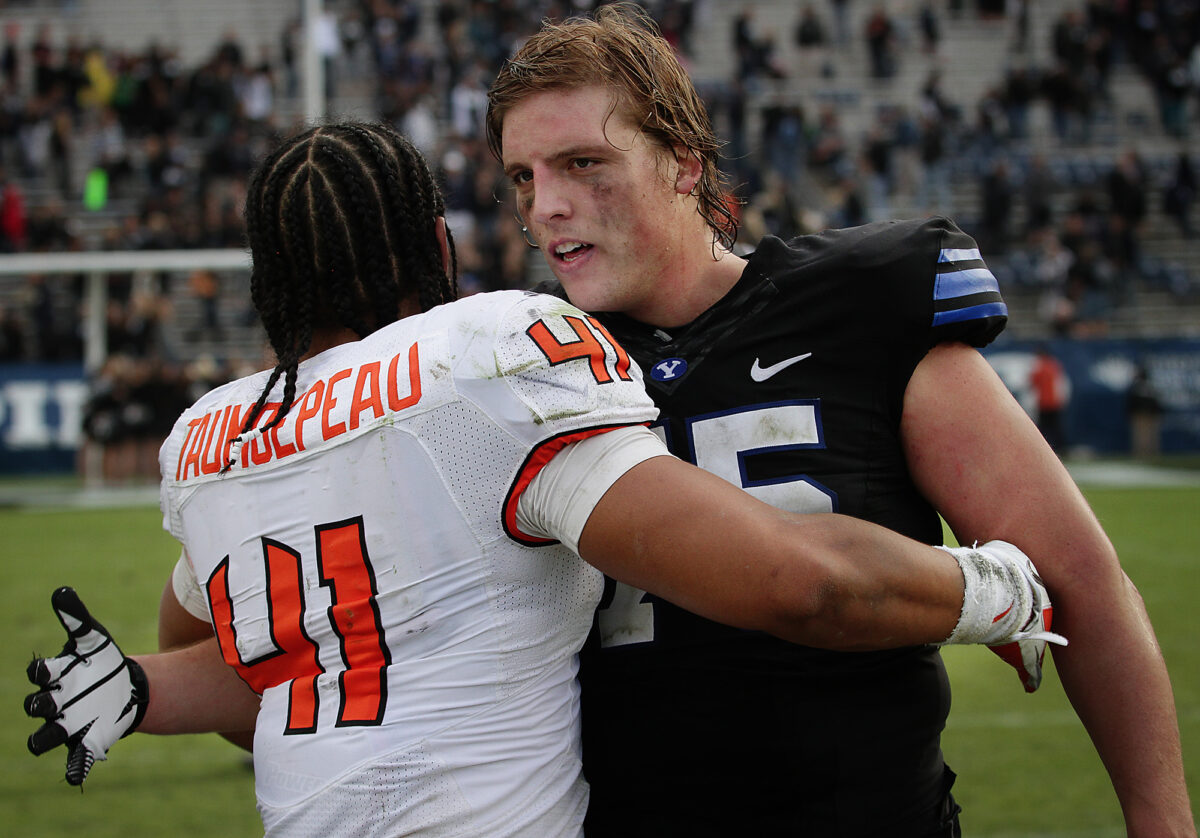
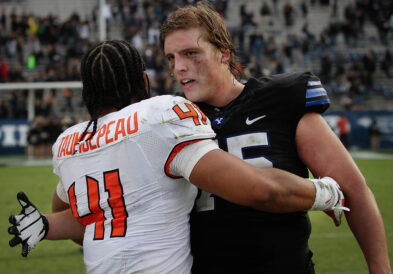
BYU offensive lineman Braden Brown and Oregon State linebacker Feti Taumoepeau exchange hugs after the game at LaVell Edwards Stadium on Saturday, October 13, 2012. JIM MCAULEY/Daily Herald



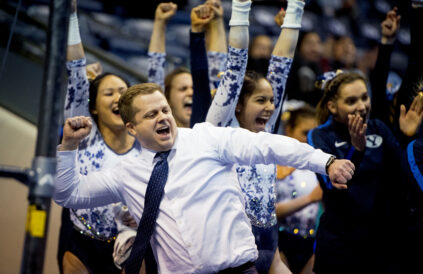
Brigham Young University head gymnastics coach Guard Young cheers after Abby Boden Stainton completed her uneven bars routine during BYU’s season-opening gymnastics meet against the University of Nebraska held Monday, Jan. 6, 2020, at the Marriott Center in Provo. Isaac Hale, Daily Herald

-
-
BYU offensive lineman Braden Brown and Oregon State linebacker Feti Taumoepeau exchange hugs after the game at LaVell Edwards Stadium on Saturday, October 13, 2012. JIM MCAULEY/Daily Herald
-

- Former BYU football player Braden Brown poses for a photo at the Ampelis Health clinic in Highland on Tuesday, July 25, 2023. Brown is now the vice president of coaching and counseling for Ampelis.
-

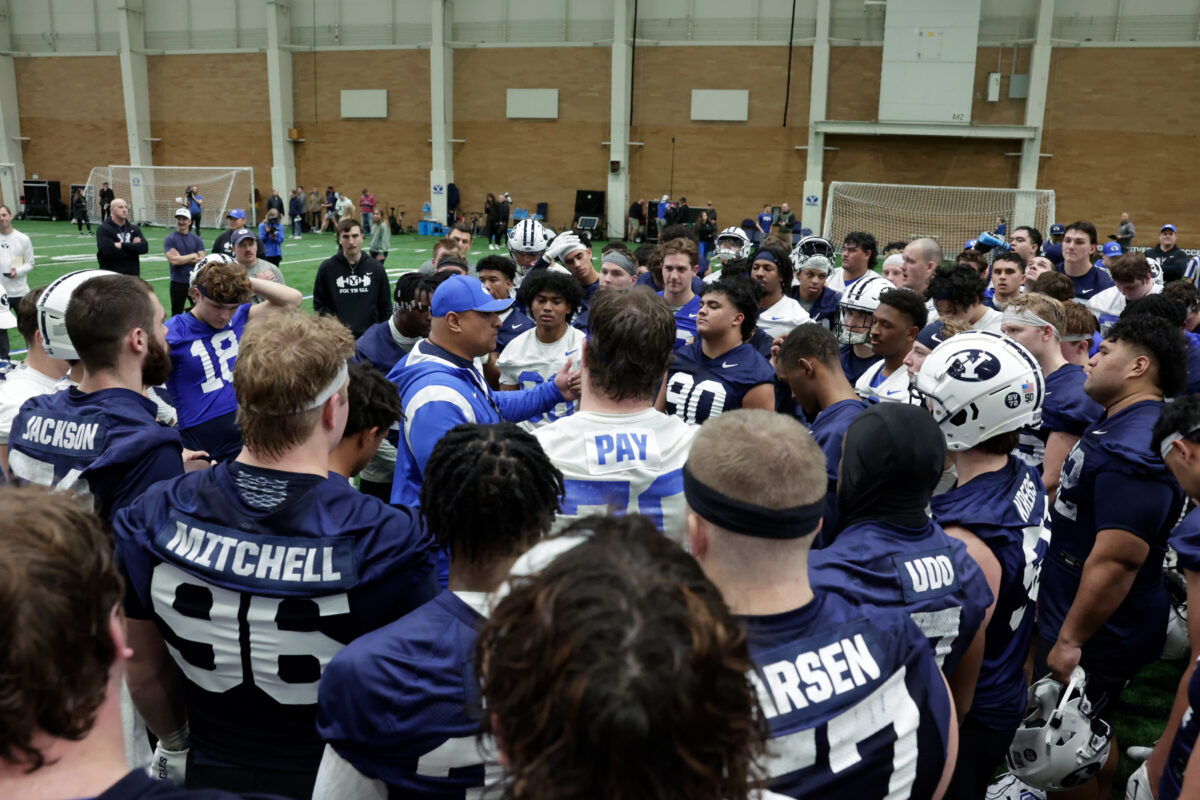
- BYU head coach Kalani Sitake talks to his team at the conclusion of the first day of 2023 spring camp at the indoor practice facility in Provo on Monday, March 6, 2023.
-

- 22-23wBKB WCC vs San Francisco 0601 22-23wBKB WCC vs San Francisco West Coast Conference Tournament in Las Vegas, Nevada. BYU: 66 USF: 56 March 4, 2023 Photography by Nate Edwards/BYU © BYU PHOTO 2020 All Rights Reserved photo@byu.edu (801)422-7322
-
-
Brigham Young University head gymnastics coach Guard Young cheers after Abby Boden Stainton completed her uneven bars routine during BYU’s season-opening gymnastics meet against the University of Nebraska held Monday, Jan. 6, 2020, at the Marriott Center in Provo. Isaac Hale, Daily Herald
-

- Former BYU football player Braden Brown poses for a photo at the Ampelis Health clinic in Highland on Tuesday, July 25, 2023. Brown is now the vice president of coaching and counseling for Ampelis.
Braden Brown has clear memories of his time as a BYU football player from 2008-12.
There was moving between tight end and offensive line, getting tossed into the lineup against Utah, and battling through the ups and downs of college football.
Looking back now with where his career has taken him, as he did during an interview on Tuesday, Brown said if he had the chance he would tell the young Cougar lineman who used to wear No. 75 to not be so hard on himself.
“Hindsight is 20/20 and you gain different wisdom and perspective as you get older,” Brown said. “But if I could go back and talk to myself as a player, I’d say, ‘dude, you’ve just got to relax. Enjoy the opportunity and don’t be so wound up about everything.’
“It’s such a small window of time where you become the best version of yourself and go out there and make memories with your brothers while you are bleeding, sweating and crying out on the field. I was always my biggest critic. I was so hard on myself. If I could go back now, I would ask myself, ‘how is that helping? Can we start working on things that would be more helpful?'”
Brown’s life has provided him with a different way of looking at things, something he is now getting the chance to share with other BYU athletes.
Learning and growing
When his football career ended, Brown started down a different road, getting a Master’s degree in marriage and family therapy from Utah State and then headed to Indiana to get his doctorate in medical family therapy. During his residency, his life took a turn back toward his days as an athlete.
“I was serving as a behavioral science faculty member at a family medicine residency,” Brown said. During that time, the program director was a sports medicine trained family medicine physician, so she was all about mental health and sports and working with athletes.”
He said led to an introduction to the athletic director at Indiana University-Purdue University Indianapolis (IUPUI), Roderick Perry, who wanted Brown to use his therapy background with the athletes. Brown ended up doing both his residency and becoming the director of mental performance and counseling services for IUPUI athletics.
“Any of the athletes from the 18 different male and female sport teams and the coaches who had any sort of mental health issues or mental performance-related issues would come see me,” Brown said. “That’s really when I fell in love with working specifically with athletes.”
He said he still enjoyed the impact he could have with other individuals or families, but this resonates with him more deeply.
“I just feel like because I was an athlete for so long and then my training as a mental health clinician, I feel like it was almost like it put me in a position to be well suited to be in that world,” Brown said.
Returning home
Brown worked for IUPUI from the summer of 2018 to December of 2022, leaving because another opportunity intrigued him.
“It started with Kurt Henderson, who was also a former BYU football player (2011-15),” Brown said. “I saw a social media post he made about working with athletes and I was like, wait, you work with athletes in a mental-health space? How did I not know this?”
Henderson told Brown about Ampelis Health, which is a mental health clinic that uses a wide range of methods to help individuals address obstacles and then discover deeper meaning and purpose in life.
“He went through the methodology and I couldn’t believe he wasn’t a trained mental health professional,” Brown said. “How he approached the work was exactly what I had been trained in for the past five years.”
While some of the terminology and perspectives differed, Brown liked what Ampelis was focusing on.
“Ampelis’s approach is that everyone’s pursuit for meaning is individual and lifelong,” Brown said. “It’s a combination of three different things: the development of self physically, mentally and emotionally; relationships with other people; and cultivating spirituality, being part of something bigger than one’s self. It’s kind of the intersection of those three things, the harmony and balance of those three things which leads to optimal meaning and optimal functioning as human beings.”
Brown signed on to join Ampelis and started in January as the vice president of coaching and counseling.
Almost immediately, that opened up the door for him to return to BYU.
Cougar connection
Brown credited others in the organization for laying the foundation and getting connections with teams like the Utah Jazz, which put Ampelis on the BYU radar.
“Once they were in the process of hiring me, we started having more conversations with Tom Holmoe and Brian Santiago,” Brown said. “They knew me and so we could talk about my background. There had been an expressed need for more mental health and mental performance services. We went through our methodology and it was something they had been looking for for some time. They were excited about it.”
It took six months for all the details to get worked out, but just last week BYU officially announced its partnership with Ampelis.
“We hope the relationship with Ampelis is a signal of what makes BYU Athletics unique,” Tom Holmoe, BYU director of athletics, said in the press release announcing the partnership. “It is possible to develop world-class student-athletes who are also equipped to lift our communities with knowledge, leadership skills, mental and emotional resilience, faith and moral character – that is our commitment at BYU and we are glad to come together with a partner who shares this important vision.”
One of the first people to get onboard, according to Brown, was Cougar head coach Kalani Sitake.
“He was like, we want to bring you into the fold with open arms,” Brown said. “Thank you for being here. Thank you for caring about our players enough to provide the service and please let us know what we can do. The message I get from Kalani consistently is that he cares about these guys. It’s like yeah, football is one thing, but I just want them to be healthy, fulfilled and the best versions of themselves that they can possibly be.”
Brown — who is already working with Cougar teams like gymnastics, women’s basketball and swimming as well as football — said getting the chance to be back working with BYU athletes is “a dream come true.”
“If I could have five years ago drawn up the dream job, it would be working with BYU athletics,” Brown said. “It would be helping out with all of the student athletes, but specifically my football team because that’s something that was just near and dear to my heart. It gave me a lot of opportunities. It really kind of started me off on this path of getting into the world of mental health and mental performance.”
Finding success through balance
Brown said that his goals now are to have his mental health and performance program become so valuable to the Cougar athletic department that they decide to continue it for many years to come.
“I want the players and staff to view us as a valuable and irreplaceable asset for their program,” Brown said. “That’s how we have talked about it. It’s not just about athletic performance because if it is, we’ve missed the boat. We want them to be stud athletes but we want them to be stud humans as well. I would argue that if you aren’t as healthy as you can be as a human being, you are not going to be perform as well as you can as an athlete.”
He said understanding the benefits and challenges of mental health is still evolving, but he believes there is progress.
“I do think that we’re getting better, just overall in terms of being accepting and embracing mental health as a real thing,” Brown said. “Most athletes realize that mental performance plays a huge role in being successful, in their ability to perform at a high level. Whether we want to do or not, it would behoove us to focus on this because it’s only going to allow us to perform better than we otherwise would.”
He also has dreams of seeing these ideas and approaches expand to help younger athletes deal with their own mental health challenges as well.
“Kyle Van Noy was here and we were talking about what we do as a company,” Brown said. “One of the things he said was that this needs to start in high school. We are looking at possibilities about how we might implement what we are doing in the high school space, trying to figure out how to expand our reach because this younger population is in desperate need.”
One final piece of advice for fans
While players and coaches appreciate the huge boost that fans provide, the reality is that some go too far. Things like athletes receiving death threats for poor play in a game sound absurd — but unfortunately it happens.
Brown still enjoys watching sports, but he has a different perspective as a trained mental health clinician. He recognizes that everyone — players, coaches, officials, fans, etc. — are dealing with their own things in their lives.
“We have this propensity to view athletes as super-human figures, like they are different from regular humans,” Brown said. “Yes, some of these athletes are getting paid to play a sport — but at the end of the day they are still a human with fears and hopes and insecurities and stresses and traumas just like you and I.”
He said part of him wishes people could listen to well-known athletes who are viewed as having it all figured out have serious, complex, mind-blowing that they have dealt with or are dealing with.
He just wants everyone to try to “re-humanize” athletes and see them for who they really are.
“Imagine having all your mistakes blasted for everyone to see,” Brown said. “It’s a lot of pressure.”