Let’s finish this: BYU offense still trying to figure out second half of games
BYU offense still trying to figure out second half of games
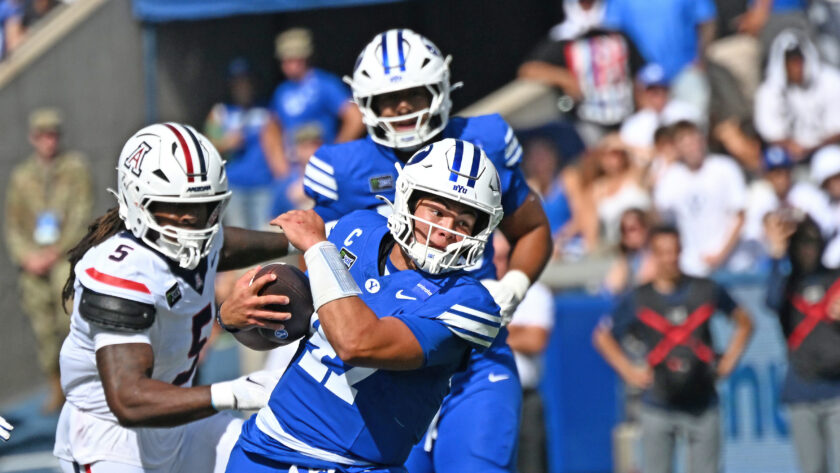
Harold Mitchell, Special to the Herald
BYU quarterback Bear Bachmeier carries the ball against Arizona in a college football game at LaVell Edwards Stadium on Saturday, Sept. 12, 2026.Among the many platitudes coming out of the mouths of college football coaches, one of their favorites is, “We want to play our best for a full 60 minutes.”
That kind of perfection is impossible to achieve, but that doesn’t stop teams from trying.
Breaking down the numbers of the BYU offense in 2026 shows just how difficult it is to maintain a high level of production for a full game. Through ten games the Cougars are averaging 17.7 points in the first half, 20th in the country.
The second half is a much grimmer story. BYU is scoring just 8.7 points in that stanza, which ranked 124th in the country.
The reasons behind the drop off are many. Some are fixable, others are likely baked into the results.
1. The overall approach by head coach Kalani Sitake
Sitake has stated repeatedly that he doesn’t worry about style points. He knows they exist. He simply feels that his job is hard enough without worrying about things he can’t control, like the whims of the CFP committee that seems to be easily distracted by the shiny lights of the SEC and the Big Ten or running up the score on hapless opponents. Sitake is also very invested in reaching into the team’s depth and getting younger players playing time when the opportunity presents itself.
In reality, it’s a very NFL-like approach. In that league, it doesn’t matter whether you win by three or 33, a victory is a victory. College football is graded differently, but Sitake seems content to focus on winning and lets the other chips fall where they may.
BYU is 31-6 over the past three seasons, so the strategy works pretty well.
2. The loss of running back LJ Martin
Martin is incredibly essential to the success of the BYU offense and his absence created a huge vacuum in the running game. He missed four games and has been limited in the two games since his return. The Cougars simply don’t have anyone in the running back room with his combination of skill, power, versatility and experience. Martin’s absence put a lot more pressure on sophomore quarterback Bear Bachmeier, which resulted in more mistakes than anticipated. Martin appears to be healthy for the stretch run of the season, which should help with the consistency of the offense.
3. The play-calling style of offensive coordinator Aaron Roderick
All offensive coordinators walk the line between brilliance and ineptitude, and Roderick has largely been very successful as a play caller. He’s coached some great quarterbacks and has produced plenty of yards and points against quality opponents. It’s easy to pick nits when the offense struggles, and Roderick is more than willing to take the blame. The players also have to shoulder responsibility for mistakes in execution. Sometimes the perfect play call results in a negative play because someone misses a block or commits a penalty.
The other part of Roderick’s play-calling style goes hand-in-hand with Sitake’s approach. Once the Cougars get up a couple of scores in the second half, Roderick sees the goal (winning) in sight and begins to play the clock game: What plays can he call to get that clock to zero the fastest? Again, winning is the No. 1 goal and it’s hard to do consistently at the collegiate level. Fans want him to be bolder and take more chances, but he knows his job and the success of the program depend on getting W’s.
4. The adjustments by opponent’s coaching staffs
BYU fans or fans of any college football program, for that matter – see things from the prism of their own fandom. It’s always about what their team did or didn’t do. That approach fails to acknowledge the other guys. This is big-time college football and other teams have great coaches. Those coaches prepare their players and make adjustments during the game. Sometimes their players and adjustments work better. That’s just football. BYU doesn’t play in the Western Athletic Conference or the Mountain West Conference, where it had institutional and financial advantages over the opponents. Every team BYU plays in the Big 12 has great resources and good coaches. The margin between defeat and victory can be razor thin.
5. Finally, the funny bounces taken by footballs
A football is an odd shape and takes the strangest of bounces. The last time BYU played Kansas was in Provo in 2024, when a quick kick somehow found the back of a Cougar defensive player for a critical turnover. Every game has breaks that sometimes go against you and sometimes go in your favor. As hard as it is for fans, those breaks are sometimes beyond the control of the good guys.
The Cougars (8-2) are No. 10 in the latest CFP rankings and need to win their final two games of the season, starting with Saturday’s contest at Kansas, to give themselves the best chance to make the playoffs.
Bachmeier is a man of few words during interviews lately, but he did have this to say about the success of the Cougars’ offense: “I think just playing our brand of football. It’s physical, it’s ferocious in the run game and then dynamic in the pass game as well.”
Easy, right?