PREECE: Wrestling should look at expanding 5A/6A state brackets
Jared Lloyd, Daily Herald
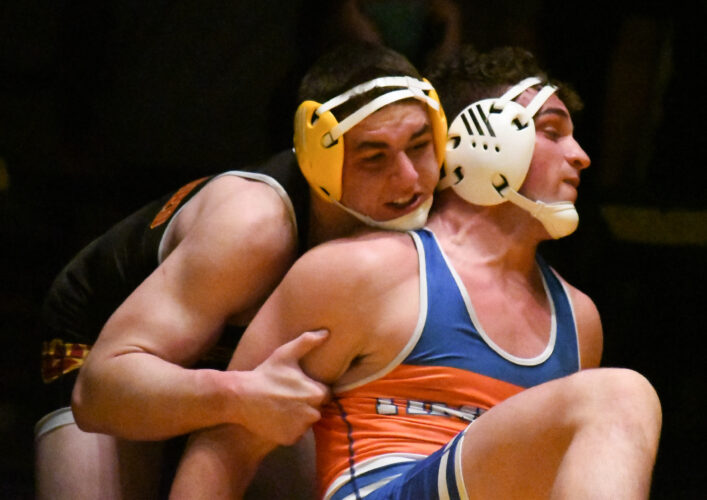
Mountain View wrestler Elijah Stafford (left) battles Timpview wrestler Cael Richardson during the finals of the 220-pound weight class during the 5A state boys wrestling tournament at Wasatch High School in Heber on Thursday, Feb. 18, 2021.
As another prep wrestling season comes to a close, there are many great teams and individual wrestlers, especially in Utah County.
But perhaps the health of the sport overall could be better.
In 5A boys wrestling, there will be three schools that won’t have any wrestlers at the state tournament including Provo High School. This many schools not having any representation hasn’t happened in 50-plus years. There will also be one 6A program not competing at the state tournament.
There have been some tectonic changes in prep athletics in recent years including expanding the playoffs in team sports and using the RPI for seeding.
In the most recent Utah High School Activities Association (UHSAA) realignment, 33 schools found themselves in 5A while only 13 schools compete in the 4A classification.
However, the size of the state tournament in regards to qualifiers was not expanded at all in wrestling. So qualifying for state in 5A and 6A has become significantly more difficult than really anytime in the sports history.
Since each team can bring two wrestlers in each weight class to divisional qualifying tournaments, this is what the data has shown with stark differences between the percentage of wrestlers that go to the state tournament in 5A and 6A versus the other classifications.
In 5A, 33 schools and 587 wrestlers competed for 224 spots allotted at the state tournament in 16-wrestler brackets. This means 61.8% of all wrestlers didn’t qualify for the state tournament. The 6A saw similar numbers with 26 schools and 554 wrestlers leading to 59.6% of wrestlers being eliminated.
Certainly, there are arguments to “thin the herd” so to speak in regards to athletes and teams going to state, though the UHSAA has gone the other direction generally in recent years. But the difference between the classifications in wrestling is quite absurd.
For example, the 2A state tournament has 16-wrestler brackets despite the fact that there are only 12 wrestling schools and 220 wrestlers competing at divisionals. This means that zero wrestlers were eliminated at the divisional and the 2A classification couldn’t even fill up its allotted spots with competitors.
At the 1A level where they use 8-wrestler brackets, 11.8% of wrestlers didn’t make the cut. The 3A with 20 schools and 4A with 13 schools eliminated 35.4 and 27.5% of their grapplers respectively.
Now if the 5A and 6A expanded to 32-wrestler brackets, the percentage of wrestlers eliminated would be 23.6 and 19.1 percent respectively, more in line with the 3A and 4A but still significantly greater than the 1A and 2A classifications.
As mentioned earlier, three 5A schools will have zero wrestlers at the state tournament. But beyond that Timpview has one lone qualifier and 10 of 33 schools have three or fewer qualifiers.
There is indeed a wealth gap in wrestling as Payson leads the 5A pack with 22 qualifiers while Uintah is next with 19. In 6A Layton will battle with 21 while Westlake and Pleasant Grove have 18 and 17 respectively.
Certainly these programs would have more representation with expansion, but the schools on the lower end of things would also have more representation — or just any representation at all.
For some, there is value in exposing wrestlers to the big tournament, even if they go 0-2 or 1-2.
The programs struggling in numbers are generally in Salt Lake County and lesser affluent schools. For example, the Salt Lake School District schools — East, Highland and West — only qualified eight total wrestlers for the state tournament and East had zero. Things aren’t that much better in the Granite District either.
I have been in some interesting discussions and the idea of expanding the state tournament has mixed support.
Yes, expanding the state tournament could help these programs have more grapplers competing at state — but it’s not going to solve the deeper issues many of these programs face.
One of these issues is the lack of quality youth and junior high programs. For example, the Provo School District doesn’t offer junior high/middle school wrestling while Alpine and Nebo districts have highly competitive programs with school-sponsored teams and coaches often as faculty members. Models must be changed, or these programs will continue to struggle.
Wrestling generally mirrors what is happening in Utah with other sports in the urban setting. The affluent schools are racking up the trophies while the lesser affluent schools struggle. Some are troubled by this, others accept it as the way it is.
The good news is that when I put my ideas for expansion out there on Facebook, it did create a discussion that led to other tangible ideas such as doing wrestling clinics and camps in areas where wrestling is struggling and making stronger efforts to target minority students to the sport as many schools wrestle (pardon the pun) with rapidly changing demographics.
There are also some suggestions, which could be applied for all sports, that at least with the larger urban schools there could be some sort of relegation system in place and classifications being created by how well the program competes over a certain time versus just using enrollment numbers.
As programs improve, they could move up to the higher level classification. If they struggle, they would be relegated to the lower classification.
Wrestling does present some challenges with that because often struggling programs have one or two elite wrestlers. For example, West’s Drew Lang right now is considered one of the best pound-for-pound wrestlers in the state. Programs like East and Provo have produced state champions in recent years.
Another idea is to change the scoring system in the 4A-6A classifications to what they do in the 1A-3A classifications where schools are allowed to bring two wrestlers to divisionals to qualify for state, but only one wrestler per weight class would score points.
An advocate for this concept is one coach who you might not think would favor such a system because his program, Payson, qualified 22 wrestlers and obviously benefits from the current system.
“I think it might be time to look at just scoring one wrestler at the state meet,” Lion head coach Jeb Clark said. “I still want to be able to qualify two wrestlers but maybe just one should score. Right now, if you’re a struggling program you have to really try to have 28 wrestlers. But if you change the scoring system, building a program with 14 good wrestlers seems a lot more doable. And maybe if you get five or six really good wrestlers you can be competitive.”
“I know it’s not maybe in the best interest for my program but sometimes you have to see the bigger picture and do what is best to grow the sport.”
While a larger percentage of 5A and 6A wrestlers are eliminated at the divisional tournaments, there is some solace in the fact that USA Wrestling Utah a few years back created the “JV State Tournament”. This often gives those wrestlers that didn’t qualify for state, or were third- or fourth-stringers in their weights and didn’t even go to divisionals, one last chance to compete.
The tournament has been successful as this year it attracted 606 wrestlers representing 57 different programs.
As for girls wrestling, 607 total wrestlers will take to the mats this weekend in four classification tournaments (6A, 5A, 4A, 1A-3A). While girls wrestling is growing at a rapid rate, the sport might be better served with a reduction in classifications. 4A has the least amount of grapplers with 112 while the 6A has the most with 198.
One idea might be combining the 6A with the 4A and putting the 1A-3A (135 wrestlers) with the 5A again (162). Each classification would now have close to 300 competitors. Yes, some weights will have more than 16 wrestlers but at this stage maybe an all-comers state tournament similar to last year still might be in order until the numbers are a bit higher. Certainly, reducing the number of classifications will make the tournaments more competitively compelling.
Westlake girls head coach Cody Burdett has these thoughts and combining classifications doesn’t seem to be in the cards in his view..
“Looking at the numbers, we could easily combine 1A through 4A and maybe combine 5A and 6A (in girls wrestling). But it’s a systematic issue at the UHSAA level,” related Burdett. “Many other sports have the same issues. When a classification like 4A only has 13 schools total, it’s kind of a joke. The UHSAA will never reduce and combine classifications. They are working to have six classifications in all sports.”
The expansion of the field of wrestlers both boys and girls would have one benefit for the UHSAA, more parents, other relatives and boyfriends/girlfriends in the stands, and therefore more revenue.
Coming out of COVID-19, there are some interesting trends in Utah prep wrestling.
Girls wrestling is exploding in numbers, though many programs still have single digits in numbers and many schools still don’t have any female competitors at all.
Meanwhile, on the boys front, participation is a bit down and the wealth gap between the top programs and the struggling programs has never been greater.
The ultimate question is whether this is the way it is and not much can really be done, or whether a many pronged approach involving individual wrestling coaches, administrators in school districts, USA Wrestling Utah, along with the UHSAA thinking outside the box, can enhance the growth of the sport.