Pleasant Grove business assembles Gryposaurus for Utah museum
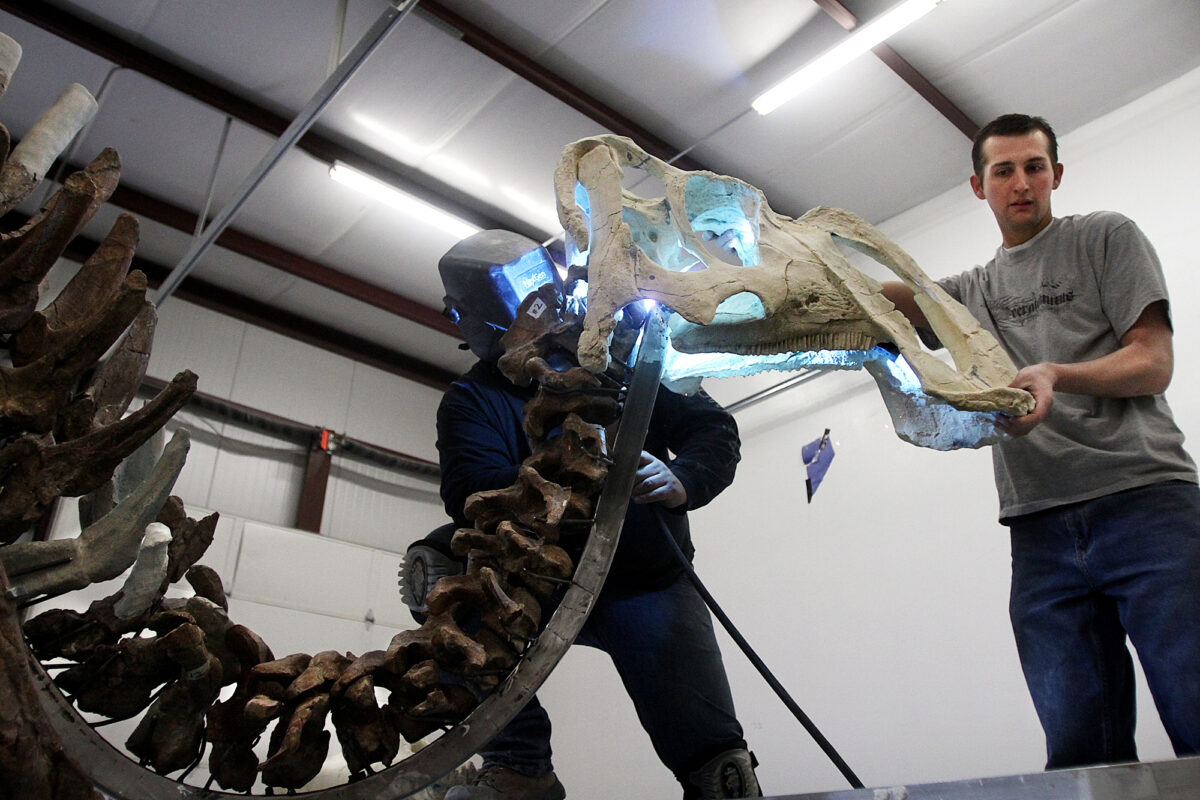
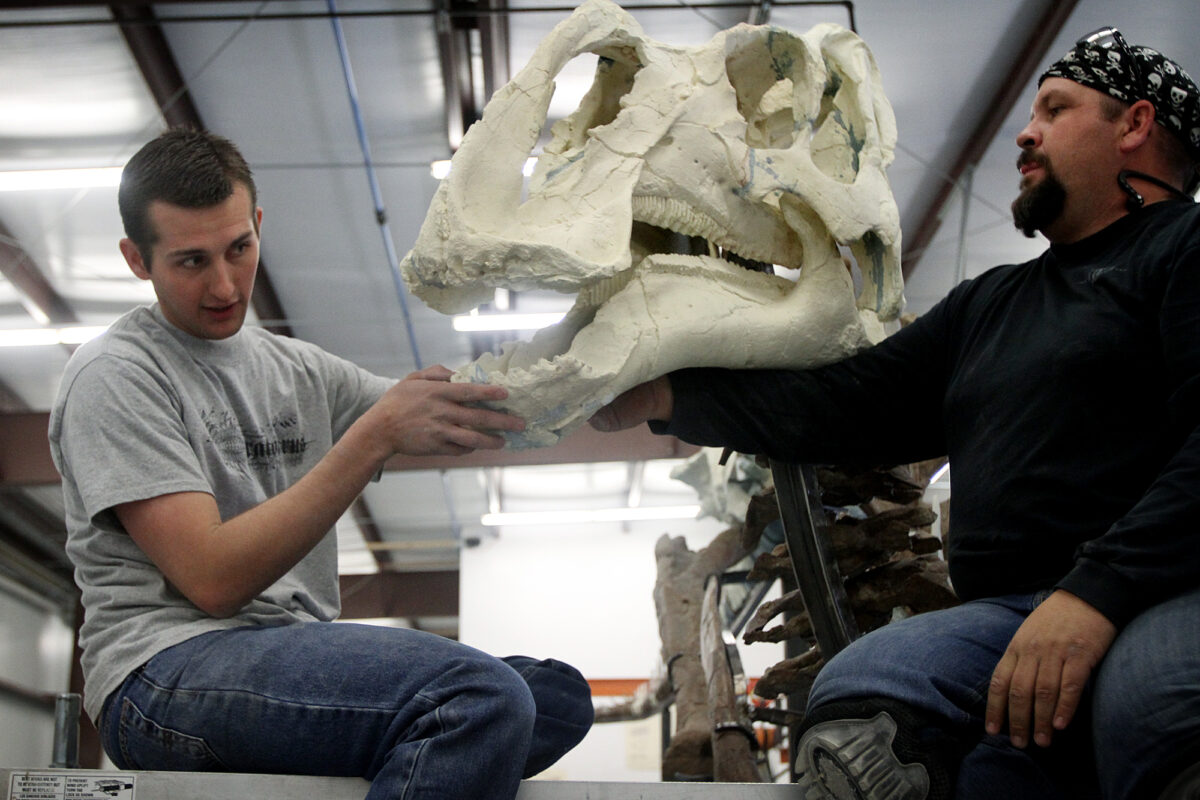
PLEASANT GROVE — Vertebrata Reproductions owner Brock Sisson got to place the last pieces of the Gryposaurus — the skull, jaw and arms — to its previously assembled mount on Wednesday morning for the Utah Museum of Natural History.
“It’s great to see the original bones on display,” said museum paleontologist Eric Lund. “At first we thought we only had the legs.”
The Gryposaurus will be the only mount of real fossilized bones and the second-largest dinosaur displayed at the state’s designated natural history museum. A floating walkway will allow visitors to take in the size of the ancient creature.
“People will actually be able to get up in its face,” Lund said.
Donations from Grand Staircase-Escalante National Monument, where the Gryposaurus was found, and grants made funding possible for the Gryposaurus project.
Vertebrata Reproductions is building custom mounts and brackets for several dinosaur skeletons — 12 to 16 — for the Past Worlds Gallery in the new state museum building, the Rio Tinto Center, which opens this fall on the University of Utah campus in Salt Lake City. The company is located in a Pleasant Grove workshop hidden from the eyes of curious dinosaur buffs.
“One of the more challenging parts is getting the anatomy right,” Sisson said. “I think we’re doing pretty good with this one.”
The few missing bones for the Gryposaurus were replicated with resin by Vertebrata workers to complete the piece. Every part of the mount is removable.
With the help of his cousin, Brannigan Hunter, Sisson stood on scaffolding to reach the neck vertebrae that were nearly 12 feet above the floor, and held the skull in place while Hunter welded the metal socket to lock the piece to the rest of the fossilized skeleton.
The company assembles fossil parts and recreates bones with resin of ancient creatures for public entities such as the American Museum of Natural History, Natural History Museum of Los Angeles County and the Cleveland-Lloyd Dinosaur Quarry.
“I love dinosaurs,” Sisson said. “This is my dream job. It’s every little boy’s dream job, isn’t it?”
Putting the last few pieces together for the Gryposaurus, a duck-billed dinosaur, took just under an hour but represented the completion of more than three years of labor on the project.
The fossilized bones were discovered in 2007 by a volunteer, Scott Richardson, at the Kaiparowits Formation in Grand Staircase-Escalante National Monument.
The following year, a team of museum volunteers began excavating the pieces. Lund said the bones were 75 million years old. Embedded in very hard sandstone, the bones were scattered and excavation was a challenge.
“It’s like playing pick up sticks,” Lund said.
Sisson and his coworkers began assembling the bones five months ago in his shop. There were about 200 pieces, he said, most real fossilized bones. This particular Gryposaurus was a fairly large dinosaur for its type with a skeleton that measured 30 feet long.
Hunter has been working for five weeks to weld the brackets, support frame and sockets together for the project.
Dressed in a Harley-Davidson T-shirt and sporting a bandana, Hunter usually works with heavy equipment but said he didn’t mind taking a break from his job for Vertebrata Reproductions.
“Oh, yeah, I love this stuff,” said Hunter and grinned. “There are 62 bones just in the tail, and then they made five more.”
He shares an excitement that is exhibited by museum volunteers. Sharon Walkington has devoted at least eight hours a week to the Utah Natural History Museum.
“I love treasure hunts, I like jigsaw puzzles,” she said. “It’s like a puzzle without the picture to work from.”
Lund said most of the staff at the museum are volunteers. A volunteer discovered the Gryposaurus bones, and volunteers helped excavate the site. Volunteers also worked at the museum facility to clean and prepare the fossils.
“You either can’t stand the dirt and after training don’t do anything more, or you get addicted and do it as long as you can,” Walkington said.
When it comes time to move Gryposaurus, the bones will be taken off the metal framework and wrapped carefully to prevent breakage. The frame will be disassembled and then all will be reassembled at the museum with the frame bolted to the concrete floor.