Blind Lindon woman partners with UDOT to advocate for safer crosswalks

-

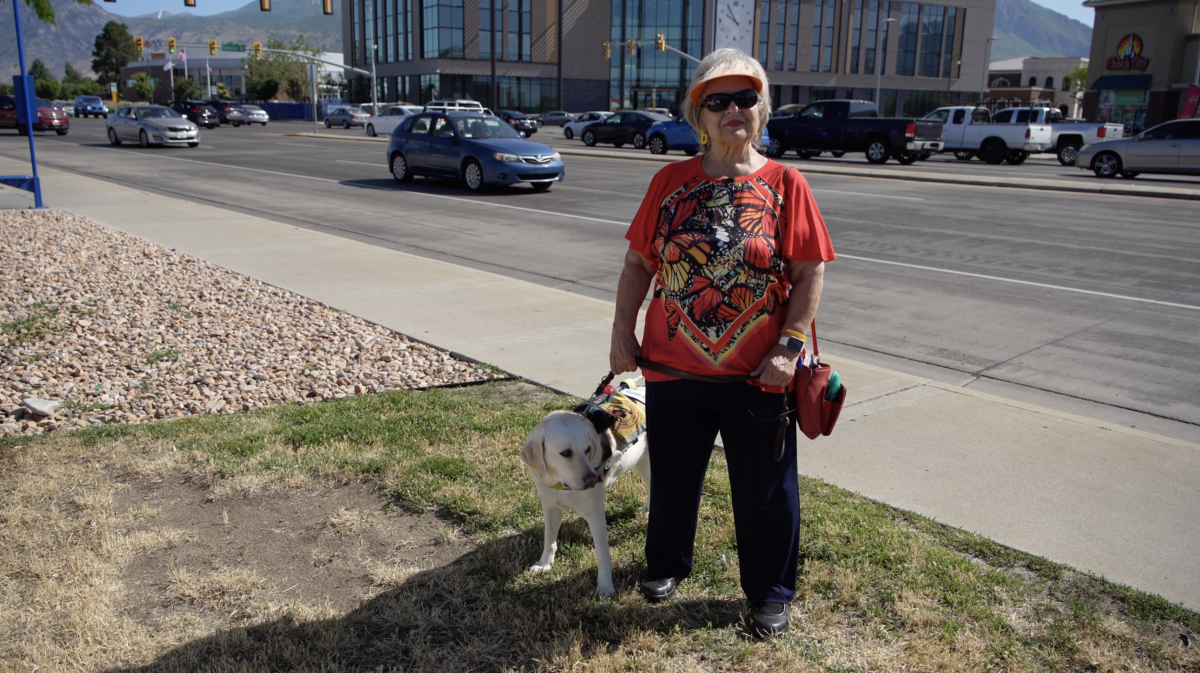
- Linda Disney and her dog Brooke are shown in this undated photo using accessible pedestrian system technology to cross an Orem intersection.
-
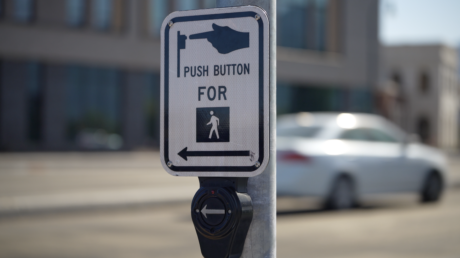
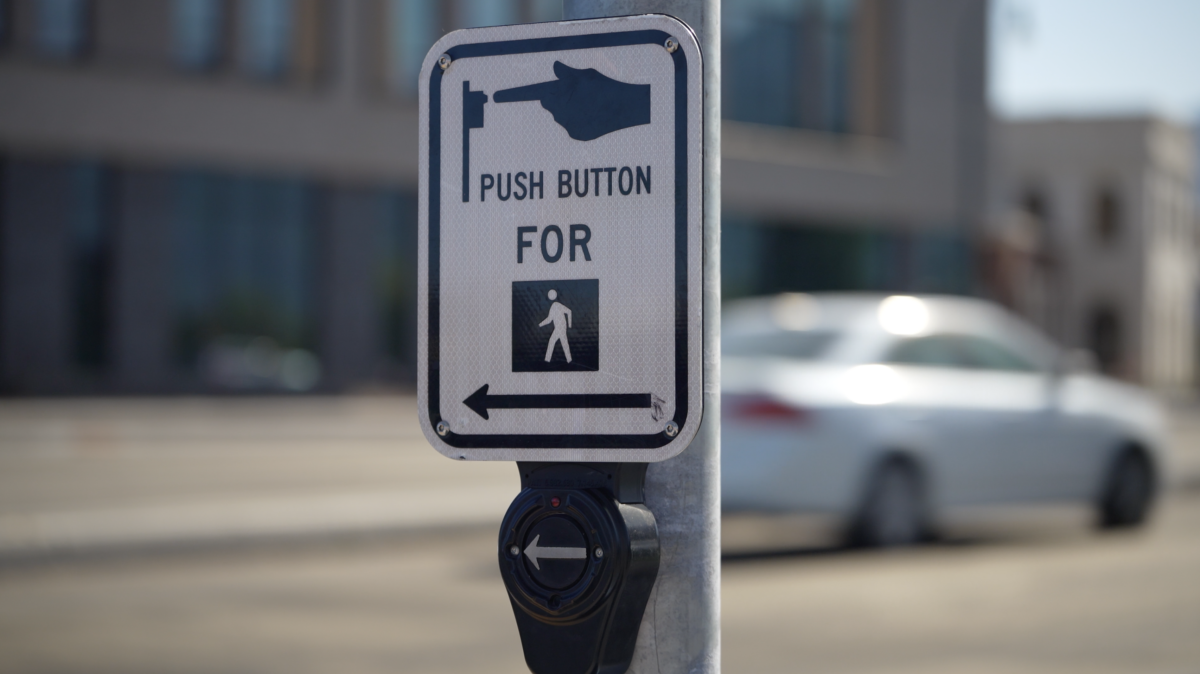
- A push button used to trigger the accessible pedestrian system at an Orem intersection is shown in an undated photo.
-
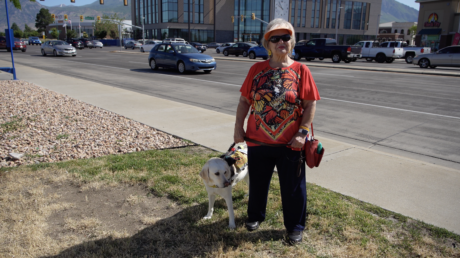
- Linda Disney and her dog Brooke are shown in an undated photo.
Linda Disney said she has dealt with being visually impaired her entire life.
Disney, of Lindon, was born with retinopathy of prematurity, an eye disease that impacts prematurely born babies — which she said left her blind in the right eye.
Disney said the decline in her vision prompted her to discontinue driving in 2015 after moving to Utah
In 2017, Disney enrolled in a nine-month program through the Utah Division of Services for the Blind and Visually Impaired. The program offers resources and assistance to help people cope with the challenges that being blind presents.
“It was the hardest thing that I’ve ever done,” she said.
Disney graduated from the program in June 2018, but less than a year later, she completely lost all of her vision when the retina of her left eye detached.
Instead of letting the setback defeat her, she became a member of the Utah Council of the Blind and started advocating for herself and others within her community who suffer with a vision disability.
That advocacy led to Disney contacting the Utah Department of Transportation each time she encountered a broken audio-enabled crosswalk button along her walking routes across Utah County.
One problem area she noted was a crosswalk at Center Street and State Street in Orem.
Degen Lewis, a traffic signal engineer for UDOT Region 3, said they began heavily installing accessible pedestrian signals, or APS technology, in 2023. He said his office specifically chose to prioritize implementing the technology at intersections in areas that Disney frequents along her walking routes.
APS technology includes audio cues like “wait” and “walk sign is on” and can be triggered by pressing a button or using a Bluetooth-enabled app to assist blind or hearing-impaired pedestrians.
The audio instructions are loud enough for pedestrians to hear, even over loud traffic.
Lewis said audio buttons that can speak to people at crosswalks have been around for many years, but in areas where the older models were not not working properly, it’s helpful to have people like Disney who contact them to address issues with traffic signals.
“Linda is an incredibly brave person,” he said, “I want to find ways to make it possible for everyone to get to where they need to go as quickly as possible and with as much optionality in their life.”
Despite her disability, Disney remains mobile by utilizing public transportation. She also relies on her trained guide dog, Brooke, who can guide her toward crosswalk buttons.
“We’re not just about moving cars,” Lewis said. “We’re about moving everybody in the community and getting them where they need to go.”
Disney said having access to technology that can translate visual pedestrian information to other sensory formats helps her safely navigate her community and other routes she may travel.
“They make a big difference, because they specifically let me know when I’m standing in front of the crosswalk (and) when I’m supposed to cross,” she explained.
It also offers Disney and those with similar disabilities a sense of independence.
“It’s just empowering.” Disney said. “It gives them more confidence, because as you come up to these road blocks – per se – it really does crush your confidence, because the scare factor sometimes comes in, even though you try to control it.”
Disney said the signals help her be comfortable traveling with her dog across Utah Valley and points northward into Weber County.
While Disney knows it’s her responsibility to monitor traffic to the best of her ability, she also urges drivers to be more attentive at crosswalks.
“When you’re coming across a crosswalk, assume there’s somebody in it,” she said. “Pay attention, even if the light says to turn, pay attention. You could save a life.”
UDOT says citizens can use an online map to see where existing and planned APS buttons are located, and they can help UDOT prioritize intersections where the device could be beneficial by submitting an online form.
UDOT plans to add APS technology at every signalized intersection on state routes by 2033.