Signature gatherers to challenge delegate-backed candidates in Utah County June primary
Jacob Nielson, Daily Herald
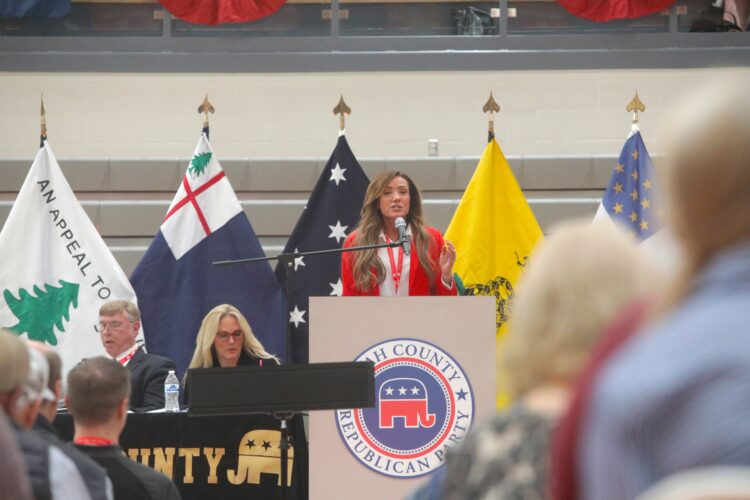
Michelle Kaufusi speaks at the Utah County Republican Party Convention Saturday, April 18, 2026, in Lehi.Saturday’s Utah County Republican Party Convention showed continued support for the convention system, but the alignment between delegates and the overall party will be measured in the June primary.
The convention at Skyridge High School in Lehi had 1,322 delegates with a 92% attendance rate — which party chair Cristy Henshaw said is a record. The party also had record numbers at the Meet the Candidates event and between 600 and 700 people at the debates, according to Henshaw.
Preserving the convention system and the decision not to pursue signature gathering was a talking point of many candidates throughout the day.
Past results, though, show there can be a divergence between who the delegates nominate and who registered Republicans vote for during the primary. The most notable instance was in 2024 at the state convention, where Phil Lyman was nominated as governor with 67.5% of the vote in the final round of voting, but Spencer Cox took 54% of the primary vote after qualifying on the ballot through signature gathering.
Recent county races have had more alignment. In the last three county commission elections, each of the three winners, Amelia Powers Gardner, Brandon Gordon and Skyler Beltran, were nominated at the convention.
However, in each of those races, no candidates who failed to qualify through the convention made the ballot. That changed this year, with former Provo Mayor Michelle Kaufusi and former Provo Deputy Mayor Isaac Paxman reaching the ballot through petitioning for commission Seat A and Seat B, respectively.
Brent Bowles defeated Kaufusi with 65% of the final vote to be nominated in Seat A, and David Spencer (52% of final vote) and Carolina Herrin (47.95% of final vote) were each nominated in Seat B.
“It’s no secret that when we have signature gatherers, that they end up in a primary that bypasses our system,” Henshaw said. “Now, ours also participated in the system, which we appreciate. They didn’t just go signature only, and we’re grateful that they went through the system.
“At this point, we support the nominees that the delegates have chosen, and so that will put them in a primary with some signature gatherers. But we’re here for it, and our delegates are ready for it, and so hopefully we can get behind our nominee and back them, regardless of the signature gatherers that will end up on the ballot.”
The Seat A primary race pits two candidates with contrasting political backgrounds. Kaufusi is a household name in the local political scene — a former two-term mayor of Provo who also chaired multiple regional committees. Brent Bowles, a former firefighter and practicing nurse anesthetist from Springville, has never held public office.
Bowles’ limited political background was no issue for many of the delegates who seemed to resonate with his staunchly fiscal conservative platform, which he said involves lowering commissioners’ salaries, trimming the budget and making Utah County “the lowest taxing county.”
Kaufusi’s priorities are small and efficient government, public safety and transportation solutions, according to her campaign website. She told delegates Saturday she was committed to serving them at the “highest level possible.”
“I think that is a testament to what the caucus convention system does,” Henshaw said regarding Bowles’ nomination. “It allows somebody who may not have a big political history to enter into the process with good ideas and a willingness to serve their community, go through the process with the delegates and be vetted and still be able to have an opportunity to serve in that capacity. So what does it mean for the public? I think it’s hopeful.”
In Seat B, Spencer, Herrin and Paxman each have public service experience. Spencer served on Orem’s City Council, while Herrin is a former law enforcement officer who currently serves as legislative affairs director for the Utah Department of Corrections. She also served as vice chair for the Utah County Republican Party. Paxman worked for the Utah Attorney General’s Office and was Provo’s deputy mayor.
Another county race left undecided after the convention is for county clerk. Incumbent Aaron Davidson received 58.63% of the vote over challenger Corey Astill (41.36%), short of the 60% threshold needed to win the party convention nomination outright. Astill, who met the 40% mark to also earn the party’s nomination, also qualified through signature gathering.
Davidson has received criticism for actions during his current term, most notably during the 2024 election cycle, when he said he keeps track of how public officials vote, telling the Deseret News that Utah Sen. Mike McKell did not put a stamp on his ballot.
In speeches to delegates, Davidson and Astill spoke directly of each other.
“My opponent has frequently criticized my involvement in the legislative process, saying the clerk should stay in his office and simply do the job, dotting his Is and crossing his Ts. Now is not the time for a clerk to sit behind the desk. Now is the time to take action, to engage and to fight the fire,” Davidson said.
Said Astill: “Over many years of coaching youth sports I’ve learned, if you don’t get the fundamentals right, the game is going to fall apart, and that’s exactly what this clerk’s office has fallen apart over the last four years. We can do better.”