Facing tough decisions: Provo City School District weighs school closures as enrollment declines
Jacob Nielson, Daily Herald
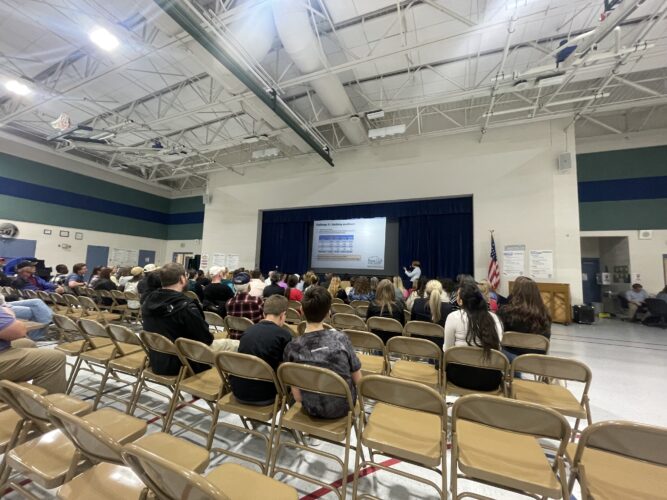
Community members attend a meeting at Spring Creek Elementary Wednesday, April 22, 2026. in Provo.Student enrollment figures are dropping across the state, including in parts of Utah Valley, forcing school districts to make difficult decisions.
The state had a decrease of 11,478 students in the 2025-26 school year from the previous year, according to Utah Policy. Provo City School District Superintendent Wendy Dau said the district is projected to drop from 13,500-plus students when she started her position in 2023 to a projected 12,700 students next school year.
Dau addressed these concerns Wednesday evening at a community meeting at Spring Creek Elementary in front of community members concerned about school closure possibilities.
She said the Provo City School District is losing students due to declining birthrates and high costs of living. These decreases have a direct impact on school district finances because they receive funding from the state on a per-pupil basis.
“Each student for this next school year will be generating $4,870,” Dau said. “And when we look at that, our starting budget as a district will already be $1.4 million less than what it is this year.”
In light of these enrollment and budget losses, school districts are searching for solutions. School boards for Nebo, Timpanogos and Provo City districts have each discussed the prospect of closing schools.
Alpine School District already closed elementary schools in recent years, including Sharon in Orem and Valley View in Pleasant Grove. Cedar Valley Elementary in Cedar Fort will close this year.
“This is the start of a conversation that is going to take a lot of time and thought, not only as a board, but as a whole community,” Provo City School District Board President Jennifer Partridge said in a March 27 board meeting. “We recognize that there are going to be a lot of emotions and a lot of feelings.
“There are communities. Each school has its own culture and identity, and just talking about adjusting any boundaries and even possibly closing schools — that hits everybody.”
The dilemma
The Provo City School District has 13 elementary schools that serve approximately 6,400 students. These schools’ enrollments range from 294 students (Franklin) to 660 students (Lakeview). Nine schools are currently below 80% capacity.
In a presentation to the school board on March 27, Dau said funding a smaller school costs more money than funding a larger school due to “inefficiencies” created.
Though smaller schools have less teachers, they pay the same salaries to administrators and support staff, yet have few students to finance those costs. A district module estimated that a school of 360 students costs at least $6,700 per student to operate per year, while a school of 525 students costs at least $5,700 per student.
Dau added at Wednesday’s meeting that paying more per student means less money for additional staff, such as a music teacher or intervention aides.
“If they’re at a smaller elementary school, it shouldn’t be that their educational opportunities are less,” she said. “So what do we need to do to make sure that we are providing those for our students?”
Some budget-reducing proposals include reducing personnel and reevaluating the existing dual-language immersion programs, which require more staff. The district is also considering raising property taxes this year to pay for teacher salaries.
Another idea to keep each school open is to reconfigure the boundaries to give each school the same projected 469 student enrollment, according to Dau. The issue, however, is open enrollment. Dau said there are currently 900 students within the district that do not attend their boundary school.
“A parent can take their child to any school that they want to,” she said. “As long as that school is not at 90% capacity, they can move that student to that school, and we can still end up with an issue of a school being small because people are choosing to go elsewhere.”
At the March 27 board meeting, Dau said the district’s most efficient enrollment figures would be 650 students at each dual-language immersion program and 600 students for non-DLI programs. Reaching that would require closing three schools.
Devyn Daylery, the district’s business administrator, offered a handful of proposals to the board that involved closing two schools. Amelia Earhart, Spring Creek and Franklin elementary schools, which are each below 60% capacity, were mentioned, along with Canyon Crest, which is at 74% capacity.
“Remember, these are just concepts,” Daylery said.
Community responds
District leaders spent Wednesday evening in the Spring Creek Elementary gym explaining enrollment issues and hearing public feedback. Dozens of community members took to the mic to express their concern over the prospect of Spring Creek closing.
A common sentiment from those who spoke was the value of the community should not be overlooked by decision makers. Teachers and parents alike spoke on the successes Spring Creek has had in developing student growth.
Matthew Rayback, a father of five children who attend or attended Spring Creek Elementary, said community is not an “interchangeable idea,” and that the surrounding neighborhood is tied to the school.
“This is true for every school across Provo,” he said. “You’re going to have the same conversation with all of them. I suspect all of them are going to bring these same points to bear. So my plea, or my encouragement here is for you to really pressure test those other ideas and make sure absolutely that they will not work before you even start down this path.”
Others said the district should look at other schools, with some citing future developments in south Provo that could increase Spring Creek’s enrollment.
Jeff Whitlock, a Provo city councilmember who lives in the neighborhood, suggested the city and district have tighter collaboration on growth projections tied to housing.
Michael Christensen, a Provo resident who attended the meeting, told the Daily Herald he believes the district should not take resources away from traditional underserved areas of the city, such as south and west Provo.
“I don’t know what the best solution is to budget shortfalls,” he said. “And there’s lots of things that are complicated, but sort of pulling the plug from a school that serves this part of the city — I think would be the wrong choice.”