Cox makes 2 picks to fill expanded Utah Supreme Court: A church attorney and a prosecutor
Katie McKellar, Utah News Dispatch
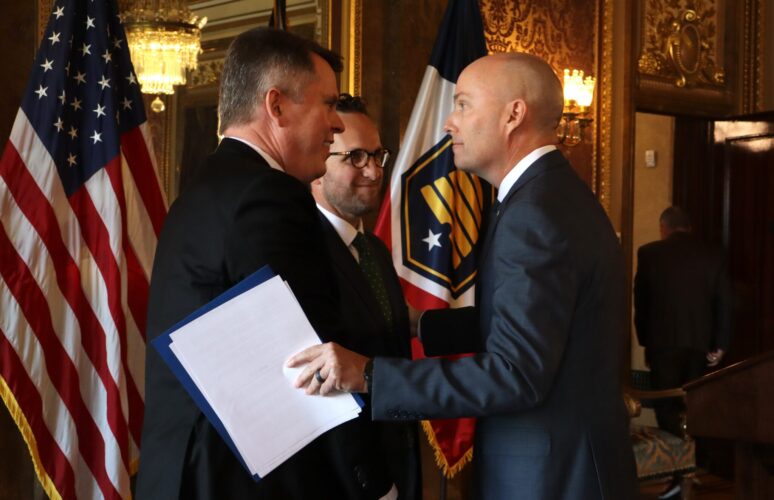
Utah Gov. Spencer Cox, right, shakes hands with Jay Jorgensen, left, and Stephen Dent after a news conference announcing their nominations to the Utah Supreme Court at the Utah Capitol in Salt Lake City on June 2, 2026. (Katie McKellar/Utah News Dispatch)Utah Gov. Spencer Cox on Tuesday announced his appointments for two new justices on the Utah Supreme Court after the Legislature expanded it from five to seven seats earlier this year.
Cox picked Jay Jorgensen, who currently works as a senior attorney for the state’s predominant faith, The Church of Jesus Christ of Latter-day Saints. The governor also picked Stephen Dent, who works as deputy criminal chief in the U.S. Attorney’s Office for the District of Utah. Both Jorgensen and Dent are subject to confirmation from the Utah Senate, which is expected to vote on whether to accept or reject Cox’s appointments on June 17. In coming weeks, the Senate Judicial Confirmation Committee will hold confirmation hearings prior to consideration by the full Senate.
Jorgensen, Dent and their families attended a news conference in the Gold Room at the Utah Capitol on Tuesday, where Cox announced their nominations, describing them both as the most qualified legal minds out of the pool of 12 applicants forwarded to the governor by the Appellate Judicial Nominating Commission.
“I feel just incredibly blessed that we had such amazing qualified people who care deeply and were interested in this position,” Cox said, adding that Jorgensen and Dent “rose to the top.”
Cox also elaborated on his hopes for the Utah Supreme Court’s next chapter amid ongoing tension between the judiciary and the Legislature spurred by rulings that have frustrated Republican state leaders, including in the state’s redistricting legal battle.
Cox said he hopes for quicker decision-making and shorter, easier-to-read opinions. He also said he hopes the new justices won’t be afraid to dissent — and passionately make their case when they disagree with the direction the majority of the court is heading. And he said three judicial philosophies were key to him as he interviewed judges: textualism, originalism and judicial restraint.”
But out of all the applicants, Cox said he’s heard “more positive feedback on these two than I’ve maybe gotten on any potential appointment, ever.”
“People across the political spectrum, the ideological spectrum, people from across the geographic spectrum who came out of the woodwork in support, letters that we received, phone calls, conversations,” Cox said. “Not a single, ‘Hey I’m worried about the bias that this person might have.”
With the upcoming August retirement of Chief Justice Matthew Durrant and the resignation of Justice Diana Hagen last month, Cox will have two more seats to fill on the state’s highest court. Applications for those positions are currently open, and Cox said he expects to make the appointments in “early fall.”
That’s after Cox appointed Justice John Nielsen last fall to replace Associate Chief Justice John Pearce who stepped down in December.
After all four open seats are filled, Cox will have appointed six out of the Utah Supreme Court’s now seven justices, with four appointments made in less than a year (Justice Paige Petersen was appointed by former Gov. Gary Herbert, while Cox appointed Associate Chief Justice Jill Pohlman in 2022).
Cox will also pick the high court’s next chief justice for the next eight years (subject to confirmation from the Senate) under another law passed last year.
The dramatic combination of turnover and expansion, paired with Durrant’s retirement after 26 years on the bench, will usher in a new era for the state’s highest court — and it remains to be seen whether the tension between the Legislature and the judiciary will persist or fade.
To represent the court, Pohlman attended Tuesday’s announcement, shaking hands with both Dent and Jorgensen afterward. Durrant couldn’t attend because “he’s had some health problems,” Cox said.
“We hate to see him retiring,” Cox said of Durrant. “But I want him to know, if he’s watching … how grateful we are. Every time I get the opportunity to pick a new justice … I try my very best to find a Justice Durrant. That’s how much I respect him.”
Jay Jorgensen
Cox introduced Jorgensen as someone whose “life and career have taken him from small-town Utah to the highest levels of legal and business worlds, and then back to Utah to serve its people.”
Jorgensen grew up in Ioka, a tiny rural community in Duchesne County. He went to law school at Brigham Young University before clerking for then-appellate judge and now U.S. Supreme Court Associate Justice Samuel Alito. Jorgensen also clerked for Judge Samuel Alito Jr. on the U.S. Court of Appeals for the Third Circuit.
Jorgensen also worked 12 years as an associate and partner with Sidley Austin, a global law firm, working in individual and corporate law. He later became executive vice president of Walmart “overseeing the global ethics and compliance program, which is recognized as one of the best in the world,” Cox said. He also previously served as an attorney, chief compliance officer and corporate secretary for Coupang, Inc., a tech and online retail company based in Seattle.
After moving back to Utah in 2021, Jorgensen started working with The Church of Jesus Christ of Latter-day Saints, first as a mission president in Chile before becoming senior counsel for the church.
As Utah’s dominant faith, many Utah lawmakers are members of the church — as is Cox.
Cox, when asked about Jorgensen’s role in the church, told reporters he doesn’t care “who they work for, I care about their legal mind and their legal scholarship. … I care a lot more about their ability to deliver justice in an unbiased way.”
“Jay is truly one of Utah’s brightest legal minds, and just as importantly, he understands Utah and its people,” Cox said. “We are excited to see him serve as a justice on our Supreme Court.”
Jorgensen said if he’s confirmed by the Senate, he’ll “do my best to fulfill this role, and to do it as a judge should.”
“Judges don’t make policy decisions. We don’t create the rules that govern our communities. Rather, judges have a limited role of applying the text of the Constitution and the laws that the people themselves have made.”
Jorgenson said that “it will not be my role to create the law.”
“If I’m confirmed, it will be my job to apply the law,” he said, “and I commit with all my heart to live up to that task.”
During criticisms of the Utah Supreme Court and 3rd District Court Judge Diana Gibson for rulings in the state’s anti-gerrymandering lawsuit that has since resulted in a court-ordered congressional map including a safe blue district, top Republican state leaders have repeatedly accused judges of “legislating from the bench.”
Stephen Dent
Dent graduated from the University of Utah’s law school in 2014. After he graduated, he clerked for two “outstanding judges,” Cox said, including U.S. District Court Judge Robert Shelby in the District of Utah and Judge Scott M. Matheson Jr. in the 10th Circuit Court of Appeals.
Dent then went on to work at Gibson, Dunn & Crutcher, another global law firm, where he litigated “appellate, complex, commercial and antitrust cases at the highest levels, including representing clients before the U.S. Supreme Court,” Cox said.
When he wanted to move back to Utah in 2019, Dent was hired to fill an opening with the U.S. Attorney’s Office in Utah’s Southern District, based in St. George. There he rose through the ranks from an assistant U.S. attorney from Southern Utah’s branch chief, to the deputy criminal chief for the entire office, Cox said.
“He has prosecuted federal crimes, including fraud, money laundering, drug trafficking, illegal immigration, and murder,” Cox said. Dent has also taught business law at Utah Tech University in St. George since 2021.
“Stephen and his family have established deep roots and a deeper love for Southern Utah,” Cox said. “While this appointment may bring him north for work, his heart is in our red desert. Stephen’s path has already shown the kind of discipline, legal ability and character we need on the bench.”
Dent said if he’s confirmed, “I pledge to faithfully and impartially discharge the duties of a fair and neutral judge.”
“I pledge to work hard to maintain the highest ethical standards and to treat litigants with respect and dignity,” Dent said, adding that he also looks forward to “working with and learning from the current justices on the court. And I have great respect and gratitude for the service they render.”
Flurry of Cox appointments launches court into new era
Cox acknowledged it’s “no secret” that there “has been a well-publicized rift” between the Legislature and the judiciary. He doesn’t expect that tension to disappear with the new court, however. Rather, he said during interviews he pushed both Jorgensen and Dent to be “willing to rule against me and against the Legislature when we get it wrong.”
“I suspect, and I hope, that we will have differences of opinion with these new justices as well,” Cox said. “I pushed really hard on them to make sure that they aren’t partisan hacks, to make sure that they care deeply about the law, and that their job is to hold me accountable … and hold the Legislature accountable to the constitution and the laws of this state.”
Cox said he “certainly didn’t anticipate” that he would end up appointing six out of seven of the Utah Supreme Court’s justices, including four this year.
The lasting impact on the court from Cox filling so many vacancies in quick succession will be “massive,” Judson Burton, an attorney at Parker & McConkie who clerked for Durrant, told Utah News Dispatch in an interview last week.
Those appointments — also coinciding with Durrant’s retirement after more than two decades on the court — means the Utah Supreme Court could be heading in a new direction in coming years. But Burton said that direction likely won’t be fully known until new justices start writing decisions and making their opinions known.
“What I’m looking for (in judicial appointments) has never changed,” Cox said, harkening back to his days as an attorney and when he was lieutenant governor sitting in on former Gov. Gary Herbert’s judicial interviews. “I am looking for people who care deeply about the constitution of the state and the Constitution of the United States.”
Cox said “judicial philosophy really matters to me.”
“I believe in textualism. I believe in originalism. I believe in judicial restraint,” Cox said. “Those are the benchmarks, and always have been and always should have been, for justices everywhere.”
Textualism — which calls for interpreting the law based on the ordinary, plain meaning of the words in a law at the time it was enacted — was a key philosophy that Durrant oriented the court around during his time on the bench, Burton said.
Durrant was also an “originalist,” Burton said, meaning he strove to interpret the state constitution or any legal text based on the public meaning it had at the time of its adoption.
Burton said he thinks Durrant’s influence — his textualist and originalist approach — is likely to continue since over the years it’s become embedded in Utah’s legal system.
“I do think some of the most important changes that we’ve seen in judicial decision-making during Chief Justice Durant’s tenure are likely to continue,” Burton said. “I don’t think you’re going to see a fundamental shift from that, and that’s going to mean the Legislature is going to get results that it does not like, and that’s just the way that a separation of power system works.”
Cox said “thorny political issues” should be decided by lawmakers, while “the only job of the court is to make sure that our actions abide by the Constitution, the actual words of the Constitution. And if the words happen to be not clear, then trying to establish what the intent was at that time, and what those words would have meant at that time. But never, never, never supplanting what a member of the court wants, would like to see happen.”
Cox also said it’s important to him that justices “understand how to build coalitions” and be “persuasive to work together” to reach a majority opinion.
But during times of dissent, Cox said “you have to be willing to disagree when you feel like the majority is going the wrong way, and you have to be willing to write a dissent that can be passionate, that can talk about why you believe that the majority got it wrong.”
Cox also said he’s heard many district court judges complaining “a lot” about Utah Supreme Court opinions, not because of they were wrongly decided, “but because they’re way too long”
“We’re getting more like the (U.S.) Supreme Court. We’re writing 50, 60-page opinions. Everything does not need to be a treatise. Simple is better,” Cox said. “Not just so our district court judges can read it quickly, because they’re overwhelmed constantly, but so average Utahns can read these cases.”
Upcoming Senate scrutiny
In the audience Tuesday was Sen. Todd Weiler, R-Woods Cross, an attorney who also chairs the Senate Judicial Confirmation Committee that will be holding confirmation hearings and interviewing Jorgensen and Dent in coming weeks.
Weiler said during those interviews, the committee puts appointees under oath, and Weiler asks “every candidate, under oath, in private, with their families outside: Is there anything in your personal life that, if it became known publicly after your confirmed, that would be embarrassing to the governor, to the Senate, to the judiciary?”
“It’s important that people’s personal lives are not something that will cause embarrassment to the state of Utah,” Weiler said, “and I will ask these candidates that as well.”
Hagen’s recent resignation came after the Utah House, in response to a public records request from KSL, released a previously dismissed complaint alleging she had an extramarital affair with an attorney involved in the state’s redistricting case. The Judicial Conduct Commission dismissed the complaint as lacking evidence and credibility, but Cox and Utah’s top Republican legislative leaders called for an independent investigation into the claims.
Hagen denied the allegations, but to avoid dragging her family into the independent investigation, she resigned last month.
Asked if the overhauled Utah Supreme Court will reset the relationship between the judiciary and the Legislature, Weiler said “that’s yet to be determined.” He added, however, that “some of that tension is to be expected,” and that for the most part, relationships “are very cordial.”
“If we stray out of line, (the court) should be calling us out,” Weiler said. “They have a job to do, which I respect. I want them to stay in their lane, and I think we should stay in our lane. I’m not saying we always do, but I think we should stay in our lane.”