RMU: Tips to keep runners healthy and enjoying every mile
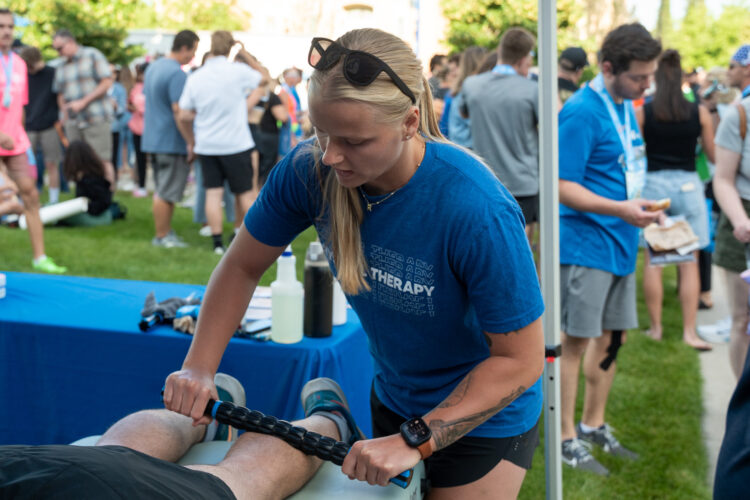
Dustin Winter/RMU
Students and faculty from Rocky Mountain University of Health Professions (RMU) assisted runners during the recent Utah Valley Marathon.Whether you’re preparing for your 25th marathon, your friends convinced you to join them on a “fun run” or you like soaking in the mountain scenery on slow jogs, running is a personal endeavor. Everybody goes at their own pace and should find out what works best for their own situations and goals.
“You’re an N of 1,” said Dr. Miriam Cortez-Cooper, an accomplished physical therapist (PT) and lifelong runner who’s qualified for and competed in the Boston Marathon. “You’ve got to do the experimentation on yourself. Your best bet is to experiment around with your training runs — find out what works for you and what doesn’t work for you.”
With the arrival of summer and peak race season, we’ve enlisted Dr. Cortez-Cooper, an associate professor and assistant program director of the Doctor of Physical Therapy program at Rocky Mountain University of Health Professions (RMU), and some PT students/running enthusiasts to share tips to help runners of all skill levels, speeds, shapes and sizes reach their potential.
RMU student Ashton Hansen, who enjoys running and long-distance triathlons, finds his groove as an endurance athlete by pushing himself in a variety of cross-training workouts (mostly swimming, cycling and running) and moving in ways that makes him happy.
“Running is what you make of it,” Hansen said. “Make it a good time — smile and give high-fives. PRs are for everyone. Have fun out there.”
RMU student Sarah Kraut loves to take her dog Huckleberry, a German shorthaired pointer, on daily trail runs in the Utah County area.
“In physical therapy, we say ‘motion is lotion,’ so just get moving,” she said. “You just have to remember that you don’t have to be happy about doing it. Sometimes, that motivation will catch up to you as long as you make yourself do it.”
Leslie Ramos, a former soccer player who’s picked up running in recent years, said running has boosted her physiologically and mentally while she balances grad school and life.
“Schedule workouts like any other commitment,” she said. “It relieves stress.”
Nick McMillan, a former collegiate runner and marathoner, loves that participating in organized races has helped him see the world (he’s done marathons from Salt Lake City to New York City and London), kept him motivated and helped regulate his mood as a DPT student.
“I’ve been doing it so long I use it as a stress reliever. I’m not necessarily relaxed during the run, but it allows me to take out any anger,” he said. “Or it can be fun to see new places and find new trails to run on.”
Here are more tips from this group of go-getters:
Training & mindset
Slow and steady wins the race training. “Always start slow,” Ramos said. “You’ll start seeing the progress and it just starts getting easier.”
Schedule a race on the calendar. “Sign up for something, like a 5K,” Ramos said. “It gives you a nice goal.”
Dress for training success. “If you want to start running, wear some running shoes, wear some shorts,” Ramos said. “You can’t really do that on the couch.”
Do your own thing. “Comparison is the thief of joy,” Ramos said. “Some people might judge, but at least you started. Just do it. Even the last finisher, they get that medal. The person on the couch is not getting the medal, so you’re a lot faster than they are.”
Pay attention to how you feel. “If something hurts, maybe you don’t run that day. It’s not the end of the world,” Kraut said. “Listening to my body is what works best for me.”
Movement is good for the body. “Motion is lotion,” multiple students said. Added Ramos: “If you don’t use it, you lose it.”
Training principles
Hansen provided the following principles:
Specificity helps. “If you’re going to train for a marathon, there’s no need for you to focus on being able to swim a mile.”
Build gradually. “No more than a 10% increase in your volume week to week.”
Recovery matters. “Make the fourth week a recovery week. Let your body recover and adapt. If you don’t let your body recover, then you’re not making any gains.”
Know before you go. “Look at the course and what it necessitates in training, because depending on the course, that totally changes how I’m going to train.”
Downhill running: “Instead of pumping your arms back and forth, start doing a little bit of circle motion. It maintains your momentum a little bit better, makes it a little bit smoother so that it’s not stopping each step as you’re going down.” Also, “Switch from heel striking to more midfoot running. Land more towards your toes rather than on your heel.”
Don’t overdo it going downhill. “Get away from thinking, ‘Hey, it’s free speed, I can just bomb down this hill.’ It’ll come back to bite you when you hit mile 20.”
Nutrition and hydration
Be prepared. You’ll want to stick with the nutrition plan that worked for you in training. Bring nutrition, like gels, with you on a race belt in case the course doesn’t have what you need.
Run. Finish. Eat. “Within an hour of finishing, get a protein and a carb snack: 50-50,” Hansen said. Kraut said women need to pay special attention to protein and suggests eating 60 grams of protein within 60 minutes of training.
Don’t try anything new on race day to avoid GI distress and extra porta-potty visits.
Avoid hitting the wall. It can happen when carbohydrate stores (liver and muscle glycogen) deplete. Symptoms include heavy legs, fatigue and reduced performance. “When you run out of liver glycogen, your brain just doesn’t function as well,” Dr. Cortez-Cooper said. “Your legs start feeling heavy, like somebody strapped 5-pound weights on your ankles.”
Aim for 65% to 70% of daily calories from carbs in the two to three days before a race (or about 4 to 7 grams/kilogram for many women/smaller athletes), Dr. Cortez-Cooper suggests.
On race morning, eat easily digestible carbs, like a bagel or banana, 2 to 3 hours prior to starting.
During the run, target about 60 to 90 grams of carbs per hour. Use gels, dates or even chewable candy every 20 to 30 minutes. Carbs with glucose and fructose can help absorption.
Stay hydrated. Be sure to balance fluids, electrolytes and carbs. Test before race day.
“Nutrition is something that some people probably overlook because they’re so focused on the actual running part,” said Dr. Cortez-Cooper in a recent episode of RMU’s Pulse podcast. “Hopefully, they will start experimenting with what works for them.”
Recovery and injury prevention
There is no finish line. “The hour after finishing is important. You got to keep moving after,” Hansen said. “Walk around, grab food and eat as you walk around before laying down.”
Rotate your shoes. “I try to go by the rule of 300 miles per pair of shoes,” Kraut said. “If they’re extra cushy, maybe up to 500. If your shoes get too flat, and you lose the squish out of there, then your mechanics and your feet are going to start changing.”
An important (and your longest) training activity: sleep. “If you’re tired, sometimes sleep is the best training you can do,” Kraut said. “That’s an underappreciated training tool — a good night’s sleep. Shoot for nine hours when you’re training for a something like a marathon.”
Warm up, cool down. “Recovery and warmups are a big thing for your runs,” Kraut said. “Walk for five minutes to start your run. That just gets blood moving.”
In addition, Hansen goes out of his way to make newcomers feel welcome and prepared.
“It’s so much fun to see the wide-eyed, sometimes scared and anxious new runners at their first-ever race and you can tell they’re nervous,” Hansen said. “It’s always uplifting. Give them a little reassurance. Say, ‘Oh, you’re going to do awesome.’ Give them a bit of advice. Ask what pace they’re looking for and find a group that goes at that pace. Helping them out is so much fun and a blessing. It makes the community better.”
The most important things to remember?
Get out there and have a good time.
“I never want to run and have it feel like it’s a chore,” McMillan said. “I try and make it fun.”
Jody Genessy is the senior content writer at Rocky Mountain University of Health Professions.
Community
‘An excitement in the room:’ Year two of Orem Film Festival sees strong turnout, showcases local films
Building something together: Shriners Children’s families connect the pieces at Boardwalk Puzzle event