LDS Church publishes writings online of early female leaders

Courtesy Intellectual Reserve
Historical print that includes Elizabeth Ann Whitney along with Emmeline B. Wells and Eliza R. Snow.
Two of the most prominent women in the early days of The Church of Jesus Christ of Latter-day saints now have their memoirs and teachings available to the public.
The Diaries of Emmeline B. Wells and The Discourses of Eliza R. Snow have been published by the Church Historian’s Press after several decades of work.
“It’s two women who are powerful and influential leaders in the early Church whose impact is still felt today by not just women in the Church, but women in Utah and women in the nation,” said Anne Berryhill, an associate historian with the Church History Department of The Church of Jesus Christ of Latter-day Saints in Salt Lake City.
Snow and Wells served as general presidents of the Relief Society, the church’s women’s organization. Snow was the second Relief Society general president (1880-1887) and Wells was the fifth (1910-1921). Each left a compelling record of her teachings and service — Snow in the form of discourses, and Wells in the form of diaries, according to church information.
The Church History Department held a media event on Thursday to celebrate the completion of the projects.
Eliza R. Snow

Courtesy Intellectual Reserve
Historical researcher Anne Berryhill holds a photo of Elizabeth Ann Whitney (left) Emmeline B. Wells (center) and Eliza R. Snow (right).
Historians on the Snow project combed through hundreds of sources, including handwritten minute books and 19th century newspapers, to find and compile her words. They found over 1,200 discourses, all of which have been published online at the Church Historian’s Press website. The content includes historical context, maps, photographs and other supporting material, according to a church press release.
“Eliza R. Snow traveled to the far-flung settlements of Utah,” Jennifer Reeder, the lead historian and editor on the Eliza R. Snow discourses project and a 19th century women’s history specialist at the Church History Department, said in a press release. “She cared enough to bring direction and love from Salt Lake City to places like Plain City or Pinto, Scipio or Salina, Willard or Wallsburg. Each time, she would look into their faces and fill them up with hope, rekindling their light. Each location would add to her understanding of the place of women in the Kingdom.”
According to online information about Snow it indicates that, “Snow’s presidency emphasized spirituality and self-sufficiency. The Relief Society sent women to medical school, trained nurses, opened the Deseret Hospital, operated cooperative stores, promoted silk manufacture, saved wheat, and built granaries. In 1872, Snow provided assistance and advice to Louisa L. Greene in the creation of a woman’s publication loosely affiliated with the Relief Society–the Woman’s Exponent. Snow’s responsibilities also extended to young women and children within the church. She was a primary organizer for the Young Ladies’ Mutual Improvement Association in 1870 and assisted Aurelia Spencer Rogers in establishing the Primary Association in 1878.”
Emmeline Wells
“Emmeline Wells has become someone we cannot ignore, both in her own right and because of all the work she did to ensure that the women of her time would be remembered,” Lisa Olsen Tait, a historian manager with the Church History Department, said in a release. “Very few people of the 19th and early 20th centuries, male or female, have left behind such an extensive record of their lives, experiences and feelings.”
Wells’s diaries not only described life in Salt Lake City in a transformative period, according to Tait, “they also give us glimpses of the wider world, as she traveled to the East and even to Europe.”
Wells participated in the national movement for female suffrage, establishing relationships with Susan B. Anthony and Elizabeth Cady Stanton. She collaborated with the National and International Councils of Women, representing women’s organizations from the West.
According to LDS Church history, in 1878 Wells wrote, “I desire to do all in my power to help elevate the condition of my own people especially women,” according to LDS Church history.
The Emmeline B. Wells diaries project has been decades in the making. Historians and editors Cherry Bushman Silver and Sheree Maxwell Bench began working on it about 20 years ago at Brigham Young University.
Working from a transcription, they annotated thousands of diary entries in the 47 volumes Wells recorded between 1844 and 1920, though they are primarily after 1874. In 2017, the Church History Department arranged to support completion and publication of the diaries. The online content includes historical introductions, chronology entries, photographs and biographical information about the people mentioned in the diaries.
Church historians said both projects illustrate the Church History Department’s ongoing commitment to women’s history.
“Women’s history is Latter-day Saint history. If we are to accurately understand our past, if we want to truly benefit from our history, we need to listen to women’s voices and take seriously women’s experiences,” said Matt Grow, managing director of the Church History Department. “We believe that scholars and students of Latter-day Saint history will find so much in these discourses and journals.”
-
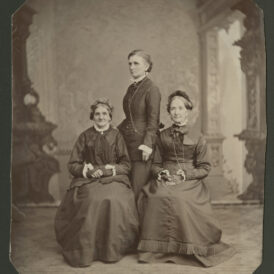
- Historical print that includes Elizabeth Ann Whitney along with Emmeline B. Wells and Eliza R. Snow.
-
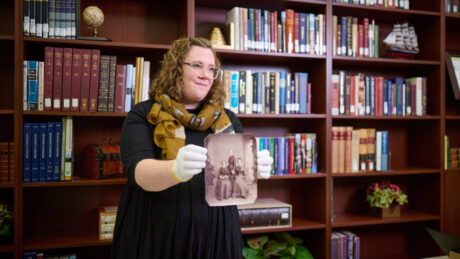
- Historical researcher Anne Berryhill holds a photo of Elizabeth Ann Whitney (left) Emmeline B. Wells (center) and Eliza R. Snow (right).