Utah officials warn of severe drought conditions as runoff season ends early
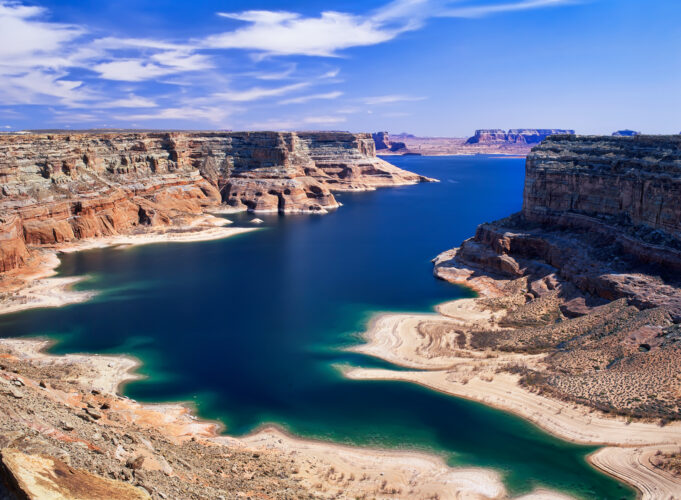
Lake Powell part of the Glen Canyon National Recreation Area in Utah and Arizona, United States
SANPETE COUNTY — Utah water officials are sounding the alarm as record-low snowpack and unusually high spring temperatures have caused this year’s peak runoff season to end weeks earlier than normal, raising concerns for water supplies across the state, including in Sanpete County.
According to the Utah Department of Natural Resources, runoff from melting snowpack — a critical source for refilling reservoirs — has already peaked and declined, far earlier than in a typical year when runoff would just be beginning.
State officials met Tuesday with county leaders and water providers to share updated drought conditions and encourage local governments to prepare for what could be a difficult summer and fall.
“To address extreme drought, we are asking county leaders to coordinate with water providers and review drought contingency plans and consider if a county-specific drought declaration is warranted,” said Joel Ferry, executive director of the Utah Department of Natural Resources.
Ferry emphasized that while the state provides guidance and drought data, decisions regarding water restrictions and local drought planning are made at the county and municipal levels to best reflect area-specific conditions.
Currently, 100% of Utah is experiencing some level of drought, with 59% of the state classified under extreme drought conditions.
Although larger reservoirs with multi-year storage capacity remain in relatively stable condition, smaller reservoirs that depend on one or two years of water storage are facing significant challenges.
Statewide reservoir storage is averaging 72% full, slightly above normal for this time of year, but lower than last year’s 82% average. Meanwhile, streamflow runoff across Utah is expected to reach only about 50% of normal levels.
Conditions are also worsening along the Colorado River system. Natural inflows into Lake Powell are projected to be just 40% of normal this year.
To help protect critical water levels at Lake Powell, Utah joined Wyoming, Colorado, and New Mexico in approving a plan for the release of between 660,000 and 1 million acre-feet of water from Flaming Gorge Reservoir. Those releases could begin as early as this week and continue through April 2027.
The April 1 Water Supply Outlook Report from the Natural Resources Conservation Service showed every major basin in Utah recorded record-low snowpack this year, with some mountain snowpacks nearly gone by early April.
That reality is especially concerning for rural counties like Sanpete, where agriculture and irrigation depend heavily on snowmelt-fed water supplies.
The state’s Drought Response Committee, made up of representatives from several state agencies, is continuing to monitor conditions closely and may recommend a statewide drought declaration to Gov. Spencer Cox if conditions worsen. A statewide drought declaration would remain in effect for 30 days unless extended by the Utah Legislature.
Officials are encouraging residents and farmers to begin conservation efforts now rather than wait for restrictions.
Programs such as the Agricultural Water Optimization Program are available to help farmers improve irrigation efficiency, while residents can find water-saving tips through SlowTheFlow.org, which promotes indoor and outdoor conservation practices.