Recent storms bring welcome drought relief to Sanpete County and Utah
Courtesy Lynn R. Blamires
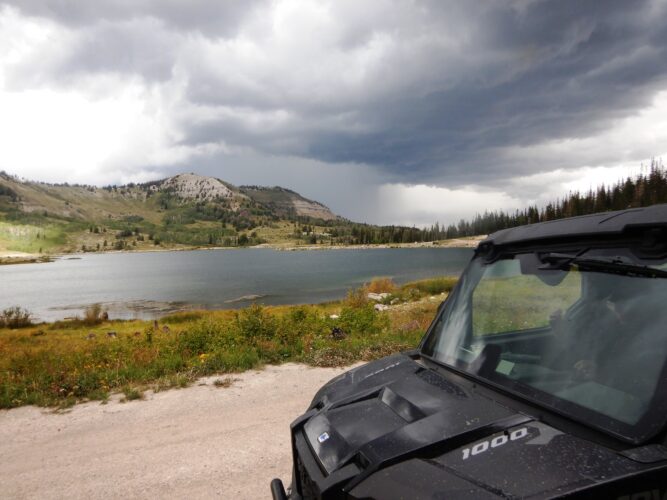
Storm clouds gathering over Ferron Reservoir where we stopped for lunch.SANPETE COUNTY — After enduring months of dry conditions and an exceptionally hot summer, Sanpete County and the rest of Utah are getting some welcome relief as a series of fall storms brought record-breaking precipitation, improved soil moisture and a much-needed boost to the state’s water supply.
According to the Utah Division of Water Resources, recent storms have increased reservoir levels across the state by approximately 5% on average since early fall, an unusually significant increase for this time of year. The improvement has also helped reduce the severity of drought conditions across Utah.
As of Nov. 12, approximately 64% of Utah remained in moderate drought or worse, down considerably from 91% in late October.
For Sanpete County, where agriculture, livestock production and rural communities depend heavily on reliable water supplies, the improved conditions offer an encouraging start heading into winter. However, water officials caution that the recent storms are only the beginning of what will need to be a consistently wet winter and spring.
“Recent storms provided a welcome boost to our water supply and resulted in excellent soil moisture levels across much of the state,” said Joel Williams, director of the Division of Water Resources. “While these saturated soils lay a great foundation for spring runoff, it is crucial to remember that a single storm event does not end a drought. We will need a steady, consistent sequence of winter storms right through spring to build a healthy snowpack and meaningfully refill our reservoirs.”
One of the most encouraging developments has been the dramatic improvement in soil moisture. Utah experienced record-breaking soil moisture readings during October and November, providing a significant advantage as the state heads into the winter months.
The Natural Resources Conservation Service reported that 11 of Utah’s SNOTEL monitoring sites recorded their highest October precipitation totals on record, while another 21 sites recorded their second-highest October totals.
Those readings are important because healthy soil moisture levels in the mountains can make a substantial difference when spring temperatures begin to rise.
When mountain soils are already saturated before winter, more of the water from melting snow can flow into streams, rivers and reservoirs rather than being absorbed by dry ground. That can improve the amount of water ultimately available for communities, farmers, ranchers and other users throughout the state.
For Sanpete County, where spring runoff plays an important role in replenishing local water systems and supporting agricultural operations, a healthy mountain snowpack will remain especially important.
The recent precipitation also comes after an exceptionally hot summer. According to the National Oceanic and Atmospheric Administration, the United States experienced its hottest summer on record from June through August 2026, based on 132 years of measurement data.
High summer temperatures across Utah accelerated the drying of soils and vegetation, worsening drought conditions and increasing the amount of water lost through evaporation. More recently, however, evaporative demand has dropped closer to normal levels, helping the state take advantage of the additional precipitation.
The improvement can also be seen at some of Utah’s largest water bodies.
Great Salt Lake has risen approximately four inches since early October, reaching an elevation of about 4,190 feet. Lake Powell has also gained approximately 20 feet in elevation during that same period.
Despite those gains, statewide reservoir storage remains below normal. Reservoirs were at approximately 51% of capacity as of the Nov. 12 report, about five percentage points below the average for this time of year.
That means the state still has considerable work ahead before water managers can consider supplies healthy heading into next summer.
The Division of Water Resources is encouraging residents to appreciate the recent improvement while continuing to use water wisely. The recent storms have provided a valuable boost, but additional precipitation throughout the winter will determine how much of that improvement carries into next year.
Officials are also reminding Utahns to be cautious during periods of heavy rainfall and snowmelt. With soils already saturated in many areas, additional heavy precipitation can create dangerous conditions.
Heavy rain falling on soaked ground increases the potential for sudden flash flooding, rapid runoff and debris flows, particularly along steep slopes and areas affected by recent wildfires.
Residents should monitor local weather alerts and report dangerous flooding conditions to emergency responders.
For Sanpete County residents, the recent storms provide reason for optimism after a difficult year of drought and heat. The improved soil conditions and additional water in reservoirs are welcome developments for an area where water availability is closely tied to farming, ranching and the health of local communities.
Still, the biggest test is yet to come. A consistent series of winter storms, followed by a healthy spring snowmelt, will be necessary to turn the promising fall precipitation into lasting water security.
For now, Utah is heading into winter in considerably better shape than it was just a few weeks ago, and that is welcome news for Sanpete County and the entire state.
Editor’s note: The statewide figures in the story are from the Utah Division of Water Resources’ Nov. 12, 2026, drought update. The report does not provide separate reservoir or drought percentages for Sanpete County, so the local references are focused on the county’s agricultural and water-supply interests rather than suggesting county-specific measurements.