With no cooling center in Provo, other resources try to fill the gaps for homeless amid heat
Lynne Sladky, Associated Press
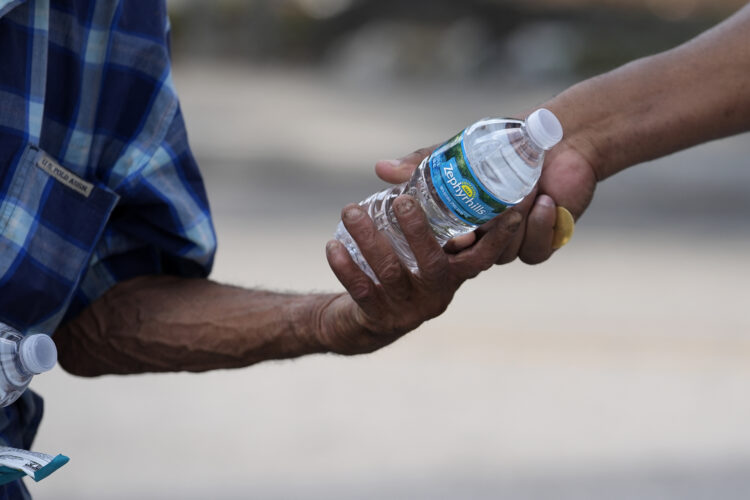
Ricky Leath, an outreach specialist with the City of Miami, right, hands a bottle of water to a person on the street as he works with the Miami-Dade County Homeless Trust to distribute water and other supplies to the homeless population, helping them manage high temperatures, May 15, 2024, in Miami.Elise Bauer of Provo knows firsthand what it’s like to be homeless.
The 24-year-old first experienced being unhoused at the age of 2. Bauer said she doesn’t have much recollection of it except for the fact that her family lived in their vehicle for a time.
It’s a reality she’s had to deal with off and on into her adult years while trying to pay for education at Utah Valley University. “Like, I’m the one paying for school. And so (to be) suitable to go to school and to be able to pay tuition, I just felt like the only option was to live in my car,” she explained.
Bauer recently voiced her thoughts on how Provo handles homelessness at a City Council meeting July 16. She expressed concerns over a lack of resources like a permanent shelter or cooling centers as well as the city’s no-camping ordinance.
“We need cooling shelters for those older adults who have compromised physical systems, or for the young infants and children who are on the streets, as well as those who are healthy,” she told the Daily Herald when reached after the council meeting. “People are more vulnerable to heat-related illness and injury after multiple days in the heat, and that’s what we’re seeing right now in these extreme seasons of heat and cold.”
During the 2023 legislative session, lawmakers passed House Bill 499 requiring certain counties in the state, including Utah County, to form a winter response plan for those experiencing homelessness. It also allowed counties and organizations to activate “code blue alerts” to provide shelter on the coldest nights of the winter.
Lawmakers have yet to pass the inverse of that bill, mandating a response during the summer months, but it is on the minds of state homelessness advocates.
A “code red” law would regulate how counties respond in extreme heat. Such a bill had been in talks around the same time “code blue” was being put into place, but state leaders opted to put the latter in motion first and get it operational, State Homelessness Coordinator Wayne Niederhauser told KSL TV.
Utah County homelessness advocates also are aware of the need for a resource for the unsheltered to escape the sweltering heat.
“It’s something that we’re discussing and kind of looking at statewide and national policies of what people are doing,” Mountainland Continuum of Care Project Coordinator Heather Hogue said.
She noted that various outreach teams and community activists will distribute water bottles and electrolyte packages to combat dehydration amid the extreme heat.
“It isn’t a secret that the heat is a problem, and we’ve got to find a solution. And I don’t know exactly what that’s gonna look like,” Hogue said.
Currently, the Mountainland Continuum of Care along with partnering agencies that make up the Utah County Winter Response Task Force are in the midst of preparing for the 2024-25 winter response plan, with a host of warming centers set to open from mid-October to the end of April.
“We have coverage for all seven nights a week. That includes interfaith groups and also county and city involvement,” Hogue said.
Meanwhile, excessive heat warnings are still in effect for portions of Northern Utah.
Unofficially, the Provo City Library has been one place the unsheltered could visit to flee the extreme weather.
“We have unsheltered individuals visiting our building throughout the year. We do see an increase during the hottest and coldest months of the year, though it is not something we track,” Library Director Carla Gordon told the Daily Herald in an email. “We hope that whenever anyone comes into our building they are finding a welcoming place to sit for a while and also use services that can help them, like free Wi-Fi and computers.”
The Church of Jesus Christ of Latter-day saints also has a list of resources of its website, icp.churchofjesuschrist.org/pages/homeless_srp.
Bauer says she hopes more can be done to accommodate the less fortunate with adequate resources and mostly a sense of understanding from citizens who may not know the obstacles of poverty. “We need to bring awareness to our fellow human beings in this community, just for them to know what an issue it is, and to be able to say, ‘Hey, we need more,'” she told the Daily Herald.