For 19th year, Utah ranks No. 1 in nation for economic outlook
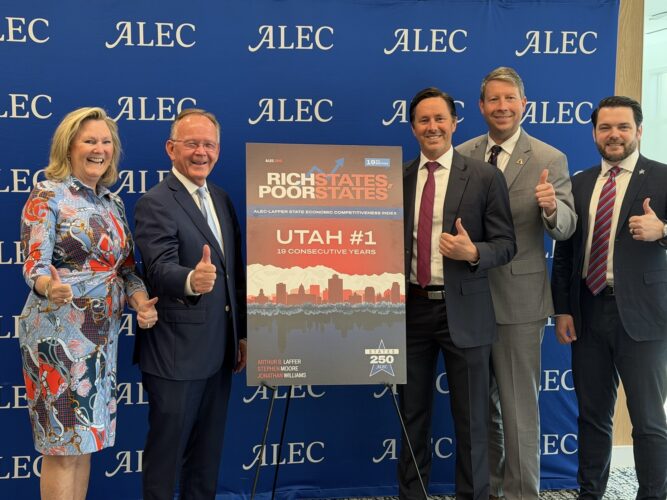
Photo Courtesy of the Utah Senate
Utah Senate President Stuart Adams, R-Layton, and Senate Majority Leader Kirk Cullimore, R-Sandy, celebrate Utah’s No. 1 ranking for economic outlook while in Washington, D.C., on April 15, 2026.Utah has again been named the No. 1 state in the nation for its economic outlook — making this the 19th year in a row — according to a new report released by the pro “limited government” think tank American Legislative Exchange Council (ALEC).
For almost two decades now, Utah has held the top spot in ALEC’s yearly publication titled “Rich States, Poor States,”
which uses the ALEC-Laffer State Economic Competitiveness Index to rank states’ economic performance of 15 policy variables. In general, states that spend less and tax less perform better in the index.
All four members of Utah’s U.S. House delegation stood shoulder-to-shoulder with the state’s top Republican legislative leaders — Senate President Stuart Adams and House Speaker Mike Schultz — in Washington, D.C., on Wednesday in a press conference to parade the ranking.
Each of them (except Rep. Burgess Owens, R-Utah) is currently running for re-election in a state that’s controlled by a longstanding statewide Republican supermajority.
Adams, R-Layton, and Schultz, R-Hooper, were in D.C. this week for the White House State Leadership Conference, which is meant to foster collaboration between federal, state and local government officials.
“Utah continues to set the national standard for pro-growth policy and long-term economic competitiveness,” Jonathan Williams, ALEC’s president and chief economist, said in a prepared statement. “Year after year, the state’s commitment to sound fiscal policy, reducing taxes and improving the economic climate make it a model for the rest of the country. Other states have seen Utah’s success over 19 years and are trying to copy the policies behind it.”
While Utah has long maintained its No. 1 ranking for economic outlook, other states have been jostling to compete, Williams said during Wednesday’s news conference. In this year’s report, Tennessee moved up to second place, Idaho ranked third, North Carolina ranked fourth, and Arizona took fifth.
“Those are all competitors, but you sharpen the pencils every year, you realize that spending equals taxation, you reprioritize spending, and you keep hardworking families and taxpayers getting back more of their hard-earned money,” Williams told Utah’s state and federal leaders.
In past years, Utah Democratic leaders have criticized the ranking as a “biased evaluation” that doesn’t account for factors that affect working-class people while praising policies that have kept minimum wages low and favored tax cuts that have disproportionately benefited the wealthy.
The state’s top Democrats, House Minority Leader Angela Romero (who is also running for re-election this year) and Senate Minority Leader Luz Escamilla, issued a joint statement later Wednesday saying that as members of the state’s powerful budgetary body, the Executive Appropriations Committee, they “take our responsibility to balance the state budget seriously.”
“That work includes fighting for the social programs and community investments that make economic participation possible,” Romero and Escamilla said. “But this ranking does not reflect the full picture and the real gaps that thousands of Utah families are facing as they struggle to make ends meet.”
In response to those criticisms, Adams pointed to another report published in January by the Urban Institute that showed Utah, compared to other states, has seen the greatest percentage growth in median income between 1970 and 2023, up 77.6% compared to the national growth rate of 32%.
In 1970, Utah’s median household income was $52,602, according to the Urban Institute. In 2023, that grew to more than $93,000 — putting Utah as eighth-highest in the nation for median income out of all 50 states. West Virginia, on the other hand, was the only state to see its median income fall, by 0.4%, to only $55,948 in 2023.
Nationally, the Urban Institute analysis said median income growth is associated with higher education attainment (like more residents with bachelor’s degrees) and an increase in foreign-born residents. That analysis, however, did not evaluate how incomes have kept pace with cost of living in each state or how they compare to cost of living since 1970, Governing reported.
In their statement, Escamilla and Romero also pointed to other findings from the Cato Institute, which they said showed “immigrants are a driving force behind our economy, nationally contributing a net fiscal surplus of $14.5 trillion over the past three decades, consistently paying more in taxes than they receive in benefits.”
“Behind every strong economy, including Utah’s, is an often invisible immigrant workforce. Those contributions need to be acknowledged in any honest assessment of what makes our state thrive,” Escamilla and Romero said. “For us, true economic success means ensuring prosperity is equally accessible. We can celebrate Utah’s ranking while recognizing it is not a complete measure of well-being.”
Schultz, however, said the “Rich States, Poor States” ranking is “proof” that Utah is the “best fiscally managed state in the nation” while pointing to increased spending on education, low debt and increased wages for Utahns.
“The proof is in the pudding,” Schultz said. “It’s hard to argue with those numbers.”
Under Schultz and Adams’ leadership, the GOP-controlled Utah Legislature has cut income taxes for six years in a row. They have said it’s to keep Utah a competitive state to do business in and to encourage continued job growth while also lowering taxes for Utahns.
“We understand affordability issues,” Schultz said. “We’ve taken steps to lower housing costs here in the state of Utah. We’ve taken steps to lower gas prices. … We’ve taken steps to lower child care, taxes, all the things to make life more affordable.”
Adams and Schultz also repeatedly pointed to former President Ronald Reagan, who focused on reduced government spending, lower taxes and less regulation on business to spur economic growth.
“Reaganomics works,” Schultz said, “and we’re very proud to live that.”
Utah News Dispatch is part of States Newsroom, the nation’s largest state-focused nonprofit news organization.
Local News
Community Action Services says it needs immediate support to keep doors open

Woman arrested after ‘a disturbance’ at Utah County Planning Commission meeting, sheriff’s office says