
Health and Wellness: Treadmill desks and other cardio catastrophes: Why your remote fitness hacks are more frightening than fun
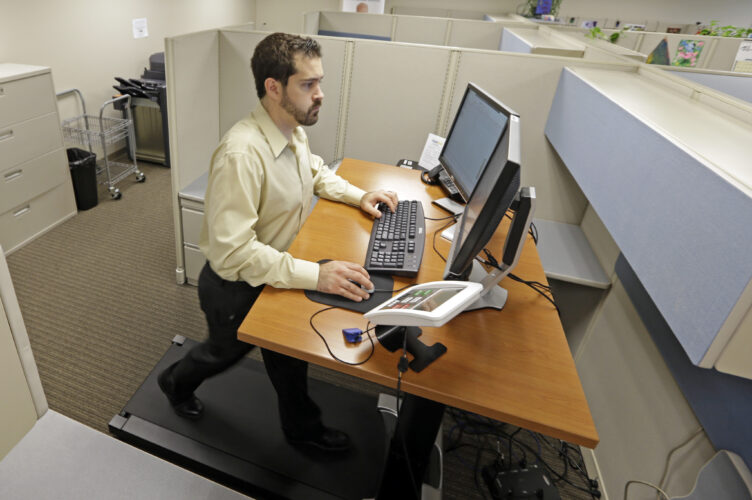
Josh Baldonado, an administrative assistant at Brown & Brown Insurance, works at a treadmill desk in the firms offices in Carmel, Ind., Wednesday, Aug. 28, 2013. Workers sign up for 30 slots not he treadmills and have their phone and computer transferred to the workstations. Being glued to your desk is no longer an excuse for not having time to exercise as a growing number of Americans are standing, walking and even cycling their way through the work day at treadmill desks, standup desks or other moving work stations. (AP Photo/Michael Conroy)
Working from home is fantastic. There’s no commute, unlimited coffee and the freedom to attend a Zoom call in pajama pants. But somewhere between your third virtual meeting and your fifth trip to the bathroom, a brilliant thought creeps in: “What if I worked out while I worked?”
Enter the treadmill desk, the under-desk bike and the precarious yoga ball chair. Research indicates that the market size for desk treadmills reached $131.8 million in 2024 and is poised for further expansion.
Some would say the bike pedals, treadmills and yoga balls are the trinity for remote worker fitness heavy hitters, promising productivity and cardio but instead delivering distractions, typos and more squeaks than a rusty door hinge.
Picture this: You’re striding confidently on your treadmill desk, feeling like the healthiest employee alive. Ten minutes later, your laptop is wobbling, your Zoom camera is bobbing up and down like a scene from The Blair Witch Project and your carefully crafted quarterly report now reads like The DaVinci Code.
Or maybe you’re pedaling furiously on your under-desk bike during a client call, blissfully unaware that your mic is broadcasting squeaky pedal noises while you’re losing focus on the very project you’re supposed to be presenting.
And let’s not even talk about the yoga ball scenario, where one tiny lean can send you rolling across the room like a sack of Idaho spuds.
Before you invest in a treadmill desk, under-desk bike or one of those “balance board” contraptions that make you feel like you’re not just surfing through your inbox but also your kitchen and into the dining room, let’s take a breath (preferably while sitting still). Because while multitasking sounds productive, it’s actually just a fast track to sore muscles, exhaustion, awkward camera angles and a surprising number of typos.
The treadmill desk: Great for steps, terrible for sentences
At first, you think you’ve discovered the secret to good health and professional success: You’re walking briskly, answering emails, feeling like a vision of health and efficiency. Ten minutes later, your heart rate spikes, your typing looks like your toddler spent the morning’s playdate working on your projects and your camera’s bobbing up and down like live footage of Taylor Swift’s Eras Tour.
“Walking while working may be great for movement, but poor posture is a real risk if your setup isn’t ergonomically correct,” warns Joanne Swann, editor at Workplace Wellbeing Professional. “Without proper alignment of the desk, screen, and keyboard, you could end up with aches and pains in your neck, back, or shoulders. It’s important to ensure your workstation is adjusted properly to avoid these issues.”
The under-desk bike: The illusion of movement
You start pedaling like a Tour de France champion while on a client call. You feel virtuous. Energized. Until you realize your camera’s shaking, your mic’s picking up suspicious squeaking noises and your focus has shifted entirely from client relationship strategy to “Why does my left knee hurt?” By the time you hit “End Meeting,” you’ve burned a total of six calories and lost all dignity.
The stability ball chair: Spoiler alert! It’s not stable
You’ve seen the influencers perched on their neon yoga balls, claiming better posture and stronger cores. What they don’t post is the moment they slightly lean for their coffee mug and roll halfway across the room like an escaped hamster.
Sure, your abs might engage for a few seconds, but mostly, your coworkers get a front-row seat to your slow-motion descent from “healthy” to “humiliated.”
The verdict: Move when you mean it
Studies have shown that prolonged sitting during work hours is associated with increased risks of heart disease and premature death. However, even attempts to counteract this by incorporating physical activity at the workstation may not fully mitigate these risks.
Remote workers are innovators. We’ll duct-tape a standing desk together from cereal boxes if it means better ergonomics. But sometimes, the best productivity hack is to log off for 30 minutes and give your body some genuine, distraction-free movement.
“Your brain and body both deserve dedicated time to shine,” says Nathan Thompson, senior director of product marketing at Fullcast. He sets aside time in the morning four times a week for exercise. “When you’re working, work. When you’re exercising, move like you mean it. Separating the two helps your focus, your form and your sanity.”
Instead of wrestling with a treadmill, Nathan suggests taking an actual walk at lunch. Stretch during breaks. Do squats while waiting for your coffee to brew. You’ll feel better and think more clearly.
Because at the end of the day, your career deserves your focus, and your treadmill deserves to stay where it belongs: facing the TV, not your inbox.
J’Nel Wright is the content director and social media manager at Fullcast, a Silicon Slopes-based, end-to-end RevOps platform that allows companies to design, manage and track the performance of their revenue-generating teams.